This is a case study of one person: me. It isn't medical advice, it isn't a protocol, and parts of what I did are things no clinician would sign off. I took Mounjaro at doses below the licensed ladder, switched myself to retatrutide, a compound that has no licence anywhere in the world, and then stopped. I'm publishing the records because I kept unusually complete ones, and I'd rather they were discussed in the open than sitting in my database.
Why I'm publishing this
I run Healthcount, a food and medication diary. I've been its heaviest user since the day I built it. Between March 2025 and today my account accumulated 6,469 diary rows:
- 5,736 food entries, an unbroken 374-day streak, 99.9% logged within two days of the meal
- 394 exercise entries
- 337 weigh-ins
- 42 confirmed injections
- 41 symptom logs
- 16 tape-measure sessions
- 26 weekly check-ins
- 50 progress photos
Most GLP-1 stories are either marketing or a headline about someone else's cousin. Trial data is rigorous but averaged. What almost never gets published is one person's complete ledger: every meal, every dose, every symptom, every weigh-in, including the embarrassing bits and the data errors. So here it is, quirks included.
Three things to hold in mind while you read. First, I started at a BMI of 25.0, the top of the healthy range, which means I wouldn't have met the licensed criteria for tirzepatide (the UK licence covers BMI 30 and above, or 27 with weight-related conditions, and NICE asks for 35 plus a comorbidity before the NHS prescribes it). Second, retatrutide is an investigational compound in phase 3 trials with published phase 2 results and no marketing authorisation, so anything sold under that name is grey-market, with no guarantee of content or sterility. Third, the doses below were my own choices, not a prescriber's.
The headline numbers
- Peak weight: 75.7kg on 26 June 2025 (I'm 174cm, so BMI 25.0)
- Lowest daily reading: 61.9kg on 14 January 2026 (BMI 20.4), 13.8kg below peak
- Now: the August 2026 average is 63.9kg (BMI 21.1), and the weekly average has sat between 63.3 and 64.2kg for six months
- Medication: Mounjaro from roughly May or June 2025 to 15 January 2026 (tracked in-app from 26 August), never above 3.75mg a week. Retatrutide from 22 January to 20 June 2026, never above 2.5mg a week. Nothing since.
- Off medication: 7 weeks and 4 days as of this audit, with weight flat. Managing appetite without the drug is the hardest part so far; the numbers on that are below.
What was logged, and how to read it
Everything below comes from a full export of my account taken on 12 August 2026, computed with scripts rather than memory, then checked again by a second pass whose only job was to refute the first. Daily calorie and macro figures are averaged over days with at least 800 kcal logged, so a handful of partially-logged days don't drag the means down. The medication ledger is reconciled against purchases. Two measurement methods changed mid-year, and I say so where it matters rather than pretending the series is continuous: exercise logging switched from per-workout estimates to whole-day watch totals on 7 September 2025, and the Mounjaro pen strength changed once, which changes what a "unit" converts to in mg.
The timeline in two charts
The two charts share the same time axis, so the dose changes line up vertically with the weight curve above them.
Reading them together: the fall from 75.7kg was already underway when tracked dosing begins, because I started Mounjaro a couple of months before I started logging doses (the first tracked injection, at 3.33mg, is clearly not a first-ever dose). The descent flattens through December, bottoms in mid-January at 61.9kg, and then the line flattens out: six months inside a one-kilogram band, first on 1 to 2.5mg of retatrutide, then, from 21 June, on nothing at all.
A practical aside: dosing by pen units means the mg you get depends on the pen strength, and it's easy to get wrong. If you need the arithmetic, I built a Mounjaro units-to-mg converter that does it for every pen strength.
The photos
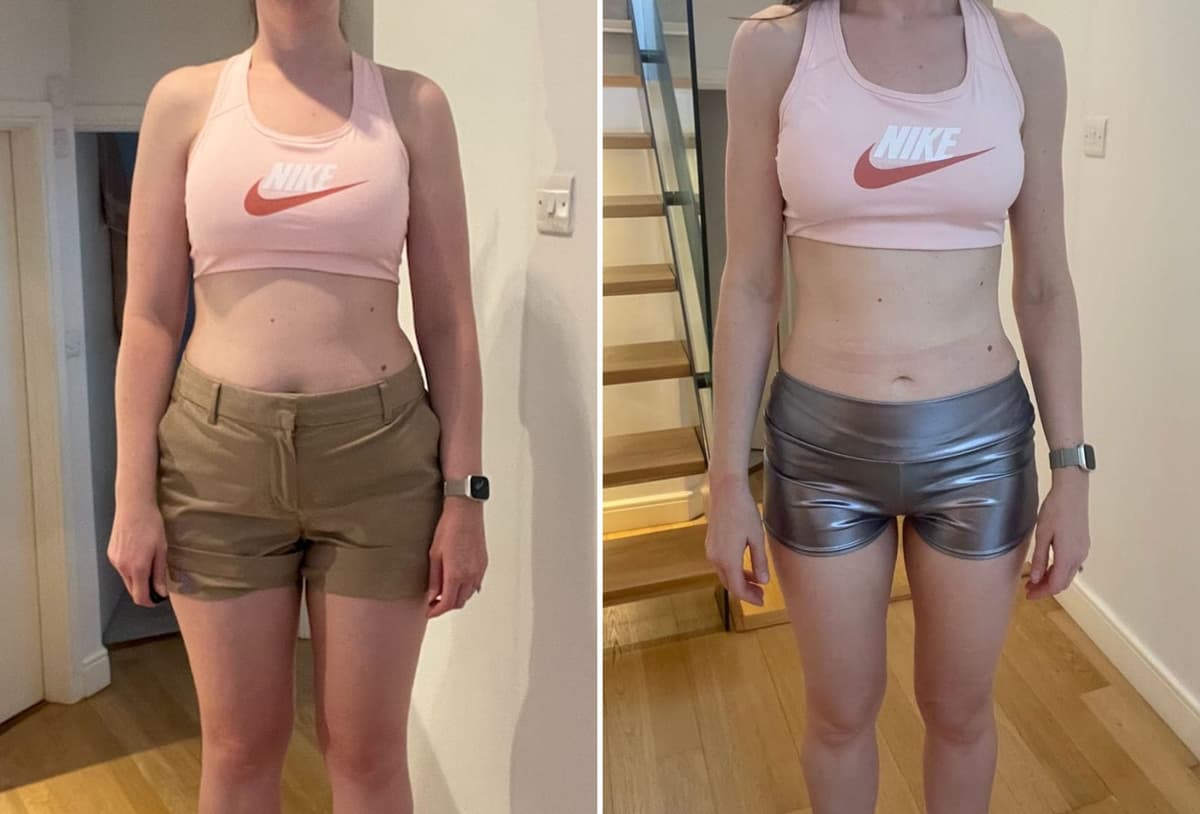
Same hallway, same mirror, most weeks, for a year. These six are the spread; the full set is 50 photos across 29 dates. One wardrobe note: by January 2026 the khaki shorts literally stopped staying up, so I switched to tighter ones. Without that change you wouldn't have been able to see any further progress.






Phase 1: Mounjaro, under the ladder
The licensed way to take tirzepatide is a ladder: 2.5mg for four weeks, then 5mg, with steps up to 15mg (SmPC, section 4.2). The trials that made it famous, SURMOUNT-1 among them, used 5, 10 and 15mg. My 21 tracked doses ran from 26 August 2025 to 15 January 2026 and never touched 5mg: the range was 2.083 to 3.75mg, the average 3.17mg a week. I dosed by pen "units" on an insulin-style KwikPen, 40 units of a 5mg pen being 3.33mg. That's how microdosing communities do it, and it's easy to get wrong: the mg you actually inject depends on the pen strength, so the same "25 units" in my own log meant 2.083mg one month and 3.125mg the next. The quirks section has the details.
On that dose I lost 7.7kg in 149 days, from 70.0kg to 62.3kg, at 0.36kg a week, while eating an average of 1,633 kcal a day, logged every single one of those 149 days. For scale, the NHS advice on steady weight loss is to aim for 0.5 to 1kg a week; my rate was below the bottom of that range, a slow loss by standard guidance, not a crash.
The energy sums for this phase check out almost perfectly, and it's worth spelling out what that means. Working backwards from the scale, the observed loss implies a deficit of roughly 400 kcal a day (Hall's energy-deficit arithmetic). Working forwards from the diary, my logged intake, logged activity and a resting estimate imply a deficit of roughly 500. The bathroom scale and the food diary are two completely independent ways of estimating the same number, and they landed within 100 kcal of each other over 21 weeks. That's the strongest accuracy check this dataset has.
Two honest caveats belong right here rather than buried later. The weight was already falling before tracked dosing began, at 0.85kg a week between late June and August, because I'd started Mounjaro, untracked, a couple of months earlier: my dose logging began when I built the medication feature into Healthcount (it's a standard feature, if you want the same records), not when I started the medication. And I began all of this at 75.7kg and BMI 25.0, which no licensing framework anywhere covers.
Phase 2: retatrutide, used to stop losing
On 15 January 2026 I took my last Mounjaro dose at 3.75mg. Seven days later, on 22 January, I injected 1mg of retatrutide. I didn't take a break between the two drugs to let the first one clear (trials call that a washout period); it was a straight weekly crossover, decided by me. Retatrutide is Eli Lilly's triple agonist; the phase 2 trial studied 1, 4, 8 and 12mg for weight loss in people with obesity. I used 1 to 2.5mg, averaging 1.68mg a week across 21 doses, for five months.
Here's the genuinely odd part, and I think the most interesting thing in the whole dataset: I didn't use it to lose more weight. I used it to stop losing while I rebuilt my eating. Between January and June my daily intake rose from 1,633 to 2,044 kcal, protein went from 97g to 135g a day, fibre from 21g to 35g, and my weight went from 62.8 to 63.7kg monthly average and stayed there. That's a deliberate reverse diet: 400 extra calories a day, held at a stable weight, run on a microdose of an unlicensed compound. There's no trial precedent for using retatrutide as a maintenance drug at those doses.
One more change landed at the same time, and it matters for everything below: I upped my training. Until early 2026 my movement was daily walking plus boxing once or twice a week. From around the switch to retatrutide I started lifting weights properly and running 3 to 5k, and that's what most of my activity looks like now. So the maintenance you see in the chart could be the drug, the 135g of protein, the fibre, the training, or all four; I honestly can't separate them, and I can't even tell you whether the drug helped supply the motivation to train. Nobody can from an n of 1.
The dosing rhythm across both drugs was rigid: 36 of the 40 clean intervals between injections were 6 to 8 days, mean 7.28. The exceptions cluster at the end: 9 days, then 5, then what the log records as a 16-day gap before the final 2mg on 20 June. I think that gap is a logging miss rather than a genuine 16-day stretch; either way, the final weeks were my version of easing out rather than stopping cold, because no published taper exists.
Phase 3: coming off
As of this audit I'm 7 weeks and 4 days past the last dose. The scale says nothing has happened: weekly averages of 63.3, 63.4, 63.4, 64.2, 64.2, 64.2, 64.0. Given that the STEP 1 extension and SURMOUNT-4 both show most regain starting promptly after withdrawal, a flat seven weeks is a decent start and proves nothing yet. Tirzepatide and retatrutide have half-lives around five to six days, so by now the drug is functionally gone. If you want the clearance arithmetic for your own dates, I've written it up in how much Mounjaro is left in my body and built it into the coming-off planner.
The scale is only half the story, so here's the other half in my own words: coming off has been harder than the flat line makes it look. My appetite is back, and managing it without the drug has taken real effort. Eating exactly the way I did while on it turned out to be almost impossible. The weekly intake numbers since stopping read 1,648, 1,745, 1,964, 2,616, 2,041, 2,054, 2,249 kcal a day. I read that as my intake finding its honest level while I learn to manage appetite myself; with the amount I now train, the low 2,000s may simply be what my maintenance costs. Healthcount's weekly check-in scores each week 0 to 24, higher meaning more strain, and mine have gone 8, 7, 9, 10, 14. The 14 was the week of 9 August, with the food-cravings item at its maximum; it was also the week I travelled to Finland to visit family, which is where I'm writing this. Alcohol: 1.3 logged drinks a week on Mounjaro, 1.7 on retatrutide, 2.5 since stopping, still a small fraction of the 14-unit weekly guideline. And one gap to be upfront about: my last weigh-in in this dataset is 8 August, because there's no scale in the house here in Finland. Food logging has continued every day; weigh-ins resume when I'm home.
What I have in place is the playbook I wrote up separately in the maintenance playbook: high protein, high fibre, daily movement, daily logging. My baseline these days isn't really a scale number at all; it's whether my tape measurements hold roughly steady and I stay healthy. Whether that holds against returning appetite is exactly what the next six months of this dataset will show, and I'll publish that too, whichever way it goes.
What I actually ate
5,736 food entries. The single most-logged food, 238 times across 189 days, is dark chocolate. Weighed, though: 170 of those entries are exactly 10g, and the average chocolate entry is 62 kcal. That's the most honest picture of how I stayed sane: nothing was banned, everything was weighed. The rest of the most-logged list:
| Food | Times logged |
|---|---|
| 🍫 Dark chocolate | 238 |
| 🍌 Banana | 230 |
| 🥛 Semi-skimmed milk | 179 |
| 🥄 Protein powder | 165 |
| 🥤 Protein shakes | 130 |
| 🍎 Apple | 123 |
| 🍗 Chicken | 116 |
| 🥬 Spinach | 87 |
| 🫒 Olive oil | 82 |
| 🍅 Tomatoes | 76 |
| 🐟 Salmon | 74 |
| 🌾 Oats | 70 |
| 🫘 Lentils | 65 |
The phase averages, over full logged days only:
| Mounjaro (tracked doses only) | Retatrutide | Off medication | |
|---|---|---|---|
| Days logged / days in phase | 149 / 149 | 150 / 150 | 53 / 53 |
| Calories (mean) | 1,633 | 2,044 | 2,035 |
| Protein | 97g (1.48g/kg) | 135g (2.12g/kg) | 138g (2.17g/kg) |
| Carbohydrate | 209g | 248g | 221g |
| Fat | 75g | 69g | 66g |
| Fibre | 21g (30g+ on 17% of days) | 35g (70%) | 40g (81%) |
| Logged alcohol, drinks/week | 1.3 | 1.7 | 2.5 |
The Mounjaro column covers the 149 days of tracked dosing only (26 August 2025 to 21 January 2026); the roughly two untracked months before that aren't in any phase average. Every retatrutide dose was logged, so that column is the whole phase.
Here's the month-by-month on the two numbers a dietitian will ask about first. Protein was high on my list from the start: in September 2025, the first full tracked month, I averaged 105g a day, which at my weight then was 1.54g per kilo, 96% of the 1.6g/kg mark the resistance-training literature (Morton et al.) points to. October was the low month at 85g, about 80% of that mark. From December onwards I was above it, and every month of 2026 has sat between 2.0 and 2.3g/kg. Fibre is the one that genuinely arrived late: 16g a day in September and October, about half the SACN 30g guideline, then the mid-20s from November through January, and above 30g every month since February. Fruit and vegetable entries climbed from around 16 a week during the Mounjaro phase to 53 a week now; lentils and chickpeas went from occasional to four times a week.
Two things the diary can't show you, because supplements were never a logged category: I take a daily multivitamin most days, and creatine. Neither appears anywhere in 17 months of entries. The diary only sees what I give it, so read the micronutrient picture with that in mind. On fish: my oily fish is nearly all salmon, 125 of 132 oily-fish entries, my usual portion is about 110g, and lately it's 5.8 entries a week. That likely runs past the NHS two-portion oily fish guidance for women who may have children, and it's on my list to vary. Chocolate frequency has doubled since stopping medication, 4 entries a week then, 8.9 now, still mostly 10g squares. And the strangest one: my weekend and weekday calories differ by five. 1,837 against 1,832, across 383 fully-logged days. I didn't plan that; the diary just shows a person who eats the same on Saturday as on Tuesday.
What I burned
394 exercise entries, and one big limitation to state first: from 7 September 2025 onwards I only logged each day's Apple Watch active-calorie total. The log doesn't know whether a day was a walk, a boxing session or a leg day; it just knows "878 burned". So the shape of my training comes from me, not the data: at the start it was daily walking plus boxing once or twice a week, and from early 2026, alongside the retatrutide switch, I added proper weights sessions and 3 to 5k runs, which is most of what my activity looks like now. These days I'm training to get fitter, not lighter. What the numbers do show: logged weekly burn climbed from 3,803 kcal on Mounjaro to 5,087 on retatrutide and 5,914 now, with part of that rise being the September logging change (estimated per-workout entries before, whole-day watch totals after).
Now the calibration lesson, and it's worth slowing down for. In the Mounjaro phase, diary maths predicted the scale almost exactly. In the off phase it doesn't. My logged intake averages 2,035 kcal a day, my watch claims 878 kcal a day of activity, and adding a resting estimate, those numbers say I should have been losing about a quarter of a kilo a week. I wasn't; the scale was flat. So at least one instrument is off by 270 kcal a day or more: either the watch overstates my burn, or I under-log food by 15 to 20%, or a bit of both. To be clear about the direction: this isn't evidence I overate, it's evidence the meters disagree. It's also why I publish intake and burn as logged values and never as a computed "balance". If you eat back your smartwatch calories, this is the paragraph to remember: the watch may be lending you calories that were never burned.
What the tape measure says
16 measuring sessions, July 2025 to July 2026, same tape, same places:
| Jul 2025 | Jul 2026 | Change | |
|---|---|---|---|
| Waist | 74.5cm | 68cm | -6.5cm (-8.7%) |
| Hips | 106.5cm | 96cm | -10.5cm (-9.9%) |
| Chest | 95cm | 92cm | -3cm (-3.2%) |
| Arms (L / R) | 28 / 29cm | 25.5 / 26cm | -2.5 / -3cm (~-9 to -10%) |
| Thighs (L / R) | 61.5 / 62cm | 56 / 57cm | -5.5 / -5cm (~-8 to -9%) |
The shrinkage is nearly uniform: arms lost the same 9 to 10% as the waist. Read on its own, a table like that can suggest a lot of lean tissue went with the fat. A tape measure can't settle that question. The scans below can say more.
What the body scans say
I have two Boditrax bioimpedance scans from my gym, taken on the same machine: 9 March 2025, before any medication, and 11 June 2026, late in the retatrutide phase. Bioimpedance estimates body composition from an electrical signal and shifts with hydration, so treat every row as an estimate with error bars, and two scans is two scans. It's not perfect data, but it's the best body-composition data I have, so here it is in full:
| 9 Mar 2025 | 11 Jun 2026 | Change | |
|---|---|---|---|
| Weight (kg) | 73.9 | 63.1 | -10.8 |
| Fat (kg) | 22.5 | 13.1 | -9.4 |
| Muscle (kg) | 48.8 | 47.5 | -1.3 |
| Fat-free mass (kg) | 51.4 | 50.0 | -1.4 |
| Water (kg) | 32.2 | 30.5 | -1.7 |
| Bone (kg) | 2.6 | 2.5 | -0.1 |
| Visceral fat rating | 4 | 2 | -2 |
| Leg muscle score | 86 | 98 | +12 |
| Protein (%) | 22 | 27 | +5 |
| Sarcopenia index (kg/m²) | 6.6 | 6.3 | -0.3 |
| BMI | 24.4 | 20.8 | -3.6 |
| BMR (kcal) | 1,544 | 1,469 | -75 |
| TDEE (kcal) | 2,393 | 2,277 | -116 |
| Metabolic age (years) | 36 | 19 | -17 |
| Boditrax score | 694 | 798 | +104 |
The headline: of the 10.8kg lost between the scans, 9.4kg was fat and 1.3kg was muscle. That's 87% of the loss from fat, and muscle as a share of my body weight rose from 66% to 75%. The visceral fat rating halved. The leg muscle score went up 12 points, which fits the running and lifting that started in early 2026. For context, in the SURMOUNT-1 body-composition substudy roughly a quarter of the weight lost was lean mass; my scan-to-scan figure is 12%. The absolute muscle number still fell by 1.3kg, and I'd rather it hadn't. But the lean-mass picture these scans paint is a long way from the one the tape table alone could suggest. The sarcopenia index row is the machine's muscle-per-height measure, and metabolic age is Boditrax's own composite score; take both as directions, not diagnoses.
There's no third scan for the off phase yet, for a mundane reason: my gym replaced the Boditrax machine with a Technogym one this summer, so my next baseline starts fresh in a new app. Once I have a run of scans on it, I'll publish those too.
Symptoms against doses
41 symptom logs, and the fair caveat first: symptom logging only existed from 23 December 2025, four months into tracked dosing, so the induction period, where GLP-1 side effects usually peak, is unobserved. And I can fill one gap from memory: my first couple of weeks on Mounjaro in mid-2025 did come with nausea. It settled after about two weeks, long before the logging feature existed. So the zero nausea entries in the logged window are true of the logged window, not of the whole 17 months. What the logged period shows: stomach pain 15 entries, gas and bloating 14, diarrhoea 5, constipation 4, plus single entries for dizziness, fatigue and low mood. 39 of the 41 were logged at the mildest severity.
I also checked whether symptoms cluster after injection day. They don't: 20 of the 35 on-drug logs fall within three days of a dose, which is 57%, and three days out of a seven-day cycle is 57% by pure chance. The GI complaints also didn't stop when the drug did: gas and cramps appear at 41, 45 and 48 days after the final dose, seven-plus half-lives out, by which point the drug had cleared while the 35 to 40g of daily fibre carried on. My working conclusion is that most of my "side effects" were a fibre-and-lentils story with the medication getting the blame. The genuinely useful part: logging symptoms against food for months taught me which foods my stomach does and doesn't get on with. That body awareness has outlasted every dose.
Strengths and limitations
I asked for this dataset to be read the way a careful clinician, dietitian or trainer would read it. These are the limitations they'd want you to know about:
- Eligibility. I started at BMI 25.0, took the first tracked dose at 23.1, and dosed down to 20.4, outside the thresholds any licensing framework covers.
- An unlicensed compound, switched to with no washout period, used for maintenance in a way no trial has studied.
- Fibre ran low through the deficit: around half the 30g guideline in September and October, and it didn't clear 30g consistently until February. Protein sat just under the 1.6g/kg resistance-training mark during the deficit months (96% in September, 80% at the October low), then well above it from December.
- Exercise type is invisible in the data. Only calorie totals were logged, so the boxing, the lifting from late 2025 and the running are my account, not the ledger's. The bioimpedance scans are the nearest thing to independent evidence the training did something.
- The off-phase energy books don't reconcile: logged intake, watch-measured burn and a flat scale disagree by at least 270 kcal a day, so one of those instruments is wrong and I can't tell you which.
- The dataset ends with four unweighed days, because I was travelling without a scale. The series resumes when I'm home.
The same review found things it couldn't fault:
- 374 consecutive days of contemporaneous food logging
- a five-calorie gap between weekend and weekday averages
- an energy ledger that reconciles to within 100 kcal a day for 21 straight weeks
- a medication log that balances against purchases to within one pen's remainder
- a six-month maintenance band one kilogram wide
- two bioimpedance scans showing 87% of the loss was fat
Both lists are true at once. That's rather the point of publishing.
One change at a time
If one part of this generalises, I think it's the order. I didn't change everything at once, and I'm fairly sure I couldn't have. The medication came first, and it opened me up to the next step: walking every day. Then more plants on the plate. Then, months later, running and lifting. Now the focus is nutrition quality and sleep. Each change opened the door to the next one, and the good habits compounded in a way a grand plan never has for me. If I'd tried to do all five in the first month, I doubt I'd have made it past the first winter. Baby steps that spiral beat big plans that collapse; that one I'll stand behind for more people than just me.
Quirks and notes in the data
Notes on the data, listed for transparency:
- The pre-August 2025 weight series, including the 75.7kg peak, was typed in retrospectively in two batches, 27 to 55 days after the fact, copied from my scale records before the app had a weight feature. One row of that batch says "74kg" in the text but stored 71.5kg.
- The first eight tracked doses were reconstructed when I built the medication feature in October 2025: they carry identical default 11:00 timestamps and dates written into the text. Dose history before 26 August 2025 doesn't exist at all; my May-or-June start date is memory, not data.
- Purchase rows were logged late, so replaying the ledger day by day sends pen stock negative by about 10mg twice. Totals reconcile; timing doesn't.
- The same text "25 units mounjaro" converted to 2.083mg in October (5mg pen assumed) and 3.125mg in November (7.5mg pen), and the 7.5mg pen had been purchased six days before the October dose. One week of the dosing curve is therefore ambiguous by about 1mg.
- Six retatrutide entries say "g" where they mean "mg". One, 19 March 2026, is genuinely unresolvable: the text says 2, the stored dose says 1. The two fields disagree and there's no way to settle it now, so the reta total is 35.2mg or 36.2mg.
- The excluded 24 April "2mg mounjaro" row, the only never-confirmed medication event, ruled a data error.
- Macros exist for 94.8% of food entries, but almost all the missing ones are pre-August 2025, so I haven't quoted pre-medication macro averages; the coverage back then is too thin to be reliable.
- Sugar was never tracked. Symptom logging starts 23 December 2025, weekly check-ins 16 February 2026, maintenance check-ins 12 July 2026: each stream begins when I shipped the feature, so absence of earlier data is absence of instrumentation, not absence of events.
- Exercise logging changed method on 7 September 2025. Before that date I described workouts and the app estimated calories ("30 minute walk, 6km"); from that date each entry is the whole day's watch total. Burn comparisons across that line are partly comparing two different measuring methods. Same-day double-counting was checked: it affects exactly one day.
- Weight coverage is 82% of days. The two longest gaps both have the same boring explanation: no scale in reach. Christmas week 2025 I was travelling in the Amazon rainforest, logging food by camera because I couldn't weigh anything, and the final four days of the dataset I was in Finland visiting family.
- Nine zero-calorie food rows survived parsing (including two glasses of rosé counted at 0 kcal, which flatters the alcohol totals slightly), plus a five-fold duplicate protein shake from launch week. Together they are under 0.1% of logged calories.
A closing thought
If you're reading this while thinking about your own body, here's the one belief this year actually changed for me: appetite isn't a fault to fix. It's a system to understand and work with, and medication, food quality, movement and sleep all pull on the same system. Mine is one person's story, parts of it sit outside any licence, and your situation is yours. If medication is on your mind, talk to a prescriber. My diary is information, not an endorsement.
Keep your own ledger
Everything in this piece was logged in Healthcount, which I built while living it. The food diary, dose tracking, symptom logs and weekly check-ins are all standard features.
Start free, it takes 30 secondsView sources (12)
- Mounjaro KwikPen: Summary of Product Characteristics (dosing ladder, section 4.2; half-life, section 5.2). Eli Lilly, via the electronic medicines compendium
- NICE technology appraisal TA1026: Tirzepatide for managing overweight and obesity, December 2024
- Jastreboff et al., Tirzepatide Once Weekly for the Treatment of Obesity (SURMOUNT-1). New England Journal of Medicine, 2022
- Jastreboff et al., Triple-Hormone-Receptor Agonist Retatrutide for Obesity, phase 2 trial. New England Journal of Medicine, 2023
- Wilding et al., Weight regain and cardiometabolic effects after withdrawal of semaglutide: the STEP 1 trial extension. Diabetes, Obesity and Metabolism, 2022
- Aronne et al., Continued Treatment With Tirzepatide for Maintenance of Weight Reduction (SURMOUNT-4). JAMA, 2024
- NHS: Treatment for obesity (the 0.5 to 1kg a week guidance on steady weight loss)
- SACN Carbohydrates and Health report (the 30g/day fibre recommendation). Public Health England, 2015
- NHS: Fish and shellfish (oily fish portions guidance)
- NHS: Calculating alcohol units (the 14 units a week guideline)
- Morton et al., A systematic review, meta-analysis and meta-regression of protein supplementation on resistance training-induced gains. British Journal of Sports Medicine, 2018
- Hall, What is the required energy deficit per unit weight loss? International Journal of Obesity, 2008