The number everyone quotes
If you've started looking into stopping, you've met the statistic already. Two-thirds of the weight comes back within a year. It gets quoted in headlines, in forum replies, and usually by someone who's about to tell you not to bother stopping at all.
It's a real finding from a real trial, and I'm not going to soften it. But it's an average from a specific study design, and it's worth knowing what that design did and didn't test. That's what this piece is about: what the stopping trials measured, what the evidence says habits can and can't do, and six things worth having in place before your last dose.
A note on names, since the brands differ by country. Tirzepatide is Mounjaro in the UK, Ireland and Australia, and Zepbound in the US. Semaglutide injection is Wegovy in all four. I'll mostly use the generic names.
If you want the full picture of what physically happens when you stop, appetite, the half-life, the cardiometabolic markers, that's covered in quitting GLP-1s: what actually happens. This post picks up where that one leaves off and builds the plan.
What that study actually measured
The two-thirds figure comes from the STEP 1 trial extension. STEP 1 randomised 1,961 adults to semaglutide 2.4 mg or placebo for 68 weeks, alongside a lifestyle programme. When the trial ended, a representative subset of 327 people who'd completed it were followed for another year off treatment.
Here are the actual numbers, as the paper reports them. Over the 68 weeks, the semaglutide group lost an average of 17.3% of their body weight. In the year after treatment stopped, they regained 11.6 percentage points of that, and the group finished 5.6% below its starting weight. (Those three are separately rounded means, so they don't subtract neatly to the decimal.) The cardiometabolic improvements drifted back toward baseline alongside the weight (Wilding et al., 2022).
Read that carefully, because two details usually get lost. First, they didn't end up back where they started: a year on, the group was still 5.6% lighter than at baseline. Second, the lifestyle programme was withdrawn at the same time as the drug. Everyone stopped everything, at once, by protocol.
It's tempting to read that second detail as the whole explanation, and to conclude that keeping your habits going would have kept the weight off. The next two trials are the real test of that idea, and they don't support it.
Three trials, one consistent finding
Two other withdrawal trials fill in the shape, and they agree with each other.
In STEP 4, 803 people first ran in on semaglutide for 20 weeks, losing an average of 10.6%. They were then randomised either to keep going or to switch to placebo, with the lifestyle programme continuing in both arms. Over the next 48 weeks, the continuing group lost a further 7.9%. The placebo group gained 6.9% (Rubino et al., 2021).
SURMOUNT-4 did the same thing with tirzepatide, again with diet and activity support in both groups. After a 36-week lead-in that produced an average 20.9% loss, 670 people were randomised to continue or switch to placebo for 52 weeks. Those who continued lost a further 5.5%; those switched to placebo regained 14.0%. Nearly 90% of the continuing group still held at least 80% of their lead-in weight loss at the end, against 16.6% of the placebo group (Aronne et al., 2024).
The consistent message across all three is that these medicines are treatments for an ongoing condition rather than a course you complete. That's uncomfortable if you were hoping to be finished, and it's worth knowing before you plan around a different assumption.
Notice too that in STEP 4 and SURMOUNT-4 the lifestyle programme kept going for everyone. The people switched to placebo still had the support, and on average weight still came back. So regain after stopping isn't simply what happens when people let their habits slip.
It's also worth being precise about what these trials did not test. Each one compared carrying on at the full dose with stopping, so none of them tells us whether a lower dose, or coming off more slowly, changes what happens afterwards. Those are fair questions for your prescriber, who can weigh them up with you. They aren't changes to make on your own.
What habits can and can't do
A 2026 review in the BMJ pooled 37 studies of people stopping weight-loss medicines. It found no evidence that behavioural support, whether given alongside the medicine or after stopping, changed how quickly weight came back, although few of its studies tested support after stopping (West et al., 2026).
So I'll be straight with you: no habit has been shown to stop the weight coming back after a GLP-1, and this playbook can't promise that either. That doesn't make habits pointless. Protein and strength training help protect your muscle while your weight is changing (Cava et al., 2017), and the rest of the playbook is about feeling well and being ready for your appetite to return. These habits are worth building for their own sake, whatever the scale does.
An average is not a verdict
A group mean tells you where the middle of a distribution sits. It tells you nothing about where you'll land, and the spread in these trials was wide.
There's a separate body of evidence about people who lose weight and keep most of it off, and it predates GLP-1s entirely. Roughly 20% of people with overweight manage long-term maintenance, defined as losing at least 10% of body weight and keeping it off for a year or more (Wing & Phelan, 2005). The National Weight Control Registry follows thousands of them, and in its ten-year follow-up of 2,886 members, more than 87% were estimated to still be at least 10% below their highest weight at both five and ten years (Thomas et al., 2014).
Two honest caveats. Registry members are volunteers who joined because they had kept weight off, so the registry describes them. It doesn't prove that copying their habits would work for anyone else. And they lost weight without a GLP-1, so the appetite they're managing may not be the appetite you'll be managing. What it does show is that the trial averages aren't the only possible outcome.
The playbook: six things worth having in place
The through-line here is timing. Habits may be easier to build while your appetite is still quiet than after it has come back, so the weeks before your last dose are a good time to start. None of this is a promise about what your weight will do. It's about going into the change feeling prepared.
1. Talk it through with your prescriber first. People arrive at "coming off" for very different reasons: cost, side effects, a supply problem, pregnancy plans, or just wanting to know who they are without it. Those reasons can point to different plans, and your prescriber can talk you through the options for your situation. Go in with your reason stated plainly and let them weigh it up. Any change to your dose, including how you stop, is their call.
2. Build protein into your meals before appetite returns. Protein is the most filling macronutrient, and it helps protect lean mass while weight is changing (Cava et al., 2017). Muscle matters for strength and getting about, so it's worth looking after. Some protein at each meal is the simplest version, and if a rough daily range helps you, the protein target calculator gives one.
3. Start strength training now, at whatever level suits you. Two or three short sessions a week is the amount the muscle research is built on. The full protocol, and why it matters more on a GLP-1 than on an ordinary diet, is in protecting muscle on a GLP-1. If you want a routine that needs no equipment, there's one in bodyweight training on a GLP-1.
4. Make your kitchen easy while appetite is quiet. On a quieter appetite, changing what's in your kitchen can feel easy. Six months later it may not. Sort the shopping list, the default breakfast and the thing you eat when you get in from work, and keep in meals and snacks you'd be happy to eat once hunger is back. Your surroundings do more of this work than your resolve does, which is the whole argument of the obesogenic environment piece.
5. Notice early changes, gently. Our page on weight regain after stopping lists the early signs worth noticing: meals slipping, appetite coming back louder, moving less, sleep or stress getting worse, and avoiding check-ins altogether. If you weigh yourself, a trend over several weeks says more than any single morning's number, which mostly reflects water. You don't have to weigh yourself at all, and if the number affects your mood or your eating, it's fine to leave it. Noticing a change early just means you can talk to your prescriber sooner.
6. Expect the hunger, so it doesn't feel like a personal failure. After weight loss, appetite hormones stay shifted toward eating more, and they stayed shifted a full year later in the study that tracked them (Sumithran et al., 2011). On top of that, you're removing a drug that was actively suppressing appetite. Hunger returning is the expected outcome of both, on schedule, and it is not evidence that you've lost your discipline.
The coming-off planner puts these into a timeline you can take to an appointment, so the conversation with your prescriber starts from a plan rather than from "I think I want to stop."
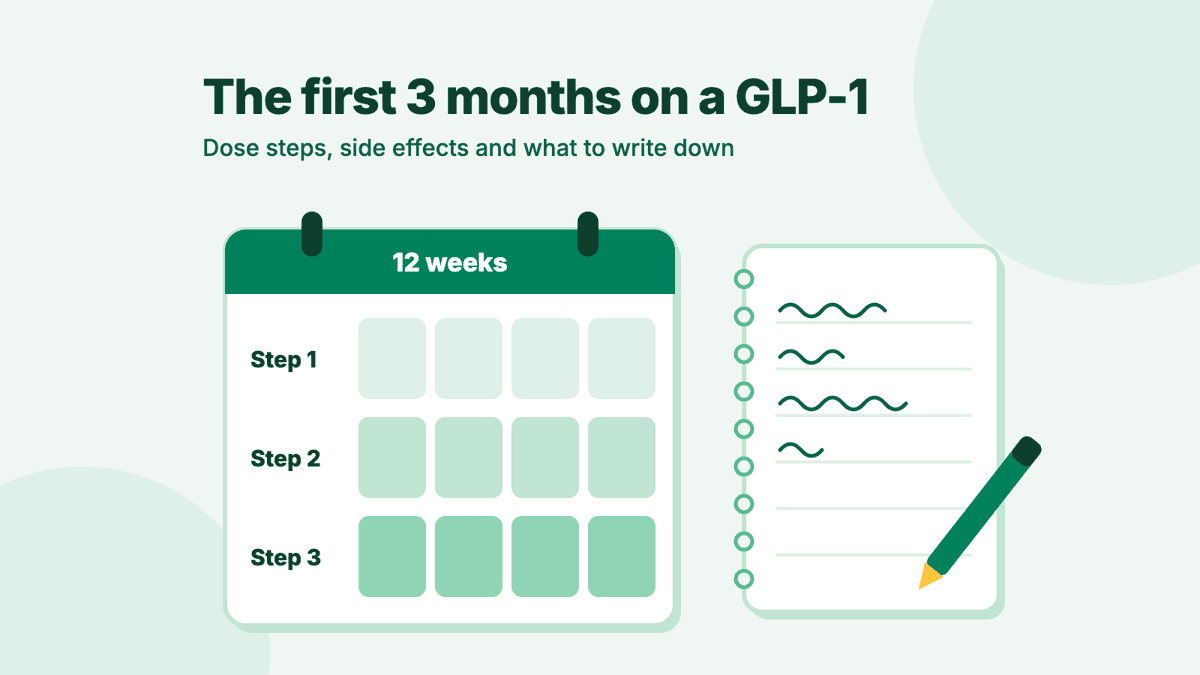
What the first twelve weeks tend to look like
A rough shape rather than a promise, because individual experiences vary a lot.
Weeks 1 to 3. Semaglutide and tirzepatide both have half-lives around five to seven days, so the drug is still meaningfully present. Most people notice little. This is the window to make sure the routines are habits rather than intentions.
Weeks 4 to 8. Appetite generally comes back over this stretch, often described as food becoming interesting again rather than as raging hunger. Portion sizes creep first, snacking second. Weight may be flat or drifting slightly up.
Weeks 8 to 12. Whatever the new normal is going to be usually becomes clearer here. If you weigh yourself, this is where a trend over several weeks tells you more than any single day, because some of the early change is just water and the extra food in your gut as you eat more.
Any gastrointestinal side effects you had should ease as the drug clears. Anything new or severe is a reason to contact your prescriber rather than to wait and see.
Agreeing a restart plan in advance
This is one of the most useful things in the whole piece, and it takes about a minute.
Before you stop, agree with your prescriber what would make you come back to talk about restarting, and write it down. It might be hunger or eating starting to feel hard to manage, a change that keeps going for several weeks, or simply feeling worse without the medicine.
The reason is straightforward. If you don't decide while you're calm, you'll be deciding on a hard day, and that's rarely the decision you'd have made with a clear head. A plan agreed in advance turns restarting from an admission of failure into a step in a plan you wrote yourself.
Restarting, if it happens, is a prescriber decision too, including the dose you restart on. Stop-start cycles are common in real life and are not a mark against you.
The questions people ask
Will I definitely regain two-thirds?
No. That was the average in one extension study of 327 people who stopped their medication and their lifestyle programme simultaneously, by design. The individual spread was wide, and the group was still 5.6% below its starting weight a year later.
Should I lower my dose before I stop?
That's a decision for your prescriber, not something to work out from an article. The withdrawal trials compared carrying on at the full dose with stopping completely, so they don't show whether coming down more gradually changes what happens afterwards. Your prescriber can weigh up cost, side effects, your reason for stopping and your history in a way an article can't. Never change or stop a prescribed dose on your own.
Can I just eat less to hold the weight?
It's harder than it sounds, and it isn't what this playbook suggests. You'd be working against two things at once: appetite hormones that have shifted towards eating more, and a lower energy requirement. Restriction also tends to cost muscle. That's why the playbook leans on protein, strength training and an easy kitchen rather than on eating less.
How long should I keep these habits going?
For as long as they help you feel well. They aren't a test you pass or fail. In the weight-control registry, people who had already kept weight off for two to five years were more likely to keep it off for longer (Wing & Phelan, 2005), but they lost weight without a GLP-1, so that describes them rather than promising anything to someone stopping one.
This is information, not medical advice. Stopping, changing your dose and restarting are all decisions for the prescriber who knows your history. Don't change or stop a prescribed medicine on the strength of an article.
If you're thinking about coming off, the coming-off planner builds the timeline and the checklist, and the protein target calculator gives you a rough daily protein range. Both are free and neither needs an account.
View sources (8)
- Wilding et al., Weight regain and cardiometabolic effects after withdrawal of semaglutide: the STEP 1 trial extension. Diabetes, Obesity and Metabolism, 2022
- Rubino et al., Effect of Continued Weekly Subcutaneous Semaglutide vs Placebo on Weight Loss Maintenance (STEP 4). JAMA, 2021
- Aronne et al., Continued Treatment With Tirzepatide for Maintenance of Weight Reduction in Adults With Obesity (SURMOUNT-4). JAMA, 2024
- Thomas et al., Weight-loss maintenance for 10 years in the National Weight Control Registry. American Journal of Preventive Medicine, 2014
- Wing & Phelan, Long-term weight loss maintenance. American Journal of Clinical Nutrition, 2005
- Sumithran et al., Long-term persistence of hormonal adaptations to weight loss. New England Journal of Medicine, 2011
- Cava, Yeat & Mittendorfer, Preserving Healthy Muscle during Weight Loss. Advances in Nutrition, 2017
- West et al., Weight regain after cessation of medication for weight management: systematic review and meta-analysis. BMJ, 2026