What CagriSema is
CagriSema is Novo Nordisk's next act: a weekly injection combining semaglutide (the Wegovy drug) with cagrilintide, an analogue of amylin, a second fullness hormone your pancreas releases alongside insulin. The idea is to press two different appetite systems at once, GLP-1 and amylin, the way Mounjaro presses GLP-1 and GIP together.
That's the interesting scientific move here: the industry has stopped asking "how much of one hormone?" and started asking "which combination of hormones?". CagriSema and Mounjaro are different answers to the same question.
The REDEFINE-1 numbers
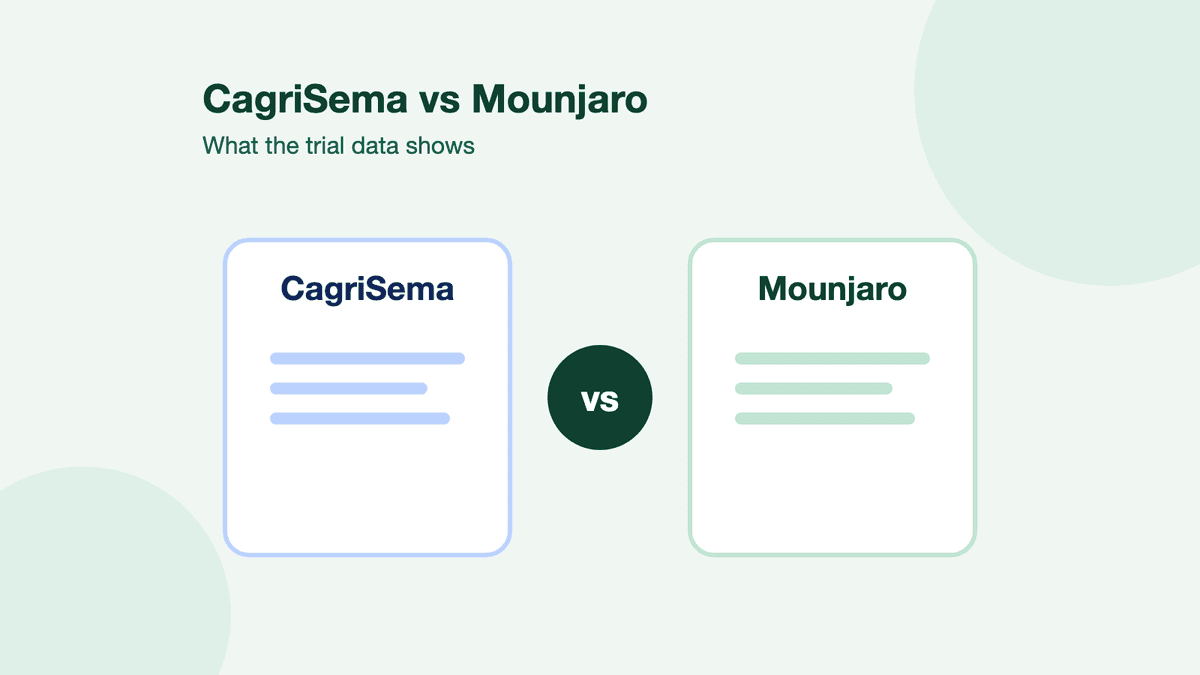
REDEFINE-1, the big phase 3 trial in people with obesity but not diabetes, reported an average of about 23% body-weight loss over 68 weeks for those on treatment, against roughly 2% on placebo (NEJM, 2025).
One detail from the trial deserves more attention than it got: the protocol let participants adjust dosing with their clinicians, and a substantial share never moved to the full dose. Real people, offered flexibility, often chose less medicine. Read that as tolerability information, and as a reminder that trial averages blend the committed and the cautious together.
The honest comparison
Mounjaro's equivalent trial, SURMOUNT-1, averaged 20.9% at 72 weeks on the top dose (Jastreboff et al., 2022). So on paper: about 23% plays about 21%. A couple of points apart, in the same league, and both far beyond what semaglutide alone averages.
If you came for a verdict: CagriSema edged the bigger headline number, and it did so in a trial that gave people unusual freedom to dose down. But "edged" is the right verb, not "beat".
Why cross-trial comparisons wobble
- Different trials, different populations, different years, different sites.
- Different dosing rules, and REDEFINE-1's flexible protocol cuts its average in a unique way.
- Different statistical estimands: "what the drug does if you take it" and "what happened to everyone randomised" can differ by several percentage points in the same trial.
The only comparison that settles it is a head-to-head randomised trial, and until one reports, anyone declaring a winner is selling something. What the data supports: both are in the low-twenties league, and the practical differences (availability, price, tolerability for you personally) will matter more than the two-point gap.
When does the UK see it?
CagriSema isn't licensed anywhere yet. Submissions to regulators followed the 2025 readouts, which puts plausible approvals, then UK private availability, into 2027 territory, with NHS access a separate NICE question after that. No firm dates exist, and we'll update this page when they do. Meanwhile, treat any online pharmacy claiming to stock it as a counterfeit red flag.
Worth waiting for?
The arithmetic rarely favours waiting a year-plus for two extra trial points. Today's options already average 15 to 21%, they exist, and their prices are falling while every new drug launches expensive. For the medicines you can actually buy today, the price table shows what they cost this month. And if you're watching the pipeline, our retatrutide comparison covers the other headline drug still in trials, no more buyable than CagriSema is.
Whichever you land on, the same instrument measures it: your own trend line. Track it free.