MariTide is not licensed in the UK, the US, the EU or Australia. It cannot be prescribed and there is no legal supply. This page is information about published research, not advice.
Most new obesity drugs are variations on a theme: take the GLP-1 idea, add another hormone pathway, see if the numbers go up. MariTide is the one that does something genuinely strange. It blocks a receptor that Mounjaro deliberately switches on, and people still lose a lot of weight.
That is not a technicality. It is one of the more interesting unresolved questions in this field, and it is almost never explained in coverage of the drug. So this page is as much about the puzzle as the percentages.
It also gets confused with amycretin, which arrived in the news around the same time and is a completely different molecule from a different company. Amycretin has its own page.
What MariTide is
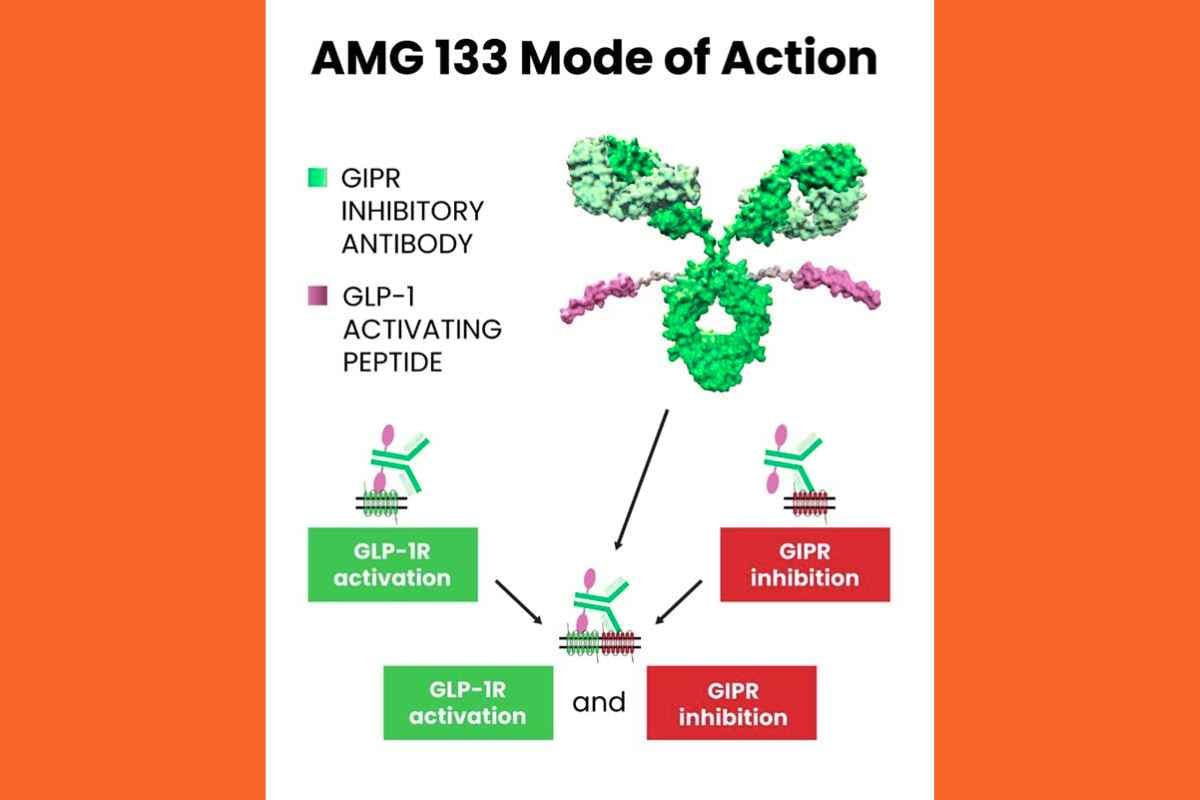
MariTide is Amgen's investigational obesity medicine. Its generic name is maridebart cafraglutide, and in earlier research it was coded AMG 133, which is what you will find in the preclinical papers.
Structurally it is unlike anything else in this class. Rather than a peptide, it is a fully human monoclonal antibody that targets the GIP receptor, with two GLP-1 agonist peptides chemically attached to it by short linkers. An antibody with peptides bolted on, essentially. That architecture does two jobs at once, and both are the point.
The GIP paradox
GIP is a gut hormone, part of the same incretin family as GLP-1. Tirzepatide, the drug sold as Mounjaro in the UK and Zepbound in the US, activates both the GLP-1 receptor and the GIP receptor, and that dual activation is credited with why it outperforms semaglutide on weight.
MariTide activates GLP-1 and blocks GIP. Same receptor, opposite direction, and it also produces substantial weight loss.
Two drugs do opposite things at the same receptor and both make people lose weight. Either the receptor matters less than assumed, or something more subtle is happening, such as chronic activation eventually desensitising the receptor and producing the same end state as blocking it. Nobody has settled this.
The working hypothesis behind the blocking approach, set out in the Nature Metabolism paper on the molecule, is that your own naturally circulating GIP may be damping down the appetite-suppressing effect of GLP-1. Take GIP out of the picture and you let GLP-1 work harder. It is a plausible story and, importantly, it is not proven.
Why it matters practically: if blocking works as well as activating, the field has more routes to a good drug than it thought, which usually means more options and eventually more competition on price. Not this year, but it is the reason people who follow this closely got excited about a molecule with unremarkable-looking headline numbers.
Why it can be monthly
The antibody backbone is not just a scaffold for the GIP blocking. Antibodies persist in the body far longer than peptides do, and MariTide's half-life is roughly three weeks. Semaglutide's is about a week, which is what sets the weekly injection.
So MariTide is dosed once every four weeks. Twelve or thirteen injections a year instead of fifty-two. For anyone who finds injections genuinely difficult, or who has ever missed a dose because a pen was in the wrong fridge on the wrong weekend, that is a meaningful difference in what treatment feels like. Whether it matters enough to prefer a monthly drug over a more effective weekly one is a conversation for a prescriber, not a ranking.
What the phase 2 trial found
The phase 2 results were published in the New England Journal of Medicine in 2025 and presented at the American Diabetes Association meeting that June. The trial ran 52 weeks in two separate groups: 465 adults with obesity and no type 2 diabetes, and 127 adults who had both.
Dosing was more varied than most trials: monthly fixed doses of 140mg, 280mg and 420mg, plus a 420mg arm dosed every eight weeks, plus two arms that started at 70mg and climbed to 420mg over either four or twelve weeks. That last design choice turned out to matter more than anything else in the study.
| Group | People | Weight change at 52 weeks | Placebo |
|---|---|---|---|
| Obesity, no type 2 diabetes | 465 | -12.3% to -16.2% across dose groups | -2.5% |
| Obesity with type 2 diabetes | 127 | -8.4% to -12.3% across dose groups | -1.7% |
Those are the figures counting everyone who was randomised, which is the conservative and more honest way to report a trial. See the next section for why you will also see bigger numbers quoted.
Two other findings worth having. Weight was still falling at 52 weeks, with no plateau reached, so the 72-week phase 3 endpoint may well land higher. And in the diabetes group, Amgen reported HbA1c reductions of up to 2.2%, which is a substantial glucose effect by any standard.
The smaller weight loss in the diabetes group is not a red flag. It happens across this entire drug class in every trial programme, and it is a reason headline figures from different populations should never be compared directly. The same pattern shows up in the CagriSema data.
Why you see two different numbers
You will see MariTide described as producing "up to 20% weight loss" in plenty of coverage, and you have just read 16.2%. Both come from the same trial. Neither is wrong. They answer different questions.
- Treatment policy, 12.3% to 16.2%. What happened to everyone who was randomised, including people who stopped the drug early or never got to the top dose. This is the intention-to-treat question: what happens if we give this to a population.
- Efficacy, 16.3% to 19.9%. What happened to people who actually stayed on treatment as intended. This answers: what does the drug do when it is taken.
Both are legitimate, and regulators normally want the first. The gap between them is itself informative: a wide gap means a lot of people did not complete treatment as planned, which for MariTide points straight at tolerability. When a press release quotes the higher number without saying which estimand it is, that is worth noticing. We use the conservative figure throughout this site, including in the pipeline tracker.
The tolerability problem, and the fix
Gastrointestinal side effects, mostly nausea and vomiting, were common and were the main reason people left the trial. This is where the study earns its keep, because it did not just record the problem, it accidentally tested a solution.
| Group | Stopped because of gastrointestinal side effects |
|---|---|
| Obesity, started low and escalated gradually | 8% |
| Obesity, started straight on a full dose | 12% to 27% |
| Obesity with type 2 diabetes | 6% to 16% |
Starting low and climbing slowly cut dropouts by a large margin without costing efficacy. Amgen redesigned the phase 3 dosing around exactly that, which is what a dose-ranging trial is supposed to produce.
There is a wrinkle specific to monthly dosing that is worth thinking about. If a weekly injection makes you feel rough, the next dose is seven days away. If a monthly injection does, you may have a much longer stretch of it. The trial reported that gastrointestinal events were mostly confined to the early doses, which is reassuring, but the convenience of monthly dosing and the difficulty of an unpleasant month are two sides of the same pharmacology. Our side effect timeline covers what the settling-in period looks like on the drugs you can actually get.
Where it is now
MariTide is in phase 3. The programme is called MARITIME: MARITIME-1 in people with obesity or overweight, enrolling around 3,500 participants, and MARITIME-2 in people who also have type 2 diabetes, with further trials in cardiovascular disease, heart failure and obstructive sleep apnoea. The main weight endpoint is measured at 72 weeks and Amgen has pointed to first readouts around 2027.
It has no MHRA authorisation, no FDA approval and no EU authorisation, and no filing has been announced anywhere. Realistically that puts UK availability somewhere past 2028, if the phase 3 results hold up. Our pipeline tracker carries the current status with the date it was last checked.
If you are choosing treatment now, this is not on your list. What MariTide is genuinely worth to you today is the mechanism story: it is early evidence that there is more than one road to the same result, which matters for what the choices look like in five years.
FAQ
What is MariTide?
Amgen's investigational obesity injection, generic name maridebart cafraglutide, formerly AMG 133. An antibody with two GLP-1 peptides attached, which switches on the GLP-1 receptor and blocks the GIP receptor. Dosed monthly. Not approved anywhere.
How is it different from Mounjaro?
Opposite action at the same receptor: tirzepatide activates GIP, MariTide blocks it. Both produce weight loss, which is an unresolved puzzle. MariTide is also monthly rather than weekly.
How much weight did people lose?
Over 52 weeks: 12.3% to 16.2% across dose groups in 465 people with obesity, against 2.5% on placebo, counting everyone randomised. Amgen also reports 16.3% to 19.9% counting only those who stayed on treatment. Weight had not plateaued at 52 weeks.
What are the side effects?
Mainly nausea and vomiting, and they were the main reason people stopped. Starting at a low dose and building up cut discontinuations to 8%, against 12% to 27% for people started at a full dose.
When will it reach the UK?
Not for several years. Phase 3 readouts are expected around 2027, with regulatory review after that and no filing announced yet.
This article is information, not medical advice. Decisions about starting, changing or stopping any weight-loss medication belong with you and your prescriber.
Monthly, weekly or daily, the thing that decides how much of the weight stays off is what you build around the drug. The evidence for keeping a diary holds whichever medicine you are on, and you can start tracking free.
Sources
- Once-Monthly Maridebart Cafraglutide for the Treatment of Obesity: a phase 2 trial. New England Journal of Medicine, 2025 (online 23 June 2025).
- Véniant MM, et al. A GIPR antagonist conjugated to GLP-1 analogues promotes weight loss with improved metabolic parameters in preclinical and phase 1 settings. Nature Metabolism, 2024.
- Amgen: results from the phase 2 obesity study of monthly MariTide presented at the American Diabetes Association 85th Scientific Sessions. Company announcement, June 2025.
- Amgen: robust weight loss with MariTide at 52 weeks in a phase 2 study. Company announcement, November 2024.
- Inside Amgen's phase 3 MARITIME programme. Company briefing, June 2025.
- Jastreboff AM, et al. Tirzepatide once weekly for the treatment of obesity (SURMOUNT-1). New England Journal of Medicine, 2022;387:205-216.