There's a saying in management that what gets measured gets managed. It's usually attributed to Peter Drucker, probably wrongly, but weight science has spent forty years testing whether it's true of eating. The answer is unusually clear for a field this messy: yes. Writing down what you eat is the single most consistently supported behaviour in the weight-loss literature. Not a superfood, not a fasting window, not a macro split. A record.
This page walks through the main evidence, what it says about how much tracking you actually need, and why the habit earns its keep even when a GLP-1 is doing the heavy lifting on appetite.
The trial that made food diaries famous
In 2008, researchers at Kaiser Permanente published results from the intensive phase of the Weight-Loss Maintenance Trial, one of the largest weight-loss studies ever run: 1,685 adults, mean BMI 33.4, across four US clinical sites. Everyone got the same 20-week programme. The behaviour that separated the results was record keeping.
Participants who kept daily food records lost around 8.2 kg (18 lb) in six months. Those who kept none lost about half that. People who recorded six or more days a week lost 5.7 kg more than people who recorded less than one day a week, inside the same programme, eating from the same advice.
"Those who kept daily food records lost twice as much weight as those who kept no records. It seems that the simple act of writing down what you eat encourages people to consume fewer calories." Jack Hollis, PhD, lead author, Kaiser Permanente Center for Health Research, 2008.
One trial is one trial, so it's worth saying that this finding replicates. A 2011 systematic review in the Journal of the American Dietetic Association examined 22 studies of self-monitoring, covering food diaries, activity logs and regular self-weighing, and found a significant association between self-monitoring and weight loss across the board. A 2021 review of the digital era reached the same conclusion for apps: engagement with digital self-monitoring is consistently associated with weight loss, and more engagement is associated with more of it.
Why writing it down changes what you eat
The strange part is that a diary contains no advice. It doesn't tell you to eat less. So why does it work? The research points at a few overlapping mechanisms.
The first is plain awareness. Most of us genuinely don't know what we eat in a day. Eating is scattered, social and often automatic, and memory smooths it into something tidier than it was. A record interrupts that. The handful of crisps while cooking becomes a line you can see.
The second is the feedback loop. Once intake is visible, you can connect it to what the scale does, and the connection is motivating in both directions. A good week stops being luck and becomes something you can repeat. A rough patch stops being a mystery and becomes a pattern with a name. You'll sometimes see this called self-regulation theory in the literature; in practice it means the diary turns weight change from something that happens to you into something you can steer.
The third is the quiet decision-shaping that Hollis described. Knowing you'll write it down changes the choice before you make it. Not always, and not by force. But often enough to show up as a doubled result in a 1,685-person trial.
Start your own record, free
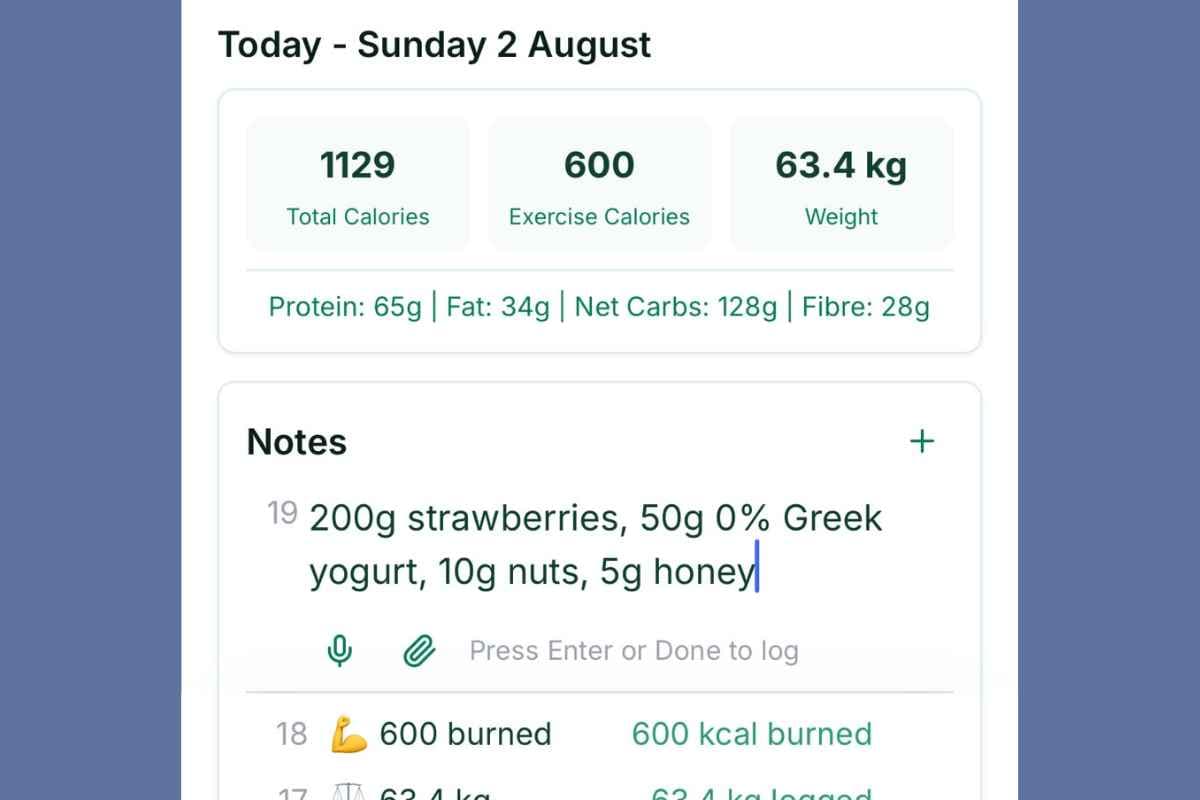
Healthcount is a food diary built for exactly this. Type what you ate in plain English and it works out the calories, protein and trend for you. No sign-up fee, no paywall, no app download.
App or paper? The Leeds trial
The habit is what matters, but the medium decides whether the habit survives. The cleanest test is a University of Leeds randomised trial that gave 128 overweight adults the same six-month task, recording their diet, through one of three tools: a smartphone diary app, a website, or paper.
| Group | Days logged (of ~180) | Still in the trial at 6 months | Mean weight change |
|---|---|---|---|
| Smartphone app | 92 | 93% | −4.6 kg |
| Website | 35 | 55% | −1.3 kg |
| Paper diary | 29 | 53% | −2.9 kg |
Three times the logging days, nearly double the completion rate, and the largest weight loss. Not because the app knew anything the paper didn't, but because it was in a pocket at the moment of eating. Friction is the enemy of recording, and the phone removes most of it.
Put it on your phone in about thirty seconds
The Leeds result came down to having the diary in your pocket at the moment you eat. Healthcount runs in the browser, so there is no App Store download, but you can add it to your home screen and it opens like any other app, full screen and one tap away.
How much tracking is enough
The objection everyone raises is time, and it's a fair one. Nobody wants a second job weighing lettuce. Here the evidence is reassuring. A 2019 study in Obesity measured exactly how long successful self-monitoring takes: about 23 minutes a day in month one, falling to under 15 minutes by month six as the habit settles and repeated meals get faster to enter.
The more useful finding was about rhythm. Participants who lost 10% or more of their body weight opened their log about 2.7 times a day, versus 1.7 for the less successful. Frequency beat thoroughness. Several short entries made at the time of eating, rather than one long nightly reconstruction from memory, was the pattern that predicted success. Which makes sense: the evening version of you is guessing.
So "enough" is smaller than most people fear: a line at breakfast, a line at lunch, a line at dinner. The perfect gram-weighed food log that collapses after nine days does less for you than a rough one you still keep in March.
What people who keep it off do
Losing weight and keeping it off are different problems, and the second one is where measurement really shows its value. The National Weight Control Registry follows thousands of people who have lost at least 13.6 kg (30 lb) and kept it off for a year or more, which makes it the largest study of successful maintenance there is. The long-term review of its members found they share a small set of behaviours: high physical activity, a consistent eating pattern, eating breakfast, and self-monitoring their weight.
The strongest evidence, though, comes from following them over time. When researchers tracked registry members for ten years, the people who regained the most were the ones whose self-weighing had become less frequent. Not the ones who ate differently. The ones who stopped looking.
The pattern reads less like a diet and more like a dashboard. Maintainers keep watching the numbers after the loss phase ends, which is how a two-kilo drift gets caught in week two instead of month six. If you've read our piece on why weight loss stalls, this is the same logic in reverse: the earlier you can see a trend, the smaller the correction it needs.
On a GLP-1? It matters more, not less
The tempting assumption is that medication makes the diary redundant. Mounjaro or Wegovy quietens appetite, the weight comes down, so why write anything down? Two reasons, and they're the two that decide how the story ends.
First, composition. A suppressed appetite doesn't distinguish between fat loss and muscle loss, and on a GLP-1 a meaningful share of what you lose can be lean mass unless protein and resistance work are protected. You can't manage a protein target you aren't measuring. That's the whole argument of our muscle-protection protocol, and a one-line diary is the instrument it runs on.
Second, what happens afterwards. In the STEP 1 trial extension, participants who stopped semaglutide regained roughly two-thirds of their lost weight within a year. The medication had done its job; the habits to hold the result mostly weren't there. The people who defy that statistic look a lot like the registry members above: they measure. Building the recording habit while the medication makes it easy is the best preparation for the day it isn't. We've written more on what actually happens when people stop.
The one-line-a-day method
Everything above points at the same practical recipe, and it's smaller than the word "tracking" makes it sound.
- Write food down when you eat it, not at night. Rough is fine.
- Weigh yourself on a consistent rhythm and watch the trend, never the single day.
- Keep an eye on protein if you're on a GLP-1, using a target, and a log to compare against it.
- Don't break the chain over one bad day. The record is for information, never judgement.
The evidence doesn't ask for perfection. It asks for a record that survives contact with your actual life, which is exactly what the doubled results in the Kaiser trial and the 92 logging days in the Leeds trial have in common: the recording kept happening.
FAQ
Does keeping a food diary actually help you lose weight?
Yes, and the effect size is unusual for behavioural research. Daily recorders in the 1,685-person Weight-Loss Maintenance Trial lost about twice as much as non-recorders over six months, and a 22-study systematic review found the same direction of effect across every form of self-monitoring.
Is an app better than a paper food diary?
The Leeds trial says the app wins on the thing that matters: adherence. Its app group logged 92 days over six months against 29 for paper, stayed in the programme at nearly double the rate, and lost the most weight.
How much time does it take each day?
Around 23 minutes a day at first, falling under 15 as the habit beds in, per the 2019 Obesity study. Frequency matters more than duration: brief entries at the moment of eating, roughly two to three times a day, was the pattern that predicted a 10% loss.
Is it still worth tracking on Mounjaro or Wegovy?
More than ever. The diary is how you protect muscle while appetite is suppressed, and it's the habit that carries the result after the prescription ends, when, per STEP 1 extension data, two-thirds of lost weight typically returns within a year for those who stop without one.
This article is information, not medical advice. Decisions about starting, dosing or stopping any weight-loss medication belong with you and your prescriber.
If you want the habit without the admin, that's exactly what Healthcount is: one diary line a day becomes calories, protein, weight trend and dose timing in one place. Set your protein range with the free macro calculator, then start your diary free. No app download, no paywall.
Sources
- Hollis JF, Gullion CM, Stevens VJ, et al. Weight loss during the intensive intervention phase of the Weight-Loss Maintenance Trial. Am J Prev Med. 2008;35(2):118-126.
- Kaiser Permanente Center for Health Research. Kaiser Permanente study finds keeping a food diary doubles diet weight loss. EurekAlert press release, July 2008 (source of the Hollis quote).
- Burke LE, Wang J, Sevick MA. Self-monitoring in weight loss: a systematic review of the literature. J Am Diet Assoc. 2011;111(1):92-102.
- Carter MC, Burley VJ, Nykjaer C, Cade JE. Adherence to a smartphone application for weight loss compared to website and paper diary: pilot randomised controlled trial. J Med Internet Res. 2013;15(4):e32. University of Leeds.
- Harvey J, Krukowski R, Priest J, West D. Log often, lose more: electronic dietary self-monitoring for weight loss. Obesity. 2019;27(3):380-384.
- Wing RR, Phelan S. Long-term weight loss maintenance. American Journal of Clinical Nutrition. 2005;82(1 Suppl):222S-225S. (National Weight Control Registry review.)
- Thomas JG, Bond DS, Phelan S, Hill JO, Wing RR. Weight-loss maintenance for 10 years in the National Weight Control Registry. American Journal of Preventive Medicine. 2014;46(1):17-23.
- Wilding JPH, Batterham RL, Davies M, et al. Weight regain and cardiometabolic effects after withdrawal of semaglutide: the STEP 1 trial extension. Diabetes Obes Metab. 2022;24(8):1553-1564.
- Patel ML, Wakayama LN, Bennett GG. Self-monitoring via digital health in weight loss interventions: a systematic review among adults with overweight or obesity. Obesity. 2021;29(3):478-499.