What the book actually argues
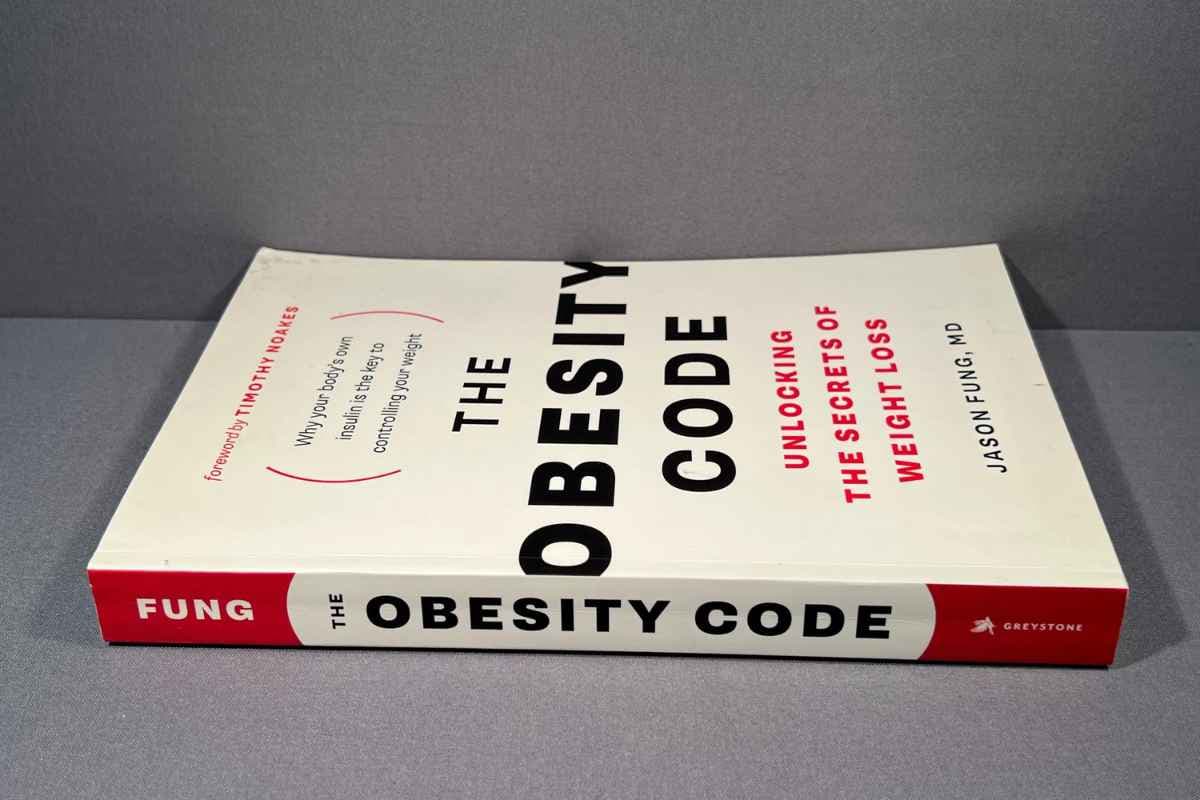
Jason Fung is a Canadian kidney doctor who spent years watching patients with type 2 diabetes get told to eat less and move more, and get worse anyway. The Obesity Code, published in 2016, is his answer to why. His argument, boiled right down, is that obesity is a hormonal problem rather than a calorie-accounting problem. Insulin is the hormone he puts at the centre of it, and if insulin is the problem, then what you eat and how often you eat matter more than how carefully you count.
It has sold enormously, and it has genuinely changed how a lot of people think about their own bodies. It has also attracted serious scientific criticism. Both of those things are true at once, which is why most reviews of this book are useless. The fan reviews skip the criticism, and the critical reviews skip the fact that plenty of his practical advice is perfectly good. I want to do neither. Here is what holds up, what doesn't, and what I'd actually take from it.
What Fung gets right
Obesity is a defended state, not a character flaw.This is the book's best idea and the reason it lands so hard with readers. Your body actively defends its weight. Lose a stone and your hunger hormones rise, your metabolism dips slightly, and your body starts working to pull the weight back on. That isn't weakness. That's regulation. Fung says this clearly and compassionately, and for a lot of people it's the first time anyone has told them their repeated failures on diets were biology rather than a moral failing. That reframe alone has real value.
Cutting sugar and refined carbohydrates is sound advice. Nothing controversial here. It also happens to be what most mainstream guidance says. Cutting carbohydrate out altogether is a different claim, and why your body needs carbs and fat covers what the evidence says about it.
Constant grazing was never great advice.The old advice to eat six small meals a day to "keep your metabolism stoked" doesn't have much behind it, and Fung is right to push back on it. For many people, fewer eating occasions simply means fewer calories without much effort.
Sleep and stress belong in a weight book.He includes them, and he's right to. They affect appetite in ways a pure calorie model tends to ignore.
Food quality genuinely matters, not just quantity. Here the evidence has actually moved toward him. In a tightly controlled trial where meals were matched for calories, sugar, fat, fibre and salt, people eating ultra-processed food ate around 500 calories a day more than the same people eating unprocessed food, and gained weight on it (Hall et al., 2019). So the type of food really does change how much you end up eating. I wrote more about that in the protein-first piece.
Where the evidence pushes back
Now the hard part, and the reason I can't write a cheerleading review. Fung doesn't just say insulin matters. He says insulin is thecause, and that calories are close to beside the point. That stronger claim has been tested, and it mostly hasn't held up.
The theory makes a specific, testable prediction: cut carbohydrates, drop insulin, and you should burn more fat even if calories stay the same. Kevin Hall and colleagues ran exactly that experiment in a metabolic ward, where every gram of food is controlled. Men were fed a normal diet and then a ketogenic one with identical calories. Insulin fell as predicted. The extra fat loss the theory promises did not appear, and if anything fat loss slowed slightly at first (Hall et al., 2016).
A later study went further and let people eat as much as they wanted on either a low-fat plant-based diet or an animal-based ketogenic one. The ketogenic diet produced far lower insulin, exactly as Fung's model says it should. People nonetheless ate several hundred calories a day more on it than on the low-fat diet (Hall et al., 2021). Lower insulin did not mean eating less or losing more.
There's one more result worth knowing, because it tests a specific piece of practical advice. Fung's framework implies that people who pump out more insulin should do better on low-carb diets. The DIETFITS trial put over 600 people on healthy low-fat or healthy low-carb diets for a year and measured exactly that. Both groups lost a similar amount, with big variation between individuals, and insulin-secretion status did not predict who did better on which diet (Gardner et al., 2018).
So the fair summary is this. Insulin is one real mechanism among several, not the master switch. And a calorie deficit is still required, whatever route you take to it. Fung is right that howyou eat changes how easily you end up in that deficit. He goes too far when he suggests the deficit itself doesn't matter.
Fasting: what the trials show
Fasting is the book's signature tool, and I think it gets a fairer hearing from the evidence than the insulin theory does, though not the one Fung would want.
The cleanest test came from a 12-month trial where everyone ate a 25% calorie deficit, and one group also had to fit their food into an eight-hour window. Both groups lost weight. The difference between them was not statistically significant, and the metabolic markers didn't separate either (Liu et al., 2022). The deficit did the work, not the window. An earlier trial of 16:8 eating without calorie counting found it wasn't more effective than eating across the day (Lowe et al., 2020), and a year-long comparison of alternate-day fasting against plain daily calorie restriction found no significant difference in weight loss, with more people dropping out of the fasting arm (Trepanowski et al., 2017).
That last detail is the one I'd hold onto. Fasting isn't magic, but it isn't useless either. For some people, "don't eat until midday" is a far easier rule to follow than weighing and logging everything, and the easiest rule you'll actually stick to usually beats the optimal one you won't. That's a genuine argument for fasting. It's just an argument about adherence, not about insulin.
How he suggests you eat
The Obesity Code Cookbook, written with Alison Maclean, turns the theory into meals. I'm not going to reproduce recipes, but the pattern is easy to describe, and honestly the pattern is the useful part.
It's built on whole, unprocessed food. Added sugar and refined grains are kept low, and bread, pasta and rice stop being the base of the plate. Protein and vegetables become the backbone instead. Natural fats like olive oil, nuts and avocado are treated as welcome rather than something to be afraid of. And meals are structured to fit an eating window, with make-ahead options for the days you have no time.
In practice that looks like a vegetable-heavy omelette to open your eating window, roasted cauliflower with warming spices and a tahini dressing as a plant-forward main, seared scallops or another protein-led seafood plate, or a slow-cooked meat dish served with vegetables rather than a mountain of starch. Snacks, if you have them, lean on vegetables and nuts rather than crackers and sweets.
Strip the theory away and you're left with: eat mostly whole food, keep sugar and refined carbs low, put protein and vegetables at the centre, and stop grazing all day. That advice is sound no matter which side of the insulin argument you land on, which is rather the point.
The books
If you want to read it and judge for yourself, which I'd encourage, there's The Obesity Code and the companion Obesity Code Cookbook. Any bookshop or library can get you either.
What readers tend to say
Read enough reader reviews and the same themes come up again and again. The most common one is relief. People describe the insulin explanation as the first thing that made their own experience make sense, particularly the bit about the body defending its weight. The second is that dropping constant snacking, and the sugar that usually comes with it, reduced their cravings noticeably. The third is that fasting felt simpler than calorie counting, because a clock is easier to obey than a spreadsheet.
The critical reactions cluster just as clearly. Some readers find the fasting hard to sustain over months, which lines up neatly with the higher dropout in the fasting arm of that year-long trial. Others come back after reading the scientific criticism and feel oversold to, because the book presents a contested theory with more certainty than it has earned.
Worth saying plainly: these are individual anecdotes, not evidence of typical results, and I've described the patterns rather than quoting anyone.
The honest verdict
Read it. Then read it sceptically, which is a slightly annoying thing to be told, so let me be specific about what I mean.
Take the reframe. Obesity really is a regulated, defended condition, and if this book is what finally lifts a decade of self-blame off you, that's worth the cover price on its own. Take the practical advice too: less sugar, fewer refined carbs, more whole food, less grazing, better sleep. And take fasting as an option worth trying, on the honest grounds that some people find it much easier than counting.
Leave the certainty behind. When the book tells you insulin is the whole story and calories don't matter, that's the part the metabolic-ward studies have tested and largely not supported. You still need a deficit. What Fung is genuinely good at is showing you routes into that deficit that don't feel like white-knuckling your way through a food diary.
The best one-line summary I've seen of this book, and I wish I'd written it, is that the theory is shaky but the diet advice is sound. That's about right.
The questions I get asked
Is the book worth reading?
Yes, with a critical eye. The reframe and the practical eating advice are genuinely useful. The claim that insulin is the primary cause of obesity is the part to hold loosely.
Is the insulin theory right?
Partly. Insulin matters. The stronger claim that it drives obesity and calories don't count has been tested in metabolic wards and mostly not supported (Hall et al., 2016).
Should I try fasting?
It's a reasonable tool if the structure suits you. Just expect it to work about as well as a calorie deficit achieved another way (Liu et al., 2022), and don't be surprised if the hardest part is sticking with it.
Whichever approach you pick, the thing that tells you whether it's working is your own data over a few weeks, not the theory behind it. Healthcount turns a plain-English food diary into calories, protein and trend lines. Start tracking free and let your own numbers settle the argument.
Sources
- Hall et al., Energy expenditure and body composition changes after an isocaloric ketogenic diet in overweight and obese men. American Journal of Clinical Nutrition, 2016
- Hall et al., Effect of a plant-based, low-fat diet versus an animal-based, ketogenic diet on ad libitum energy intake. Nature Medicine, 2021
- Gardner et al., Effect of low-fat vs low-carbohydrate diet on 12-month weight loss and the association with genotype pattern or insulin secretion (the DIETFITS trial). JAMA, 2018
- Liu et al., Calorie restriction with or without time-restricted eating in weight loss. New England Journal of Medicine, 2022
- Lowe et al., Effects of time-restricted eating on weight loss and other metabolic parameters (the TREAT trial). JAMA Internal Medicine, 2020
- Trepanowski et al., Effect of alternate-day fasting on weight loss, weight maintenance and cardioprotection. JAMA Internal Medicine, 2017
- Hall et al., Ultra-processed diets cause excess calorie intake and weight gain: an inpatient randomized controlled trial. Cell Metabolism, 2019