Food noise is a name people gave to persistent, unwanted thoughts about food. In trials, semaglutide (Wegovy) and tirzepatide (Mounjaro, Zepbound) reduced food cravings while people took them. Nobody has yet measured food noise before and after someone stops, so how often it comes back is unknown. A craving starts as an automatic thought and grows as you picture the food, and that second step can be interrupted: in one week-long study, three minutes of Tetris cut craving strength by about 14 points out of 100.
A note before you read
This is partly my own story, and it isn't medical advice. The medicine I came off, retatrutide, isn't licensed anywhere, and nothing here is a reason to try it.
If thoughts about food feel out of control, or you're bingeing or eating very little, please talk to a doctor. There's a helpline further down.
The fortnight I thought something was wrong with me
I stopped taking retatrutide on 20 June 2026. I'd taken it since January, and Mounjaro before that, and every dose is in my case study. My appetite came back once I stopped. I expected that. I didn't expect the noise.
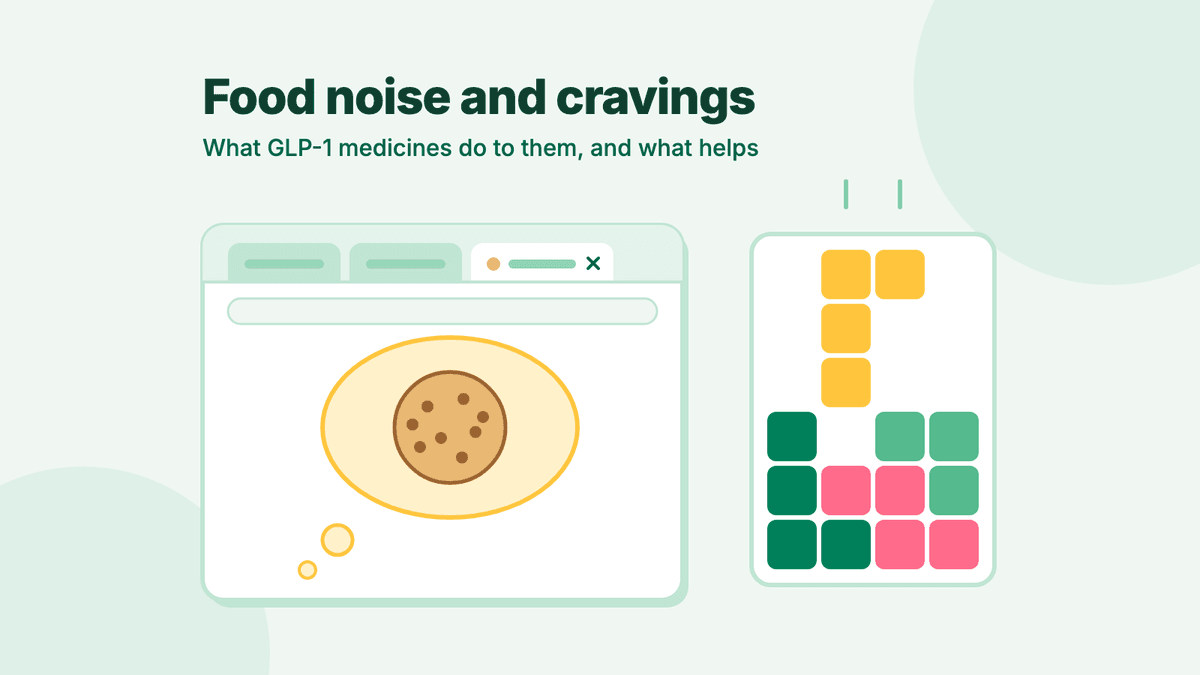
For about two weeks I thought something had gone properly wrong with me. Not hungry, exactly. Obsessed. I'd be doing something else entirely and my brain would produce a fully rendered picture of one particular food, then keep producing it, like a browser tab I couldn't close.
My weekly check-in in Healthcount caught it. In the week of 9 August, about seven weeks after my last dose, its question about food cravings hit the top score.
What unsettled me most was how convincing it felt. It didn't feel like a symptom. It felt like a personality, as though the quiet months had been the fake bit and this was me going back to my factory settings.
One thing before I go on. Retatrutide isn't licensed anywhere. Lilly, which makes it, says it is "legally available only to participants in Lilly's clinical trials" (Lilly, May 2026), and the UK's medicines regulator warns that with products sold as retatrutide "there's no guarantee that they even contain retatrutide" (MHRA, July 2026). Nothing here is a reason to take it.
So I read about cravings, the way I read about everything now. The research turned out to be more specific than I expected, and more honest about what it doesn't know.
Food noise, cravings and hunger aren't the same thing
Food noise didn't start as a scientific term. It was made popular by people managing their weight, and researchers have only lately tried to pin it down. One group defines it as persistent thoughts about food that feel unwanted or upsetting, and that are more intense and intrusive than ordinary thoughts about what to eat (Dhurandhar et al., 2025). The phrase took off on TikTok and Reddit, usually in posts about GLP-1 medicines (Wylie et al., 2026).
It's common. In a survey of 1,000 US adults in May 2026, about half said they had food noise at least sometimes, and nearly 1 in 5 had it often or always. Having it often was more common in people who felt a loss of control over eating, or were restricting what they ate. It was also more common in people taking a GLP-1, or who had taken one: about 1 in 4 of them, against about 1 in 6 of people who never had (Hayashi and Masterson, 2026). A survey like that can't tell you what causes what.
A craving is narrower. It's an intense wanting for one particular food (Hill, 2007). In my experience, hunger builds slowly and almost any food settles it. A craving arrives in your head, it's about one thing, and an apple does nothing for it. You eat the apple and the craving's still there, now with an apple on top.
Two findings from the craving research surprised me. The old idea that a craving is your body asking for a nutrient it's short of hasn't held up. And trying to cut out one particular food goes with craving it more (Hill, 2007). Hold on to that second one. It comes back later.
What GLP-1 medicines do to cravings while you take them
For many people they turn cravings down. Not for everyone, though, and maybe not for good.
In a 12-week trial of semaglutide, the medicine in Wegovy and Ozempic, people had less hunger and fewer food cravings, and felt more in control of their eating, than on a placebo (Blundell et al., 2017). A 20-week trial of the 2.4 mg dose found fewer and weaker cravings (Friedrichsen et al., 2021). Novo Nordisk, which makes semaglutide, sponsored the 2021 trial, and its staff co-wrote both papers. For tirzepatide, the medicine in Mounjaro and Zepbound, a 6-week trial funded by Lilly found lower appetite, fewer food cravings and less reaction to food around them than on a placebo (Martin et al., 2025).
Researchers have started measuring food noise itself. In a 2026 study of 79 adults, people who'd been on a GLP-1 medicine for six months scored lower on a food noise questionnaire than people who were eligible for one but hadn't started (Rutigliani and Mattes, 2026). That's a snapshot of different people, not the same people followed over time. And when 30 people in the US who were taking these medicines, or had taken them, were interviewed, less food noise, or less appetite, was one of the main things they described (de Vere Hunt et al., 2026).
The quiet may not last, even on the medicine. In a 60-week trial, people on semaglutide reported less hunger and less preoccupation with food than the placebo group at week 20. By weeks 40 and 60 the two groups no longer differed on those, although the semaglutide group was still eating less at a test lunch (Tronieri et al., 2026). Two of its authors report a research grant from Novo Nordisk to their university. Reviewing the field in September 2026, Wylie and colleagues put it plainly: "little is known about what exactly food noise is, what causes it" (Wylie et al., 2026).
Why food noise can get louder when you stop
The honest answer starts with this: nobody has measured it. On 25 October 2026 we searched PubMed for studies that mention food noise alongside stopping or cutting down a GLP-1. There were 8. None measured food noise before and after someone stopped. A 2026 review suggests watching for early changes in appetite and preoccupation with food after stopping, and says these ideas "require prospective validation" (van Bruggen et al., 2026).
What we do know points one way. These medicines work partly by turning appetite down (NHS, Tirzepatide), and once you stop they leave your body over a few weeks. Tirzepatide's half-life is about 5 days (Mounjaro SmPC, 2026) and retatrutide's about 6 (Urva et al., 2022). Our guide to how long Mounjaro stays in your body works through the arithmetic.
In the trials where people stopped semaglutide or tirzepatide, they regained, on average, much of the weight they had lost within a year (Wilding et al., 2022) (Aronne et al., 2024). Weight was what those trials measured, not cravings, but I find it hard to see how that happens without appetite coming back. The 2026 review describes it as possibly "the re-emergence of biological pressures favouring weight restoration rather than treatment failure" (van Bruggen et al., 2026). And in the US survey, people who had stopped a GLP-1 reported frequent food noise about as often as people still taking one (Hayashi and Masterson, 2026). Again, a survey can't say why.
So if you stop and the noise comes back loud, it isn't a sign you've failed. You've stopped taking a medicine that was turning the volume down. Our guides to what happens when you stop and coming off a GLP-1 cover the practical side.
How a craving works: an automatic thought, then a picture
One of the best-known theories of craving is the elaborated intrusion theory. It comes from a 2005 paper with the best title in the field, "Imaginary relish and exquisite torture" (Kavanagh, Andrade and May, 2005). It splits a craving into two steps.
Step one is the intrusion. A thought about food pops up on its own, set off by something around you, something in your body or another thought (Kavanagh, Andrade and May, 2005). You don't choose it.
Step two is the elaboration. If the thought is a pleasant one, you start building on it. You picture the food, how it tastes, where it is in the cupboard. Those pictures feel good for a moment, but they also make you more aware of what you're missing (Kavanagh, Andrade and May, 2005). That's the exquisite torture.
Ten years on, the theory's authors looked back at the evidence. The split between automatic intrusions and their elaboration is "well established", and tasks that bring in competing sights or sounds get in the way of the elaboration, especially when they use the same limited mental space (May, Kavanagh and Andrade, 2015).
That changed more for me than any willpower advice. The thought arriving isn't a verdict on me. What happens in the next half a minute is where anything gets decided.
Why Tetris works better than the television
If cravings run on mental pictures, anything that keeps your mind's eye busy should crowd them out. Researchers at Plymouth tested that in everyday life. Thirty-one students carried iPods for a week, and a text message asked them 7 times a day what they were craving and how strongly. Fifteen of them then played Tetris for 3 minutes and rated the craving again. Their cravings fell by about 14 points on a 0 to 100 scale. That held for food and drink, for alcohol, nicotine and caffeine, and for things like exercise and gaming (Skorka-Brown et al., 2015).
Three minutes of falling blocks, outside a lab. I still find that surprising. It also explains something I'd noticed and misread. Sitting in front of the television never did anything for my cravings, and I took that to mean distraction didn't work for me. The study didn't test television. My guess, from the theory, is that it asks too little of your mind's eye: you can watch a whole episode and picture a bag of crisps the entire time.
What I do now
None of this is a treatment plan. It's what I landed on after that fortnight, built on the two-step idea.
I name it. Out loud sometimes, which is ridiculous, but it works. "That's a craving." Calling it an event rather than a fact about me stops the second step about half the time.
I give my hands and eyes something to do. Not the television. A game, a puzzle, my language app, anything I have to look at and press. Three minutes is usually enough, which I wouldn't have believed before I read the Tetris study.
I say yes, in 25 minutes. Not no. Yes, in 25 minutes, if I still want it. Saying no starts an argument, and arguing means picturing the food. It also makes the food forbidden, and cutting out a food goes with craving it more (Hill, 2007). Most of the time the 25 minutes passes and I've forgotten. When I haven't, I eat the thing and it's fine. I use the same timer at the end of meals, which I wrote about in how I learned to eat more slowly.
I write it down. Partly because that's what I built Healthcount for, and partly because a craving that's written down is already a bit outside my head. Mine cluster in ways I'd never have guessed from memory.
I still get them. That's the honest ending. What changed is that they stopped feeling like evidence of something wrong with me, and started feeling like weather.
When it's more than noise
Food noise can sit close to something more serious. In the US survey, the strongest link with frequent food noise was feeling a loss of control over eating (Hayashi and Masterson, 2026). A 2026 article in the International Journal of Eating Disorders warns that the same effects that quieten appetite and preoccupation with food may, in some people, feed restriction, skipped meals and relapse, and asks for plans for stopping (Škudar, 2026).
If cravings come with bingeing, feeling out of control, or eating very little to make up for them, that's worth talking to a doctor about. Our piece on why regular eating works looks at how regular meals can help break a binge and restrict cycle, and our review of Overcoming Binge Eating covers a self-help programme with trials behind it.
What's solid and what isn't
| Claim | How strong is the evidence? | Main sources |
|---|---|---|
| GLP-1 medicines reduce food cravings while you take them | Good, from short trials run with or funded by the makers | Blundell 2017; Friedrichsen 2021; Martin 2025 |
| People on these medicines notice quieter food noise | Likely. One small comparison study, plus interviews | Rutigliani and Mattes 2026; de Vere Hunt 2026 |
| The quiet can fade even on the medicine | Possible. One 60-week trial | Tronieri 2026 |
| Food noise comes back after you stop | Unknown. Nobody has measured it | PubMed search, 25 October 2026; van Bruggen 2026 |
| Weight tends to come back after stopping | Strong, from the stopping trials | Wilding 2022; Aronne 2024 |
| A craving grows as you picture the food | Good. A leading theory, with ten years of studies behind it | Kavanagh 2005; May 2015 |
| A visual task such as Tetris weakens cravings | Moderate. Lab studies, and one week-long study of 31 students | Skorka-Brown 2015 |
| Cutting out a food goes with craving it more | Likely, from prospective and experimental studies | Hill 2007 |
Questions people ask
What is food noise?
Persistent thoughts about food that feel unwanted or upsetting, more intense and intrusive than ordinary thoughts about what to eat. The term came from people managing their weight rather than from researchers. In a nationally representative US survey in May 2026, nearly 1 in 5 adults said they had it often or always.
Do GLP-1 medicines get rid of food noise?
They turn it down for many people while they take them. Trials of semaglutide and tirzepatide found fewer food cravings than on a placebo, and people who had taken one for six months scored lower on a food noise questionnaire than people who hadn't started one yet. In one 60-week trial, though, the drop in hunger and preoccupation with food had faded by week 40.
Does food noise come back after stopping a GLP-1?
Nobody knows how often, because nobody has measured food noise before and after people stop. In the stopping trials, people regained, on average, much of the weight they had lost within a year, though those trials measured weight, not appetite. In a 2026 US survey, people who had stopped a GLP-1 reported frequent food noise about as often as people still taking one.
What's the difference between hunger and a craving?
A craving is an intense wanting for one particular food, and trying to cut that food out goes with craving it more. The old idea that a craving means your body is short of a nutrient hasn't held up. Hunger is broader: in my experience almost any food settles it, and nothing but the one thing settles a craving.
Does distraction help with cravings?
The right kind can. In a week-long study, playing Tetris for 3 minutes cut craving strength by about 14 points out of 100, for food and drink and for alcohol, nicotine and caffeine. The theory is that cravings run on mental pictures, so a task that keeps your mind's eye busy competes with them.
Should I go back on the medicine if the cravings are bad?
That's a conversation with your prescriber, not with a blog. One 2026 review says weight coming back after stopping may reflect the body's biology rather than treatment failure, which is worth taking into that appointment. If the cravings come with bingeing, feeling out of control or eating very little, say so.
This is one person's story and general information, not medical advice. Decisions about your medicine belong with your prescriber.
View sources (26)
- Kavanagh, Andrade and May. Imaginary relish and exquisite torture: the elaborated intrusion theory of desire. Psychological Review, 2005
- May, Kavanagh and Andrade. The Elaborated Intrusion Theory of desire: a 10-year retrospective and implications for addiction treatments. Addictive Behaviors, 2015
- Skorka-Brown, Andrade, Whalley and May. Playing Tetris decreases drug and other cravings in real world settings. Addictive Behaviors, 2015
- Hill. The psychology of food craving. Proceedings of the Nutrition Society, 2007
- Dhurandhar et al. Food noise: definition, measurement, and future research directions. Nutrition and Diabetes, 2025
- Wylie et al. Food noise: a theoretical review. Appetite, published online 22 September 2026
- Hayashi and Masterson. Prevalence and correlates of perceived food noise among US adults in a nationally representative sample. Obesity Science and Practice, 26 September 2026
- Blundell et al. Effects of once-weekly semaglutide on appetite, energy intake, control of eating, food preference and body weight in subjects with obesity. Diabetes, Obesity and Metabolism, 2017
- Friedrichsen et al. The effect of semaglutide 2.4 mg once weekly on energy intake, appetite, control of eating, and gastric emptying in adults with obesity. Diabetes, Obesity and Metabolism, 2021
- Martin et al. Tirzepatide on ingestive behavior in adults with overweight or obesity: a randomized 6-week phase 1 trial. Nature Medicine, 2025
- Rutigliani and Mattes. The effects of glucagon-like peptide-1 receptor agonists on chemosensory function and ingestive behavior. Physiology and Behavior, published online 25 August 2026
- de Vere Hunt et al. Patient experiences with GLP-1 receptor agonists. JAMA Network Open, 1 June 2026
- Tronieri et al. Short- and long-term effects of semaglutide 2.4 mg on energy intake, appetite, and food reward: a 60-week, double-blind randomized controlled trial. American Journal of Clinical Nutrition, August 2026
- van Bruggen, Damhof and van Roon. Adaptive maintenance after incretin-induced weight loss: moving beyond the continue-or-stop paradigm. Obesity Pillars, 27 August 2026
- Wilding et al. Weight regain and cardiometabolic effects after withdrawal of semaglutide: the STEP 1 trial extension. Diabetes, Obesity and Metabolism, 2022
- Aronne et al. Continued treatment with tirzepatide for maintenance of weight reduction in adults with obesity: the SURMOUNT-4 randomized clinical trial. JAMA, 2024
- Urva et al. LY3437943 (retatrutide), a novel triple GIP, GLP-1, and glucagon receptor agonist in people with type 2 diabetes: a phase 1b trial. The Lancet, 2022
- Škudar. Eating disorders in the GLP-1 era: a spotlight on emerging clinical risks, research gaps, and practice priorities. International Journal of Eating Disorders, October 2026
- NHS (UK): Tirzepatide, last reviewed 15 May 2026
- Mounjaro (tirzepatide) Summary of Product Characteristics, emc (UK), text revised 29 August 2026 (section 5.2)
- Lilly's triple agonist retatrutide delivered powerful weight loss in pivotal phase 3 obesity trial (TRIUMPH-1), Eli Lilly, 21 May 2026
- No summer shortcut for safe weight loss, MHRA, GOV.UK, 24 July 2026
- Beat (UK): helplines
- ANAD (US): eating disorder helpline
- Bodywhys (Ireland): helpline
- Butterfly Foundation (Australia): National Helpline