Partly. While a GLP-1 medicine turns hunger down, eating at planned times stands in for the two intuitive eating principles that rely on hunger and fullness, and the other eight can be practised as they are. On weight, trials show intuitive eating mostly keeps weight about the same rather than lowering it, and nothing shows it slows regain after the medicine stops.
A note before you read
This article is about intuitive eating and hunger on GLP-1 medicines. It's information, not treatment. You won't find calorie numbers, weights or "good" and "bad" foods in it, and that's on purpose.
If food or your body is taking up a lot of room in your head, or you binge, purge or go long stretches without eating to control your weight, please talk to a doctor. If you're being treated for an eating disorder, your team's plan comes before anything here. And if you're underweight, or you've been eating very little for a while, please don't change your eating on your own. That needs medical support.
Intuitive eating asks you to trust your body: eat when you're hungry, stop when you're full, drop the diet rules. A GLP-1 medicine changes what your body is telling you. In one trial of 72 adults, people on semaglutide 2.4 mg ate 35% less at a help-yourself lunch than people on a placebo, and felt less hungry and fuller (Friedrichsen et al., 2021). So what do you listen to when the medicine has turned the volume down?
The short version: your hunger is on mute, not gone. While it's quiet, eating at planned times does hunger's job, and most of intuitive eating never depended on hunger anyway. When the medicine stops, hunger is likely to come back, though the trials that followed people after stopping didn't measure it.
And the weight part, since it's in the title. Intuitive eating isn't a weight-loss method, and its creators say so. Evelyn Tribole, one of its two authors, wrote: "No health professional can rightly state you will lose weight with Intuitive Eating, including me" (Tribole, 2019). In trials, it mostly keeps weight about the same rather than lowering it (Van Dyke and Drinkwater, 2014).
What is intuitive eating?
Intuitive eating is a set of 10 principles for eating by your body's signals and your own judgement, rather than by diet rules. Two US dietitians, Evelyn Tribole and Elyse Resch, created it in 1995 (IntuitiveEating.org, 2019). Tribole says the principles work by building "interoceptive awareness", which just means sensing what's going on inside your body, like hunger and fullness. She's also clear (Tribole, 2018) that it "is not a diet or food plan. Period."
It's broader than mindful eating, which Tribole describes as paying attention, on purpose, to the experience of eating without judgement. Intuitive eating includes that and more (Tribole, 2010, updated 2024). The book is in its fourth edition (IntuitiveEating.org), and a fifth is listed by a bookseller for 15 June 2027, with a blurb that mentions "GLP-1 medications" (Barnes & Noble listing, read 16 October 2026).
What are the 10 principles of intuitive eating?
Here they are as the official site lists them, read on 16 October 2026. The names are American, so we've kept the spelling, and older official pages put a few in a different order (IntuitiveEating.org).
- Reject Diet Culture
- Honor Your Hunger
- Make Peace with Food
- Discover the Satisfaction Factor
- Feel Your Fullness
- Challenge the Food Police
- Cope with Your Emotions with Kindness
- Respect Your Body
- Movement: Feel the Difference
- Honor Your Health: Gentle Nutrition
Only two of them, Honor Your Hunger and Feel Your Fullness, depend on reading hunger and fullness signals. Rachael Hartley, an intuitive eating dietitian, says that focusing on those two and ignoring the rest turns intuitive eating into "the hunger fullness diet" (Hartley, 2022). The other eight still apply when hunger is quiet.
Can you lose weight with intuitive eating? What the studies show
Not reliably. Trials mostly show weight staying about the same, and its founders say weight loss can't be the aim.
A 2014 review of 26 studies concluded that intuitive eating "results in weight maintenance but perhaps not weight loss" (Van Dyke and Drinkwater, 2014). In a US trial of 78 women with a long history of dieting, those randomised to a diet lost weight and then regained it, while those taught body acceptance and intuitive eating "maintained weight, improved in all outcome variables, and sustained improvements" over two years (Bacon et al., 2005). Surveys find that people who eat more intuitively tend to have a lower BMI, but a snapshot can't show which came first (Eaton et al., 2024).
Tribole puts it like this (Tribole, 2019): "It's true that some people will experience weight loss as a side effect of Intuitive Eating. Other bodies on the IE journey may stay the same, while others may need to gain weight. I'm not against weight loss, it just can't be the focal point."
Does intuitive eating work?
For how people feel about food and their bodies, the evidence is promising. For weight and physical health, it's weak or neutral.
A 2021 meta-analysis of 97 studies linked intuitive eating with less disordered eating and better body image and wellbeing, though about 9 in 10 of the studies were snapshots that can't show cause and effect (Linardon et al., 2021). The trials are smaller. A single online session reduced binge eating in a 2025 trial of 248 people, but only 129 of them gave data at the two-week check (Messer et al., 2025). In a trial of 106 young women, an eight-week group run by dietitians reduced disordered eating without changing diet quality (Casgrain et al., 2026).
Reviews disagree about whether it changes diet quality (Hensley-Hackett et al., 2022); (Grider et al., 2021), and no experiment has yet measured what intuitive eating does to appetite itself (Ahmadyar et al., 2026).
What does a GLP-1 do to hunger and fullness?
It turns hunger down and fullness up. The US labels for Wegovy and Zepbound call GLP-1 "a physiological regulator of appetite" (Wegovy label); (Zepbound label).
In the semaglutide trial above, people also had fewer, weaker cravings (Friedrichsen et al., 2021), and in a trial in type 2 diabetes, tirzepatide lowered appetite about as much as semaglutide did (Heise et al., 2023). Both trials were funded by the makers. A 2025 joint advisory from four US obesity and nutrition organisations puts the drop in how much people eat at between 16% and 39% compared with placebo (Mozaffarian et al., 2025).
It isn't the same every week. Food aversions turn up "typically at the initiation of treatment and with dose increases", the advisory says, and it warns that "A limited interest in food, reduced hunger, and increased fullness may cause individuals to go several hours without eating" (Mozaffarian et al., 2025). Your body still needs food on a quiet day. The signal that tells you so has just been turned down.
Can you eat intuitively on Wegovy, Zepbound or Mounjaro?
Partly. Most of it works as it is, but the two principles that depend on hunger and fullness need a stand-in while the medicine is working: eating at planned times. (Names differ by country: semaglutide is Wegovy for weight and Ozempic for type 2 diabetes, and tirzepatide is Mounjaro in the UK, Ireland and Australia and Zepbound in the US.)
Intuitive eating's co-creator allowed for this long before these medicines were used for weight. In a 2010 article for eating disorder clinicians, Tribole listed what decides when regular hunger cues return in recovery, including "Medications (which can distort hunger and satiety cues)", and described eating in that phase as necessary self-care, "regardless of the absence of hunger or the presence of early fullness" (Tribole, Perspectives, Winter 2010). Even Honor Your Hunger begins: "Keep your body biologically fed with adequate energy and carbohydrates" (IntuitiveEating.org).
Hartley calls eating ahead of hunger practical hunger: "a need to eat in response to anticipated physical hunger that you won't be able to satisfy" (Hartley, 2024). Elyse Resch, the other co-creator, made a similar point on the Rethinking Wellness podcast in February 2025: illness can interfere with your instincts, and sometimes you eat because you know you need to (Rethinking Wellness, 17 February 2025). Eating disorder dietitians call it mechanical eating, and Caroline Young, one of them, calls it "an important first step toward intuitive eating" (Young, 2025). Obesity specialists say the same: the 2025 advisory suggests small, frequent meals when hunger is low, and says "setting an alarm or other reminder to eat can be helpful" (Mozaffarian et al., 2025).
Chevese Turner, a long-time body liberation advocate who has had binge eating disorder and atypical anorexia, takes Mounjaro for diabetes. On an Australian eating disorder charity's podcast in January 2026 (transcript), they said: "And so I set timers every day to remind myself to eat, including my snacks. You know, I kind of had to go back to the beginning of eating disorder recovery and make sure that I was getting enough nutrition."
No trial has tested intuitive eating on these medicines. Our PubMed search on 16 October 2026 found two observational studies from the same French team (PubMed search), where people who scored higher on intuitive eating before starting semaglutide tended to do better on it (Avignon et al., 2025); (Tournayre et al., 2026). Several authors have ties to drug makers, and studies like these can't show cause and effect.
Regular eating or intuitive eating?
Both, in that order. Eating disorder treatment starts with planned eating, and intuitive eating's co-creator put that structure first whenever hunger can't be trusted.
I've had CBT for an eating disorder, and it's been life changing. In CBT-E, the version for eating disorders developed by Christopher Fairburn and colleagues at Oxford, people are usually asked by the third session to eat three planned meals and two or three planned snacks a day, so there's rarely more than about four hours between them (Murphy et al., 2010).
Tribole's 2010 article heads its first phase "Nutrition Rehabilitation Phase I: Intuitive Eating is Contra-Indicated", because someone in the throes of an eating disorder "is not capable of accurately hearing biological cues of hunger and fullness". Her picture for the structure that replaces them (Tribole, 2010): "This is similar to when a cast is needed to support the healing of a broken arm. The cast provides structure and support, but it is not lifelong, nor the destination in recovery."
A GLP-1 isn't an eating disorder, but the signal problem is similar: hunger quieter than your needs, and fullness arriving early. Hartley puts it plainly (Hartley, 2022): "Following your meal plan is honoring your hunger, even if you're not feeling hungry." And intuitive eating can come later. In a two-year pilot, eating disorder patients learned to eat intuitively, and being able to was linked with better outcomes (Richards et al., 2017).
Structure can harden into a rule, though. Elizabeth Davenport, a dietitian quoted by Equip, a US online eating disorder service, warns that "mechanical eating, like any tool, can end up being misused by the eating disorder" (Equip, 2025). So treat planned times as a floor: eat at least this often. They aren't a test you can fail, and Tribole says that choosing to stay with a plan "is not failure" (Tribole, 2010). Our pieces on why regular eating works and on Fairburn's Overcoming Binge Eating go further.
Which principles can you practise while hunger is quiet?
All of them, with two adjustments. This table is our reading of the sources above, not a research finding.
| Principle | While hunger is quiet | As hunger comes back |
|---|---|---|
| Reject Diet Culture | Notice if eating less starts to feel like winning. | Watch for the urge to diet before hunger is fully back. |
| Honor Your Hunger | Eat at planned times instead of waiting for a signal. | Answer hunger early rather than holding out. |
| Make Peace with Food | Food aversions can quietly build a new list of foods you avoid. | Permission matters more as cravings return. |
| Discover the Satisfaction Factor | Food may give you less pleasure, so small meals you like help. | Plan meals you enjoy. |
| Feel Your Fullness | Fullness comes early and lasts. Don't let it decide how little you eat. | Fullness may feel weaker than it did on the medicine. The comparison has moved; your body hasn't failed. |
| Challenge the Food Police | "A good day is a day I barely ate" is a food police rule. | "I've lost control" is a verdict, not a fact. |
| Cope with Your Emotions with Kindness | Feelings don't go quiet because food noise has. | Old ways of coping with food may come back with appetite. That's expected. |
| Respect Your Body | A changing body can push some people to eat even less. | Weight change after stopping is common, and it isn't a verdict. |
| Movement: Feel the Difference | Energy may be low. Gentle movement counts. | The same. |
| Honor Your Health: Gentle Nutrition | Protein and nutrients matter more when you eat less. | The same, without turning it into rules. |
If the food police are loud for you, our piece on the all-or-nothing guilt cycle goes further.
How do you use a hunger scale when the medicine turns hunger down?
Use it to notice, not to decide whether you're allowed to eat. On a GLP-1 you may sit near the middle of any hunger scale all day, so "wait until you're properly hungry" can mean waiting until evening.
Even WeightWatchers' guide to intuitive eating on a GLP-1, which uses a numbered scale, says to set an alarm or follow a rough schedule if the medicine means you go hours without getting hungry (WeightWatchers, 2026). And Hartley's warning applies twice over: intuitive eating "is much more nuanced and complex than eating according to the hunger and fullness scale" (Hartley, 2022).
The medicine changes the signal, not your skill at reading it. So on a GLP-1, reading your body mostly means learning the medicine's pattern:
- Check in at your planned times, then eat anyway. It's information, not permission.
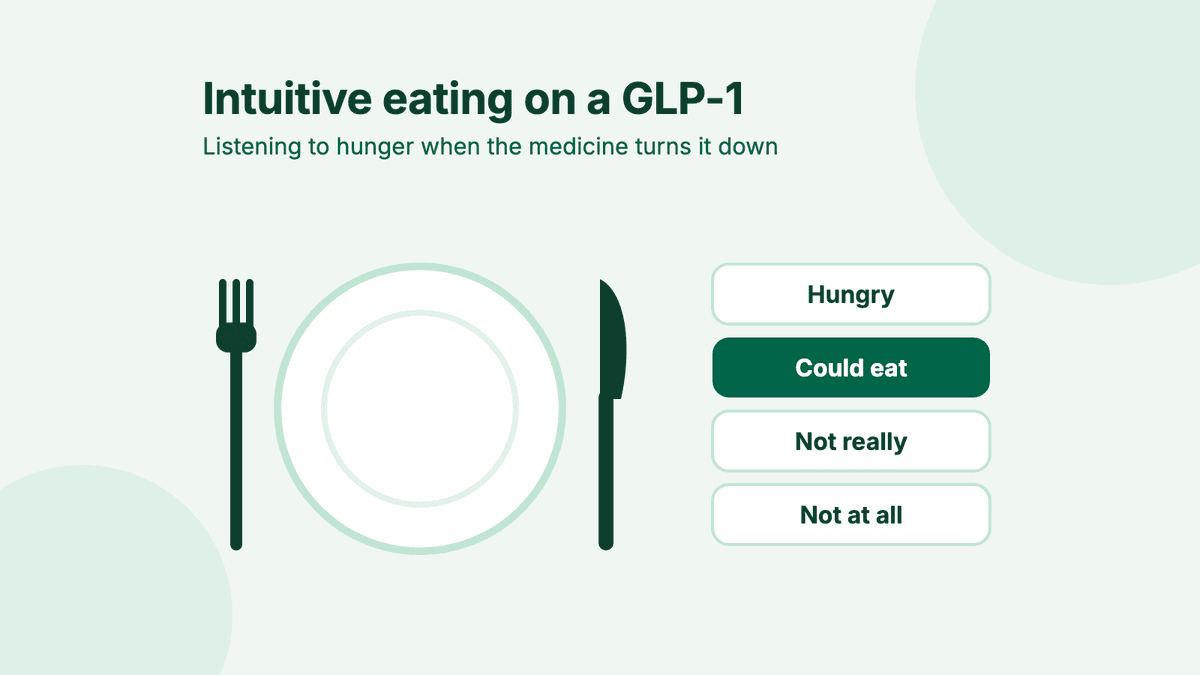
- Use a plain word if a number starts to feel like a score: hungry, could eat, not really, not at all.
- Look for patterns over a few weeks, such as changes across the week or after a dose increase.
- Don't count a low reading as a win. It's a reason to eat at your planned times.
- Notice when hunger starts to come back.
What happens to hunger when you stop a GLP-1?
It's likely to come back, because the medicine was holding it down. How fast and how strongly hasn't been measured: the stopping trials tracked weight, not hunger.
Weight is well measured. The STEP 1 trial extension followed 327 people for a year after treatment and its lifestyle programme ended, and those who had taken semaglutide had on average "regained two-thirds of their prior weight loss" (Wilding et al., 2022). In SURMOUNT-4, about 9 in 10 people who stayed on tirzepatide kept at least four-fifths of what they had lost over the next year, against fewer than 2 in 10 of those switched to a placebo (Aronne et al., 2024). Our piece on what actually happens when you stop goes through these trials.
Hunger is the gap. The full STEP 1 extension paper reports no hunger, appetite or craving results at all (Wilding et al., 2022, full text). So the appetite part is inference, but it's well grounded. After weight loss by diet, how much a meal dampened people's appetite fell by 14% over a year in the placebo group, and not at all in people on liraglutide, an older GLP-1 medicine (Jensen et al., 2022). A 2026 review says stopping suddenly may cause "a transient mismatch between increased biological drive for weight regain and the sudden loss of pharmacological appetite suppression" (Damhof et al., 2026).
Nobody yet knows how hunger changes week by week after stopping, whether it ends up stronger than before, or how long it takes to settle. If it comes back hard, that's biology, not a lack of willpower, and our piece on set point theory explains why. Returning hunger can also start a binge-restrict cycle, one reason eating disorder researchers want "discontinuation planning" (Škudar, 2026). Talk any plan to stop through with your prescriber first.
Will intuitive eating stop the weight coming back?
Nothing shows that it does. We found no study testing intuitive eating, or regular eating, as a way of coming off a GLP-1.
A 2026 BMJ review of 37 studies found weight came back faster after weight-loss medicines than after diet and behaviour programmes. It found no evidence that more intensive behavioural support during treatment, or support after stopping, changed that, though only one study compared support with none (West et al., 2026). The 2025 advisory says structured nutrition and lifestyle support after stopping "has not been studied in controlled trials" (Mozaffarian et al., 2025).
So we won't promise that intuitive eating will hold your weight. What it may offer, in our judgement, is narrower: if you've practised the other principles while hunger was quiet, returning hunger is something you've prepared for, not an emergency.
What are the downsides of intuitive eating?
The evidence is thinner than its popularity suggests, and it assumes you can get enough food and can trust your hunger.
Most studies are surveys, the trials are small, and samples lean towards white women: in the 2025 binge eating trial, about 8 in 10 participants were white and 9 in 10 were women (Messer et al., 2025). Food insecurity goes with lower intuitive eating scores, though the effects are small (Burnette et al., 2023).
Medicines can make hunger unreliable (Tribole, 2010), and so can illness (Rethinking Wellness, 2025). If you take insulin or a sulfonylurea for diabetes, the labels warn that using these medicines alongside them "may increase the risk of hypoglycemia, including severe hypoglycemia" (low blood sugar), so talk to your prescriber before changing how you eat (Zepbound label); (Wegovy label). Intuitive eating's reliance on internal signals can also be a barrier for many autistic people (Longhurst and Burnette, 2023).
And it takes a view on weight: the official definition calls the pursuit of intentional weight loss "a failed paradigm" (IntuitiveEating.org, 2019). You can use the tools without sharing that view. Our piece on Health at Every Size and GLP-1s looks at whether the two fit together.
How to start, on the medicine or coming off it
If you're in treatment, your team's plan comes first. If you're underweight or have been eating very little, increasing your eating needs medical support. Otherwise, here's a gentle way in.
- Pick rough times for three meals and two or three snacks, so you're rarely more than about four hours without eating (Murphy et al., 2010). Move them to fit your day.
- Eat at those times even when you're not hungry. Small is fine, and our guide to easy foods when nothing sounds good has ideas.
- Before eating, notice your hunger in a word or two. Afterwards, notice how full you feel and whether you enjoyed it.
- Each week, practise one principle that doesn't need a hunger signal, like spotting one food rule.
- If you miss a time, eat when you notice and carry on (CCI). Nothing needs making up.
- Keep the times as hunger returns, and let them loosen as your signals settle. As a Western Australian clinical handout puts it, "You won't have to do this forever, and in future your eating can become more flexible" (CCI).
If you use Healthcount, you can set your own times for three meals and two or three snacks and choose to get a reminder at each. There's also an optional setting, off by default, to note how hungry you are before a meal and how a meal left you feeling.
What's solid, what's likely and what's unknown
| Claim | How strong is the evidence? | Main sources |
|---|---|---|
| Intuitive eating goes with less disordered eating and better wellbeing | Good for the link. Cause and effect is less clear, because most studies are surveys | Linardon 2021 |
| Intuitive eating programmes reduce binge eating | Promising. Small trials, one with heavy drop-out | Messer 2025; Casgrain 2026 |
| Intuitive eating leads to weight loss | Not supported. Trials mostly show weight staying about the same | Van Dyke 2014; Bacon 2005 |
| Intuitive eating improves diet quality | Contested. Reviews disagree | Hensley-Hackett 2022; Grider 2021 |
| GLP-1 medicines lower hunger and raise fullness | Strong. Placebo-controlled trials, funded by the makers | Friedrichsen 2021; Heise 2023; US labels |
| Planned eating is the right stand-in while hunger is muted | Agreed by eating disorder and obesity clinicians. Not tested in trials on these medicines | Tribole 2010; Murphy 2010; Mozaffarian 2025 |
| Intuitive eating helps people on a GLP-1 | Unknown. No trials; two observational studies from one French team | Avignon 2025; Tournayre 2026 |
| Weight comes back after stopping, on average | Strong | Wilding 2022; Aronne 2024; West 2026 |
| Hunger comes back after stopping | Likely, from how the medicines work. Not measured in the stopping trials | Jensen 2022; Damhof 2026 |
| Intuitive eating, or any support, slows regain after stopping | No evidence that it does | West 2026; Mozaffarian 2025 |
| These medicines should generally be avoided in active eating disorders | Expert consensus | Keshen 2026; Škudar 2026 |
When to get more help
These medicines aren't for everyone. A 2026 consensus of 45 experts and people with lived experience agreed they "should generally be avoided" in people with an active eating disorder, especially anorexia, atypical anorexia and bulimia with marked restraint, and that clinicians should "proceed cautiously" after a past one. It recommends screening before starting, monitoring, and talking therapy alongside (Keshen et al., 2026). The worry is that the effect that quietens food preoccupation "may also reinforce restriction, avoidance of regular eating, compulsive weight control, and relapse in vulnerable individuals" (Škudar, 2026).
If you've had an eating disorder, tell your prescriber before you start and before you stop. Talk to a doctor soon if any of these sound like you (a practical list, not a diagnosis):
- going most of the day without eating, or feeling relieved or proud about not being hungry
- feeling dizzy, faint or cold all the time, or being unable to concentrate
- dreading hunger coming back, or planning to restrict harder when you stop
- using the medicine, or extra doses, to control eating, or getting it without a proper consultation
- bingeing or losing control of eating as a dose wears off or after stopping
- making yourself sick, using laxatives or exercising to make up for eating
A helpline isn't an emergency service. If you're in danger right now, call your local emergency number.
The questions people ask
Can you lose weight with intuitive eating?
It isn't designed for weight loss, and in trials it mostly keeps weight about the same rather than lowering it. Its co-creator Evelyn Tribole says weight loss can't be the focal point: some people lose weight, some stay the same and some need to gain.
Can you eat intuitively on Wegovy, Ozempic, Mounjaro or Zepbound?
Partly. Eight of the 10 principles don't depend on hunger signals and still apply. The two that do, Honor Your Hunger and Feel Your Fullness, need a stand-in while the medicine turns hunger down: eating at planned times. No trial has tested intuitive eating on these medicines.
What should I do if I have no appetite on a GLP-1?
Eat small amounts at planned times rather than waiting to feel hungry. A 2025 US joint advisory suggests small, frequent meals when hunger is low, and says a reminder to eat can help. If you're going most of the day without eating, tell your doctor or prescriber.
What is mechanical eating?
Eating at planned times instead of waiting for hunger or fullness cues. Eating disorder dietitians use it when hunger signals are unreliable, as a possible first step towards intuitive eating. Intuitive eating dietitians call eating ahead of hunger practical hunger.
Is intuitive eating safe if I've had an eating disorder?
It can be part of recovery, but usually not at the start or on your own. Treatment begins with planned eating, and co-creator Evelyn Tribole called intuitive eating contra-indicated in early nutritional rehabilitation. A 2026 expert consensus also says GLP-1 medicines should generally be avoided in an active eating disorder.
Will my hunger come back when I stop a GLP-1?
Probably. These medicines work largely by turning appetite down, and losing weight pushes appetite up by itself. The stopping trials measured weight, not hunger, so how fast and how strongly it returns isn't known. If it comes back hard, that's biology, not a lack of willpower.
Will intuitive eating stop me regaining weight after a GLP-1?
Nothing shows that it does. A 2026 BMJ review found no evidence that behavioural support changed how fast weight came back after weight-loss medicines, and structured support after stopping hasn't been tested in controlled trials.
Is intuitive eating the same as mindful eating?
No. Evelyn Tribole describes mindful eating as paying attention, on purpose, to the experience of eating without judgement. Intuitive eating includes it, and adds principles like rejecting diet thinking and respecting your body.
This is information, not medical advice. Decisions about starting, changing or stopping a medicine belong with your doctor or prescriber. If you're in treatment for an eating disorder, your care team's plan comes first.
View sources (49)
- Friedrichsen et al. The effect of semaglutide 2.4 mg once weekly on energy intake, appetite, control of eating, and gastric emptying in adults with obesity. Diabetes, Obesity and Metabolism, 2021
- Tribole. No health professional can rightly say you will lose weight with Intuitive Eating, including me! evelyntribole.com, 2019, updated 2026
- Van Dyke and Drinkwater. Relationships between intuitive eating and health indicators: literature review. Public Health Nutrition, 2014
- IntuitiveEating.org. Definition of Intuitive Eating (Tribole), 2019
- IntuitiveEating.org. What is Intuitive Eating? (Tribole), 2018, updated 2020
- IntuitiveEating.org. The Difference Between Intuitive Eating and Mindful Eating (Tribole), 2010, updated 2024
- IntuitiveEating.org. About us (Intuitive Eating "now in its 4th edition"), read 16 October 2026
- Barnes & Noble. Intuitive Eating, 5th Edition, listed for release on 15 June 2027 (read 16 October 2026)
- IntuitiveEating.org. 10 Principles of Intuitive Eating, updated July 2024 (read 16 October 2026)
- Hartley. Intuitive Eating in Eating Disorder Recovery. Rachael Hartley Nutrition, 2022, updated 2023
- Bacon et al. Size acceptance and intuitive eating improve health for obese, female chronic dieters. Journal of the American Dietetic Association, 2005
- Eaton et al. A systematic review of observational studies exploring the relationship between health and non-weight-centric eating behaviours. Appetite, 2024
- Linardon, Tylka and Fuller-Tyszkiewicz. Intuitive eating and its psychological correlates: a meta-analysis. International Journal of Eating Disorders, 2021
- Messer et al. Acceptability and efficacy of a web-based, intuitive eating-focused single session intervention for recurrent binge eating: a randomized controlled trial. International Journal of Eating Disorders, 2025 (full text)
- Casgrain et al. Effect of an intuitive eating intervention on disordered eating behaviours and dietary quality in young adult Canadian women: a randomized controlled trial. Eating Behaviors, 2026
- Hensley-Hackett et al. Intuitive eating intervention and diet quality in adults: a systematic literature review. Journal of Nutrition Education and Behavior, 2022
- Grider et al. The influence of mindful eating and/or intuitive eating approaches on dietary intake: a systematic review. Journal of the Academy of Nutrition and Dietetics, 2021
- Ahmadyar et al. Effects of mindfulness and mindful eating on food intake and appetite: a systematic review and meta-analysis. Clinical Psychology Review, 2026
- Wegovy (semaglutide) US prescribing information, DailyMed, revised June 2026
- Zepbound (tirzepatide) US prescribing information, DailyMed, revised August 2026
- Heise et al. Tirzepatide reduces appetite, energy intake, and fat mass in people with type 2 diabetes. Diabetes Care, 2023
- Mozaffarian et al. Nutritional priorities to support GLP-1 therapy for obesity: a joint advisory from the American College of Lifestyle Medicine, the American Society for Nutrition, the Obesity Medicine Association and The Obesity Society. American Journal of Clinical Nutrition, 2025 (full text)
- Tribole. Intuitive Eating in the Treatment of Eating Disorders: The Journey of Attunement. Perspectives (Renfrew Center Foundation), Winter 2010 (PDF)
- Hartley. Four Types of Hunger in Intuitive Eating. Rachael Hartley Nutrition, 17 January 2024
- Rethinking Wellness with Christy Harrison. "All Instinct, No Rational Thought," and Other Myths About Intuitive Eating, with Elyse Resch, 17 February 2025 (paraphrased: the published transcript is AI-generated)
- Young. Rethinking Mechanical Eating: A Flexible Tool for Nourishment and Recovery. Whole Self Nutrition, 2025, updated 2026
- Let's Talk, a Butterfly Foundation (Australia) podcast. The medicine and the message: unpacking the chatter around GLP-1s, 30 January 2026 (transcript)
- WeightWatchers. Can you eat intuitively on a GLP-1? (Brownfield), 25 August 2026
- PubMed search for intuitive eating and GLP-1 medicines, run 16 October 2026 (two results, both observational)
- Avignon et al. Clustering of intuitive eating and psychological health identifies subgroups associated with weight loss following semaglutide. Obesity, 2025
- Tournayre et al. Digital engagement and predictors of semaglutide persistence and weight loss in severe obesity: 48-week observational study. Journal of Medical Internet Research, 2026
- Murphy, Straebler, Cooper and Fairburn. Cognitive behavioral therapy for eating disorders. Psychiatric Clinics of North America, 2010
- Richards et al. Can patients with eating disorders learn to eat intuitively? A 2-year pilot study. Eating Disorders, 2017
- Equip. Mechanical Eating in Eating Disorder Recovery (Young; clinically reviewed by Hargrave-Klein), 2025, updated June 2026
- Wilding et al. Weight regain and cardiometabolic effects after withdrawal of semaglutide: the STEP 1 trial extension. Diabetes, Obesity and Metabolism, 2022
- Aronne et al. Continued treatment with tirzepatide for maintenance of weight reduction in adults with obesity: the SURMOUNT-4 randomized clinical trial. JAMA, 2024
- Wilding et al. STEP 1 trial extension, full text (searched 16 October 2026 for hunger, appetite and craving results: none reported)
- Jensen et al. Exploratory analysis of eating- and physical activity-related outcomes from a randomized controlled trial for weight loss maintenance with exercise and liraglutide single or combination treatment. Nature Communications, 2022
- Damhof, van Bruggen and van Roon. Early weight regain after GLP-1 receptor agonist discontinuation: mechanisms and implications for treatment de-escalation strategies. Diabetes, Obesity and Metabolism, 2026
- Škudar. Eating disorders in the GLP-1 era: a spotlight on emerging clinical risks, research gaps, and practice priorities. International Journal of Eating Disorders, 2026
- West et al. Weight regain after cessation of medication for weight management: systematic review and meta-analysis. BMJ, 2026 (full text)
- Burnette et al. Is intuitive eating a privileged approach? Cross-sectional and longitudinal associations between food insecurity and intuitive eating. Public Health Nutrition, 2023
- Longhurst and Burnette. Challenges and opportunities for conceptualizing intuitive eating in autistic people. International Journal of Eating Disorders, 2023
- Centre for Clinical Interventions (Western Australia). Regular Eating for Recovery, information sheet (PDF)
- Keshen et al. Consensus-based clinical and research recommendations for use of glucagon-like peptide-1 receptor agonists in the context of eating disorders: a modified Delphi study. World Psychiatry, 2026
- Eating disorder helpline, United Kingdom: Beat
- Eating disorder helpline, United States: ANAD
- Eating disorder helpline, Ireland: Bodywhys
- Eating disorder helpline, Australia: the Butterfly Foundation