⚠️ This article is for information only and is not medical advice. Don't change your dose or timing without speaking to the prescriber who knows your history.
If you're on Mounjaro (tirzepatide), it's completely normal to wonder:
- "How much of this dose is still in my system after a few days?"
- "How long does it take to clear if I stop?"
- "Is there still Mounjaro in my body when I take my next weekly injection?"
In this guide, we'll walk through the numbers in plain English, using what we know from high-quality sources like official prescribing information and regulator reports – then translate that into everyday scenarios, including a worked example.
Quick answer – how long does Mounjaro stay in your system?
Let's get straight to it.
From official prescribing information and pharmacology studies:
- Mounjaro (tirzepatide) has an elimination half-life of about 5 days.
- The manufacturer notes that because of this, if you stop using tirzepatide, it should be gone from your body in about 30 days.
In practice, that means:
- After 5 days, roughly 50% of a dose is still in your system.
- After 10 days, roughly 25%.
- After 20–30 days, only a small percentage remains, then it becomes negligible.
If your question is: "How much Mounjaro is left in my body after 1–7 days?"
You can think in rough terms like this (we'll show a table shortly):
- 1 day: most of the dose is still there
- 2 days: about three quarters
- 3–4 days: roughly half to two-thirds
- 5 days: about half
- 7 days (1 week): a bit over one-third
✅ Make timing easier to keep track of
If you're on Mounjaro, simply logging how much you injected and on which day makes it much easier to remember how many days it's been since your last dose.
Mounjaro UK Dose Tracking App — Simple Weekly Dosing, Done RightWhat "half-life" actually means for Mounjaro
You'll see the phrase "half-life ~5 days" everywhere, but it's rarely explained in a way that's easy to visualise.
Here's the simple version:
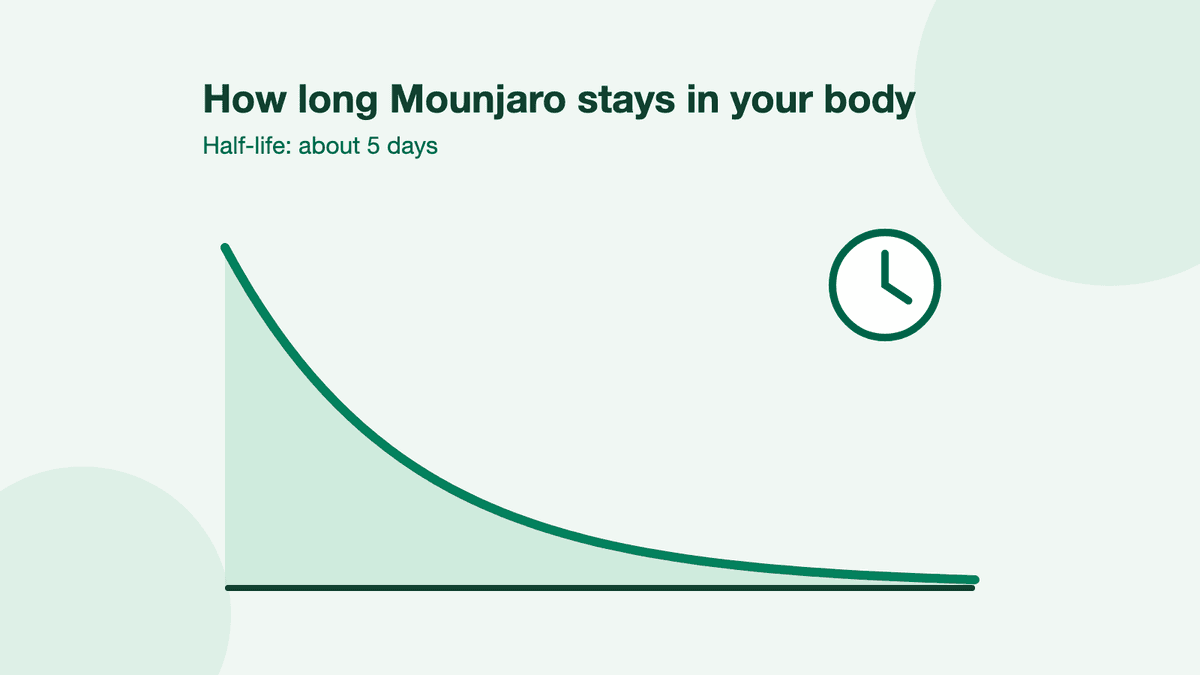
Half-life is the time it takes for the amount of drug in your body to fall by half.
For Mounjaro, that's about 5 days on average.
So, starting from a single dose:
- At the beginning: 100% of that dose is in your system.
- After 5 days: about 50% remains.
- After 10 days: about 25% remains.
- After 15 days: about 12.5% remains.
It's a curve, not a straight line – the amount drops faster at the beginning, then tails off.
Where these numbers come from
They come from:
- The Mounjaro prescribing information, which reports a mean apparent clearance of about 0.06 L/h and an elimination half-life of approximately 5 days, supporting once-weekly dosing.
- Independent reviews and pharmacokinetic studies, which also describe a half-life around 5 days for tirzepatide.
Of course, there's normal human variation – weight, kidney and liver function, other medicines and genetics can all nudge those numbers slightly – but this is the basic pattern.
Day-by-day: how much Mounjaro is left after 1–7 days?
Let's make this concrete.
Below is a simplified day-by-day breakdown for a single Mounjaro dose, assuming:
- Elimination half-life ≈ 5 days
- We're looking at the percentage of that one dose still in your body
These are rounded values based on the standard half-life equation; they're meant as useful approximations, not lab-grade measurements.
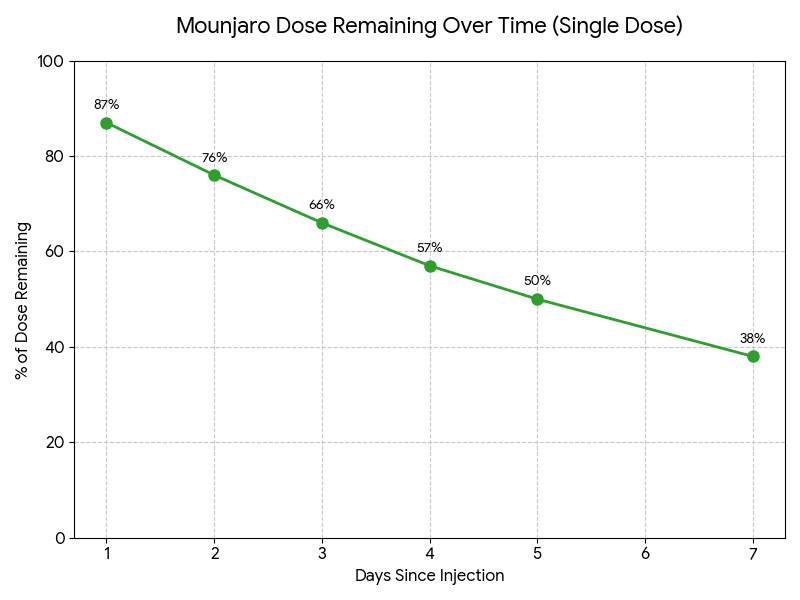
Approximate % of a single dose remaining over the first week
| Time since injection | Approx. % of that dose left | If the dose was 3 mg, approx. mg left |
|---|---|---|
| 1 day | ~87% | ~2.6 mg |
| 2 days | ~76% | ~2.3 mg |
| 3 days | ~66% | ~2.0 mg |
| 4 days | ~57% | ~1.7 mg |
| 5 days | ~50% | ~1.5 mg |
| 7 days (1 week) | ~38% | ~1.1–1.2 mg |
So if you're thinking:
"I injected on Tuesday, what's left by the weekend?"
You can roughly match your day count to this table and get a ballpark figure.
These figures are consistent with the reported half-life and standard "first-order" drug elimination used in clinical pharmacology.
💡 Use your dose log as a timeline
Rather than trying to remember when you injected last week, you can log the exact day and dose in the app, then glance back and count the days in seconds.
Mounjaro UK Dose Tracking App — Simple Weekly Dosing, Done RightWorked example: "I dosed on Tuesday and want to re-dose on Thursday"
Here's a very common real-world scenario:
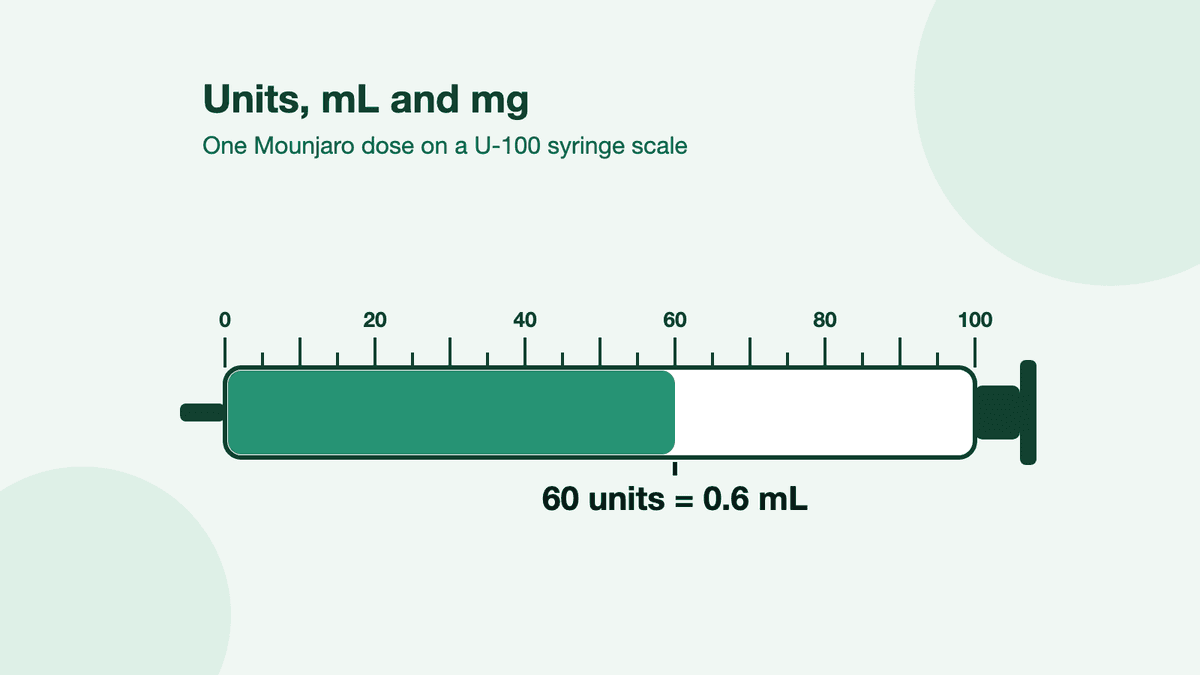
"I took 24 units of a 7.5 mg Mounjaro pen (about 3 mg) on Tuesday evening. I've got a weekend full of dinners and going out, and I'm tempted to re-dose on Thursday evening to 'top myself back up to 100%' and keep food noise down."
Let's unpack what's going on.
1. How much of that 3 mg dose is left on Thursday evening?
From the table:
Tuesday evening → Thursday evening is 2 days.
After 2 days, we estimate ~75–76% of that dose is still in your system.
For a 3 mg dose:
75–76% of 3 mg ≈ 2.25–2.3 mg still on board.
So the key insight is:
By Thursday evening, you're not "empty" – you still have roughly three-quarters of that dose in your system.
As a rough rule of thumb, you can think:
After 2 days, around 75–80% of that dose is still there.
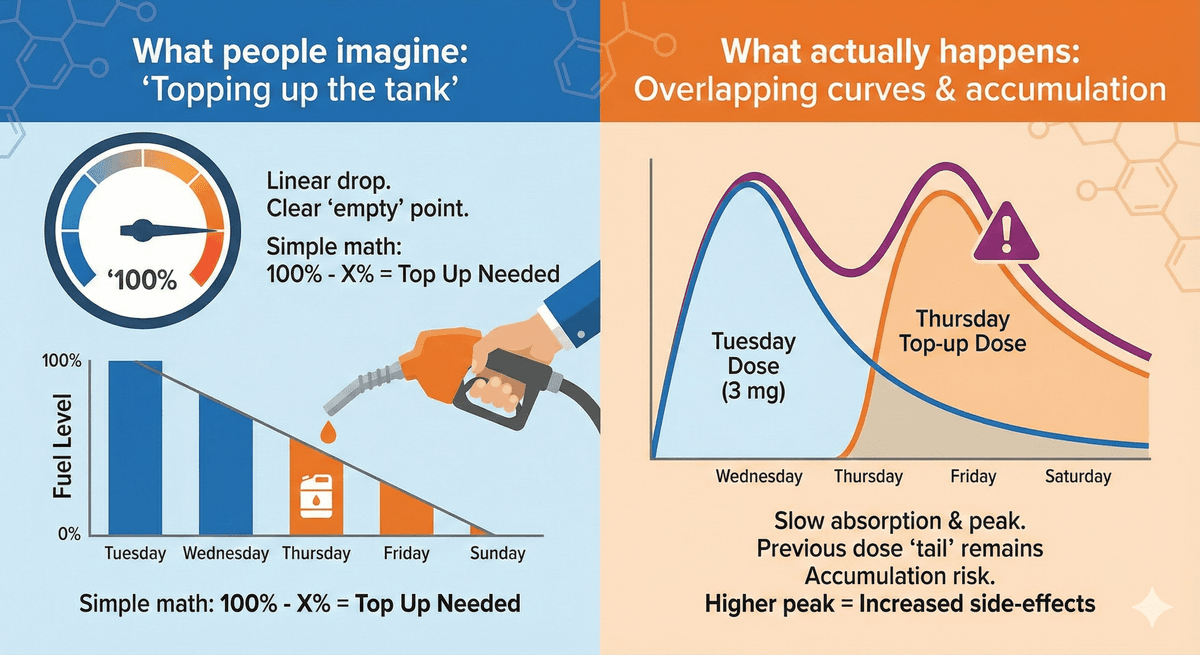
2. Why "topping up" is more complicated than it looks
It's very tempting to think:
"If 80% of 3 mg is about 2.4 mg, I'll just take enough extra to get closer to a full 3 mg again."
From a pharmacology point of view, there are some complications:
You're still absorbing the first dose
Mounjaro reaches its maximum concentration 8–72 hours after the injection, because it's absorbed slowly from the injection site.
At 48 hours, you're still within that window – so the picture isn't a neat "peak then decline".
If you've been dosing weekly for a while, older doses are still in the background
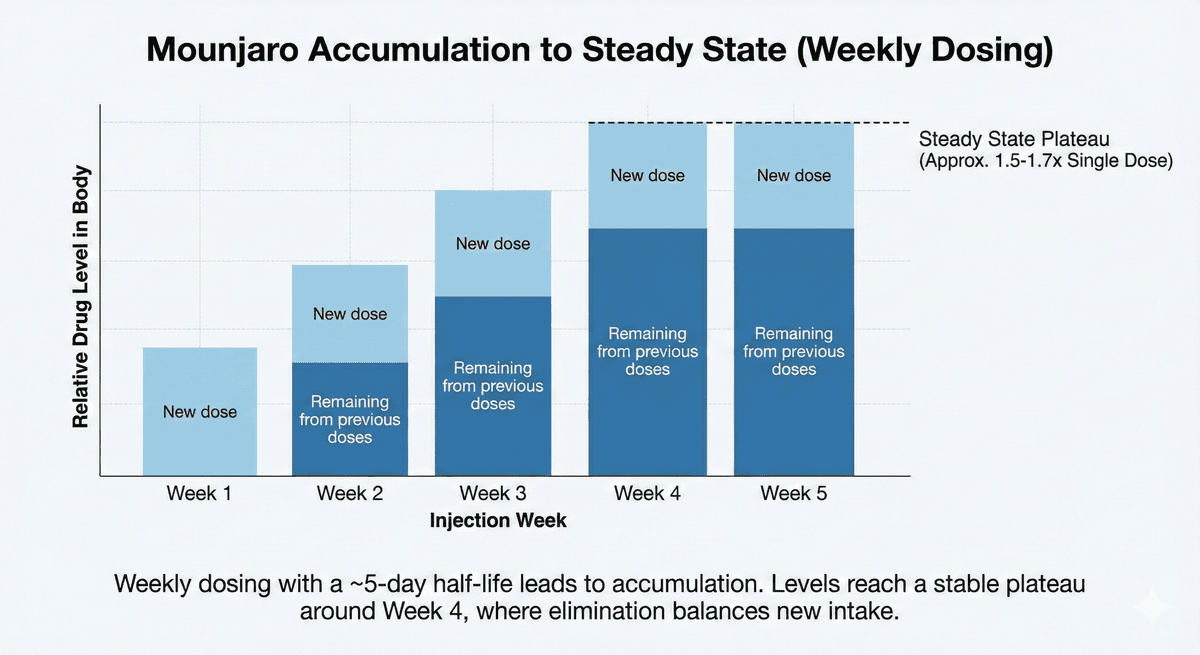
Weekly dosing plus a ~5-day half-life means accumulation.
Even before Tuesday's dose, there was a "tail" of drug left from previous weeks. Clinical pharmacology reviews report an accumulation ratio of about 1.5–1.7 with weekly dosing.
Changing timing changes your overall exposure
The regimens tested in trials were structured once-weekly schedules, not early "top-ups".
Bringing doses closer together, or stacking extras, pushes total exposure outside those tested patterns.
Side-effects and risks can rise
Higher drug levels can mean more GI symptoms (nausea, vomiting, diarrhoea), and in people with diabetes on other glucose-lowering medicines, a higher hypoglycaemia risk.
So although the maths of "how much is left" is interesting – and good to understand – it's not a safe basis for self-designing your own dosing schedule.
✅ What this example is good for
It's a brilliant way to understand that most of your dose is still there just a couple of days later – and that any urge to "boost" should be a flag for a dose-review conversation with your prescriber, not DIY adjustments.
How long does it take to clear Mounjaro completely?
Now let's flip the question:
"If I stop Mounjaro, how long until it's basically out of my system?"
The "5 half-lives" rule
A standard rule of thumb in medicine is:
- After 1 half-life: ~50% remains
- After 2 half-lives: ~25%
- After 3 half-lives: ~12.5%
- After 4 half-lives: ~6.25%
- After 5 half-lives: ~3%
Because Mounjaro's half-life is about 5 days, that translates to:
- 5 half-lives ≈ 25 days → around 3% of the last dose left
- 6 half-lives ≈ 30 days → closer to 1–2%, usually considered negligible in everyday practice
Eli Lilly's own medical information summarises this neatly:
Because the half-life is approximately 5 days, tirzepatide should be gone from your body in about 30 days after you stop using it.
So roughly:
- 1 week after last dose: still a meaningful amount left
- 2 weeks: much lower, but not zero
- 3–4 weeks: very low levels
- Around 30 days: generally treated as "cleared" for most practical purposes
Why regulators care about this
Regulators explicitly use this long half-life in their advice. For example:
The EMA product information and safety reviews highlight tirzepatide's long half-life and once-weekly dosing, and regulators typically advise stopping at least 1 month before a planned pregnancy so levels are very low before conception.
This is why questions about pregnancy, surgery or switching medicines should always go via your clinician – they're thinking in half-lives and risk windows, not just single doses.
Why there's still Mounjaro in your system on the day of your next injection
Another common question:
"If I inject once a week, is there still Mounjaro left from the last dose when I take the next one?"
Short answer: yes – and that's by design.
With a weekly injection and a ~5-day half-life:
- At 7 days (just before your next dose), about 38% of that last dose is still in your body.
- On top of that, there's a smaller "tail" from previous weeks.
Regulatory assessments and population pharmacokinetic modelling show that:
- Tirzepatide half-life is around 5–5.7 days,
- Concentrations reach the lower limit of quantitation about 4 weeks after a steady-state dose,
- The accumulation ratio with weekly dosing is about 1.7, meaning steady-state exposure is roughly 1.7 times higher than after a single dose.
- Steady state is usually reached after about 4 weeks of once-weekly injections.
This is why:
- Side-effects and appetite changes can feel different in Week 4–5 than they did after your very first injection.
- If you pause Mounjaro, levels drift down over several weeks rather than disappearing immediately.
🔗 Related reading
If you ever find yourself squinting at the pen labels and wondering what those "mg" and "units" actually mean in practice:
Mounjaro UK conversion to mL and unitsCommon questions about Mounjaro in your system
1. Is it safe to re-dose early to "top up" before a big weekend?
It's very human to want more support when you've got a social weekend or holiday coming up. But from a safety point of view:
- The dosing schedules that have been tested are structured once-weekly regimens, not early "boosts".
- Re-dosing early increases your total exposure, and may increase side-effects and risk, especially if you live with diabetes and take other glucose-lowering medicines.
- Even though understanding "how much is left" is useful, any change in dose or timing should go through your prescriber.
2. Why do I sometimes feel Mounjaro "wear off" before the next injection, if there's still drug left?
Two things can be true at the same time:
- There is still a measurable amount of tirzepatide in your system.
- Your subjective experience of appetite, cravings or "food noise" can change faster than the drug level itself.
This reflects brain, gut and hormone biology – not just the concentration of drug in the blood.
What you can do:
- Note which day after your injection tends to feel harder (e.g. Day 5 or 6).
- Bring that pattern to your prescriber as part of a structured review.
- A simple dose log (what you took, on which date) is enough to anchor that conversation.
3. Does my weight change how long Mounjaro stays in my body?
Population pharmacokinetic analyses haven't found big changes in half-life across different BMI ranges – the half-life stays roughly around 5 days across studied populations, with exposure broadly similar in people with type 2 diabetes and those with obesity.
That said, dose, response and tolerability are still very individual, which is why titration is gradual and personalised.
4. What about kidney or liver problems?
In the studies supporting approval, mild to moderate kidney or liver impairment did not require major dose adjustments, and half-life stayed broadly similar.
However:
- Severe impairment,
- Multiple other medicines, or
- More complex medical histories
…are all reasons to have a tailored plan with your clinician rather than assuming the standard schedule fits you perfectly.
✅ Turn your dosing history into a useful tool
You don't need anything fancy – just a clear record of how much you took and when. That's enough to:
- know how many days it has been since your last dose
- talk through patterns with your prescriber
References
Mounjaro (tirzepatide) injection, prescribing information
Eli Lilly and Company; 2024. (Includes pharmacokinetics: half-life ≈ 5 days, clearance ~0.06 L/h, once-weekly dosing.)
Lilly Medical Information
How long will tirzepatide be in the body after the last dose? Reviewed 19 December 2024. (States that, with a half-life of ≈5 days, tirzepatide should be gone from the body in about 30 days after stopping.)
European Medicines Agency
Mounjaro (tirzepatide) – product information and assessment reports
Describes Tmax 8–72 hours post-dose, absolute bioavailability ~80%, steady state reached after ~4 weeks of once-weekly dosing.
Swissmedic
Swiss Public Assessment Report – Mounjaro (tirzepatide). 28 August 2024. (Reports a tirzepatide half-life of ~5.7 days and an accumulation ratio of ~1.7 at steady state.)
StatPearls / NCBI Bookshelf
Farzam K, et al. Tirzepatide. Updated 2024. (Summarises tirzepatide as a once-weekly dual GIP/GLP-1 receptor agonist with a long half-life, metabolised and excreted as metabolites in urine and faeces.)