The F*ck It Diet (Harper Wave, 2019) is an anti-diet book by Caroline Dooner, a former actor and chronic dieter with no clinical training, who argues that restriction and guilt about food drive bingeing, and that the way out is to stop dieting, eat what you want and rest. Research backs part of that: rigid restriction and fasting predict bingeing, and the body defends lost weight. But no trial has tested her approach, restriction isn't the only cause of binge eating, and her advice to eat a lot at first sits awkwardly with a GLP-1 medicine, which works by turning appetite down.
A note before you read
This is a review of an anti-diet book, so it talks about dieting, bingeing and weight. It's information, not treatment. You won't find calorie numbers, weights or "good" and "bad" foods in it, and that's on purpose.
If you binge, purge, or go long stretches without eating to control your weight, or food is taking up a lot of room in your head, please talk to a doctor. If you're underweight or you've been eating very little for a while, please don't start eating a lot more on your own, whatever any book says. That needs medical support. And if you're being treated for an eating disorder, your team's plan comes first.
The F*ck It Diet isn't a diet. Caroline Dooner's 2019 book argues that dieting keeps people stuck: restrict, binge, feel guilty, restrict harder. Her answer is to stop. Eat what you want, let your body settle, and rest.
Some of that matches eating disorder research, and some goes further than the evidence. None of it was written with GLP-1 medicines in mind, and many of our readers take one: semaglutide (Wegovy), or tirzepatide, sold as Mounjaro in the UK, Ireland and Australia and as Zepbound in the US. So we've checked the book's big claims against the research, and asked what they mean if you're on one of these medicines or coming off.
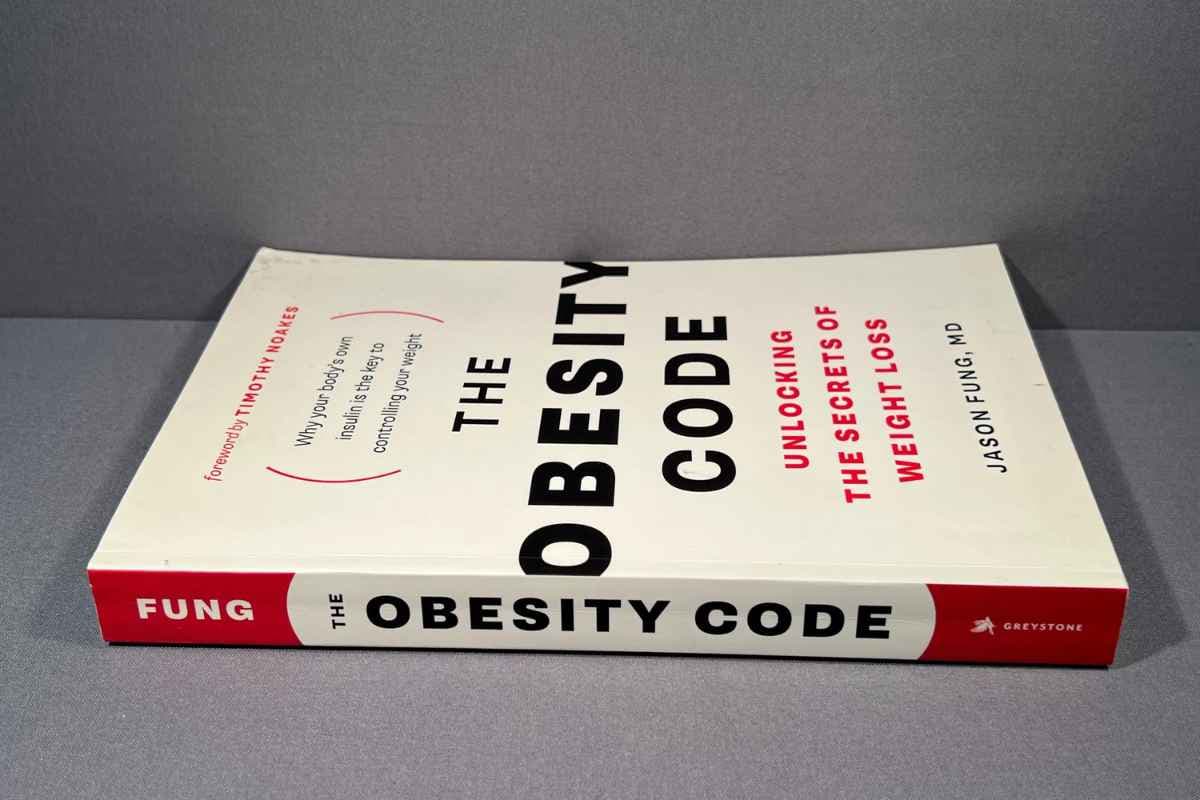
Like our review of The Obesity Code, this one is built from what we could check: the publisher's details, the Publishers Weekly review, and a decade of Dooner's own posts and podcast notes. Where we couldn't check the book's exact wording, we've left it out.
Where we stand: Healthcount is a food journal, and Dooner's approach asks you to stop counting what you eat (Dooner, 2022). I've had CBT for an eating disorder, and it's been life changing. CBT uses food records. So we have a stake in one of the arguments below, and we'll show you where it sits.
What is The F*ck It Diet?
The F*ck It Diet: Eating Should Be Easy is an anti-diet book by Caroline Dooner, published in the US by Harper Wave, part of HarperCollins, on 26 March 2019 (Open Library), and in the UK by HQ (The Bookseller, 2018). Her own summary: "Dieting Backfires. Our bodies are actually hardwired against dieting" (Dooner, book page).
Restricting food, she argues, whether by a strict diet or by quieter rules about what you "should" eat, makes the body react as if there's a famine. Food takes over your thoughts, bingeing follows, and the body fights back "by regaining all the weight lost, and then some", as Publishers Weekly put her claim (Publishers Weekly, 2019). She calls the quieter kind mental restriction: "guilt over eating. The mind chatter version of restriction" (Dooner, 2016).
The fix is to stop restricting, on your plate and in your head: eat when you're hungry, have carbs and sugar when you want them, and settle into "a naturally-occurring weight range" (Publishers Weekly, 2019). On her blog she's blunter: "You have to let yourself eat a lot." And: "You have to commit to gaining weight. I don't know how much weight your body wants to gain. I can't give you a number" (Dooner, 2016).
Five self-care tools go alongside. Publishers Weekly names three: a daily lie-down of 10 to 20 minutes, "Breathe and Feel" and "The Belief Release" (Publishers Weekly, 2019). We couldn't verify the other two. She calls the whole thing "a temporary healing phase that lasts 1-2 years (it may happen faster than that)" (Dooner, 2016). Publishers Weekly called the book "a lively case against dieting", and Goodreads readers rate it 4.01 out of 5 from 9,441 ratings, as of 16 October 2026 (Goodreads).
Who is Caroline Dooner?
A writer, not a clinician, and she says so: "remember I am NOT a doctor and I am not a scientist" (Dooner, 2015). She describes herself as a former "chronic dieter" who spent ten years dieting and bingeing (The Financial Diet, 2019), and when she had what she calls her "F*ck It Diet epiphany", she was 24 and "a professional (struggling) musical theater actress" (Dooner, 2022). She wrote and ran workshops about the approach for a decade from 2012 (Dooner, About page), hosted a podcast that ran to 61 episodes between 2016 and 2022 (Apple Podcasts), and published a second book, Tired as F*ck, in 2022.
She has since stepped back from writing about food, saying she "just got burnt out on it", but in April 2024 she said she still stands by the book: "Short answer: I do! Well, 97-99%!" She added that she wished people understood that "food quality does matter for overall health, though it doesn't need to be a focus in the beginning" (Dooner, 2024). Keep that in mind if you have a health condition.
What does The F*ck It Diet get right?
Its central idea, that restriction feeds bingeing, has decades of research behind it. A review of starvation and self-imposed dieting found they "appear to result in eating binges once food is available" (Polivy, 1996). After the Second World War, binge eating was rare among 67 combat veterans but more common among 198 former prisoners of war who had lost a lot of weight in captivity (Polivy et al., 1994). And among 496 teenage girls followed for five years, going a whole day without eating to control weight predicted who started binge eating (Stice et al., 2008).
She's right that the rules matter as well as the amount. Rigid, all-or-nothing control of eating goes with more frequent and more severe binges, and flexible control with fewer (Westenhoefer et al., 1999). That's close to her mental restriction, and to the all-or-nothing guilt cycle we've written about.
And she's right that the body fights back when weight comes off. People who lose weight burn less energy than their new size predicts (Leibel et al., 1995), their hunger hormones are still tilted towards eating more a year later (Sumithran et al., 2011), and appetite rises in step with the weight lost (Polidori et al., 2016). Being hungrier after weight loss is the expected result, not a failure of willpower. Our guide to set point theory has the detail.
Where does the evidence push back?
Mostly where a fair point turns into an absolute.
Restriction isn't the only cause of binge eating
"That is the only reason we binge. Restriction," Dooner wrote in 2016 (Dooner, 2016). The research disagrees. In one clinic, more than half of 87 people with binge eating disorder said their bingeing started before they'd ever dieted (Spurrell et al., 1997); in another, about a third of 98 said the same (Grilo and Masheb, 2000). Low mood also tends to rise before a binge (Haedt-Matt and Keel, 2011). She has since softened: asked in 2020 whether trauma, emotions or anxiety can cause binge eating disorder without restriction, she answered "Yes!", though she said restriction and guilt nearly always come into it too (Dooner, 2020).
The 95 to 97% figure doesn't hold up
In a 2019 interview she said "95-97% of dieters gain all of their weight back, and often more weight than they lost" (The Financial Diet, 2019). Regain is the usual pattern after dieting (Hall and Kahan, 2018), and one critical review found a third to two-thirds of dieters regain more than they lost (Mann et al., 2007). But 95 to 97% isn't what the long-term studies show. About 1 in 5 people who lose at least a tenth of their weight keep it off for a year or more (Wing and Phelan, 2005), and in the Look AHEAD trial's intensive programme, about half were still at least 5% below their starting weight eight years on (Look AHEAD Research Group, 2014).
Eating less doesn't automatically cause bingeing
The Minnesota Starvation Experiment she leans on (Publishers Weekly, 2019) put 36 young men on a severe semi-starvation diet (Kalm and Semba, 2005). It shows what extreme restriction does, not what an ordinary diet does. For adults with obesity on supervised programmes, moderate dieting doesn't generally lead to binge eating: a national task force found worries that it causes eating disorders "are generally not supported by empirical studies" (National Task Force, 2000). In a trial of 123 women randomly assigned to two diets or a non-diet approach, a brief rise in bingeing in one diet group had gone by week 40, and "at no time did any participant meet criteria for binge-eating disorder" (Wadden et al., 2004). In people who already had binge eating disorder, supervised programmes reduced bingeing (da Luz et al., 2015). The risk seems to sit in fasting, long gaps and rigid rules more than in eating less as such.
A natural weight range is unproven
The body resists weight loss more strongly than weight gain (Müller et al., 2010), but a simple set point "does not effectively explain" why whole populations have got heavier (Speakman et al., 2011), and researchers on different sides agree that "further experiments to test between the models are sorely required" (Speakman and Hall, 2023). We found nothing showing that eating freely brings people to a particular weight and keeps them there.
The diabetes claims from her podcast
These lines are from her podcast notes, and we can't say whether the book repeats them. Introducing a 2020 episode with a dietitian, Dooner wrote: "Did you know that sugar does not cause diabetes? Not even type 2? Did you know that weight gain does not cause diabetes either?" (Dooner, 2020). For type 2, major studies disagree. In the US Diabetes Prevention Program, type 2 diabetes developed in about 5 in 100 people a year on a lifestyle programme with a weight-loss goal, against 11 in 100 on a placebo (Knowler et al., 2002). In the DiRECT trial, 68 of 149 people with type 2 diabetes were in remission after a year on a weight-management programme, against 6 of 149 with usual care (Lean et al., 2018). People who drink more sugar-sweetened drinks are also more likely to develop it, even allowing for body size (Imamura et al., 2015). Nobody is to blame for having diabetes, but if you have it, or prediabetes, talk any big change in how you eat through with your doctor or diabetes team first.
Does The F*ck It Diet work?
Nobody knows, because nobody has tested it. On 16 October 2026 we searched PubMed, the main database of medical research, and ClinicalTrials.gov, the main register of trials, and found no trials of it (PubMed); (ClinicalTrials.gov). The evidence is Dooner's own experience and messages from readers, some saying it helped with bulimia, which is partly why she stresses that her work is "ONLY a supplement" to treatment (Dooner, 2022).
Its nearest relatives have been studied. Intuitive eating goes with less disordered eating and better body image across 97 studies, though 89% were snapshots that can't show cause and effect (Linardon et al., 2021). In a trial of 78 women who were long-term dieters, a Health at Every Size group kept their weight stable and improved on every outcome measured, while a diet group regained what they'd lost; only half of each group came back at two years (Bacon et al., 2005). A review of ten studies found weight-neutral approaches did better than weight-loss ones for bulimia symptoms, and no differently on anything else (Dugmore et al., 2020). None of these programmes told people to eat a lot, and weight in them mostly held steady, so they don't test Dooner's eat-a-lot phase. There's more on Health at Every Size and GLP-1 medicines in a separate piece.
Is The F*ck It Diet the same as intuitive eating?
Not quite, though they're close. Dooner wrote that "true intuitive eating is fully aligned with The F*ck it Diet" (Dooner, 2017) and calls intuitive eating "life changing, evidence based" (Dooner, 2021), but her page for the book says it "does not use the same framework as Intuitive Eating" (Dooner, book page).
The biggest practical difference is hunger ratings. Dooner is against them at first: "So yes, I am negative about rating your hunger, especially in the early stages of this healing process" (Dooner, 2017). Her approach also expects a phase of eating a lot and asks you to accept weight gain up front. And intuitive eating has a research base, mostly observational, where the F*ck It Diet has none.
If you have a health condition, keep one line from a research definition of intuitive eating: "no restrictions on types of food eaten unless for medical reasons" (Van Dyke and Drinkwater, 2014). There's more on intuitive eating on a GLP-1 in a separate piece.
How does The F*ck It Diet compare with CBT for binge eating?
On the cause, they agree more than you might expect. Enhanced cognitive behaviour therapy (CBT-E), developed by Christopher Fairburn and colleagues at Oxford, sees binges as largely the result of trying to stick to "multiple extreme, and highly specific, dietary rules", and aims "to reduce, if not eliminate altogether, dieting". People are even helped to break their food rules on purpose, to learn that what they fear, usually weight gain or a binge, isn't inevitable (Murphy et al., 2010). That's Dooner's diagnosis in clinical language.
The fix is where they part. Dooner says drop the rules and stop counting: "you just eat" (Dooner, 2022). CBT swaps rigid rules for structure. "Establishing a pattern of regular eating is fundamental to successful treatment whatever the form of the eating disorder", which means three planned meals and two or three planned snacks a day, and in-the-moment food records have "an essential and central role throughout most of treatment" (Murphy et al., 2010). In a small study of guided CBT self-help, weeks when people stuck more closely to the eating pattern had fewer binges (Zendegui et al., 2014).
| Question | The F*ck It Diet | CBT for eating disorders |
|---|---|---|
| What keeps bingeing going | Restriction, on the plate and in your head, including guilt about eating | Strict dieting rules, driven by judging yourself by weight and shape; binges come largely from trying to keep those rules |
| Food rules | Drop them all | Find them, test them by breaking them, and loosen them |
| Structure | Eat what you want, when you want, and a lot at first | Three planned meals and two or three planned snacks a day |
| Writing down what you eat | No counting: "you just eat" | In-the-moment food records, central to treatment |
| Trial evidence | None for the approach itself | 79 trials reviewed: therapist-led CBT beat waiting lists and other talking therapies |
This is the argument we flagged at the top, so here's how we see it. A CBT food record isn't a diet. It's a way of seeing patterns: what you ate, when, and what you were thinking and feeling. Some people find that steadying. For others any tracking turns obsessive, and if that's you, don't track, whatever an app says, ours included. CBT also has trials behind it: a review of 79 found therapist-led CBT did better than waiting lists and other talking therapies for bulimia and binge eating disorder, though many of the trials were of poor quality (Linardon et al., 2017).
The obvious companion to Dooner's book is Christopher Fairburn's Overcoming Binge Eating, the self-help version of his CBT. Here's our review of Overcoming Binge Eating, and our guide to CBT for eating disorders covers the rest of the model.
Can you do The F*ck It Diet on Wegovy, Mounjaro or Zepbound?
Not as written. As far as we can find, Dooner hasn't written about GLP-1 medicines: on 16 October 2026 we searched both her Substack archives, more than a decade of posts, for Ozempic, Wegovy, Mounjaro, Zepbound, semaglutide, tirzepatide and GLP-1, and found nothing. (We didn't check her Instagram or podcast audio.) She has called the book "extremely critical of pharma" (Dooner, 2024), but that's about the book in general, and we won't guess what she'd make of these medicines.
Her model says food obsession comes from restriction. GLP-1 medicines complicate that. In two short trials funded by the manufacturer, people on semaglutide ate 24% less across a day of eating freely (Blundell et al., 2017) and 35% less at a help-yourself lunch (Friedrichsen et al., 2021), with less hunger and fewer or weaker cravings. Eating less while thinking about food less is the opposite of what her model predicts. It suggests that food noise, persistent thoughts about food that feel unwanted or distressing (Dhurandhar et al., 2025), comes partly from appetite biology. Restriction still plays a part: in a 2026 survey of 1,000 US adults, nearly 1 in 5 had food noise often or always, and more than 1 in 4 of those who were restricting what they ate (Hayashi and Masterson, 2026). But "little is known about what exactly food noise is, what causes it" (Wylie et al., 2026).
So the eat-a-lot phase doesn't fit. It's her answer to a body semi-starved by years of dieting (The Financial Diet, 2019), and a GLP-1 medicine works by turning appetite down. On these medicines the more common risk is the reverse: eating too little, leaving long gaps, and turning a low appetite into a new rule. Eating disorder researchers warn that the effect that quietens appetite "may also reinforce restriction, avoidance of regular eating" in vulnerable people (Škudar, 2026). That's where Dooner's warning about restriction earns its place. Obesity specialists have reached part of her conclusion too: with the new medicines, one wrote, "it now seems redundant to prescribe strict diets or meal replacements" (Dalle Grave, 2024). If you're finding it hard to eat enough, tell your prescriber.
What if you're coming off a GLP-1?
This is where Dooner's central idea fits best. Stopping takes away a medicine that was holding appetite down, at a time when your weight is lower and your body is defending it. The withdrawal trials measured weight rather than hunger, but the result is clear. A year after stopping semaglutide in the STEP 1 trial extension, people had regained about two-thirds of the weight they'd lost, and improvements in things like blood pressure and blood sugar drifted back (Wilding et al., 2022). In STEP 4, people switched to a placebo gained 6.9% of their body weight over 48 weeks, while those still on semaglutide lost a further 7.9% (Rubino et al., 2021). In SURMOUNT-4, people switched from tirzepatide to a placebo gained 14.0% over a year, while those who carried on lost a further 5.5% (Aronne et al., 2024).
None of that is a failure of willpower, and Dooner's message is good at taking the shame out of it. Here's what we'd take from her, and what we'd leave.
Worth taking
- Expect hunger and food thoughts to come back, and read them as biology rather than failure.
- Don't answer them with a crash diet or strict rules. Fasting and rigid, all-or-nothing rules are what come before bingeing (Stice et al., 2008); (Westenhoefer et al., 1999).
- Eat regularly. Planned meals and snacks are the version of "eat" with evidence behind it (Murphy et al., 2010), and our regular eating guide shows how to start.
- Take the moral labels off food. No food is good or bad.
- Look after your sleep. Two nights of short sleep left 12 young men hungrier in a small lab study (Spiegel et al., 2004).
- Notice what you're feeling before you eat. Low mood often comes before a binge (Haedt-Matt and Keel, 2011).
Worth leaving, or talking through first
- "Commit to gaining weight" and "eat a lot". If you take a GLP-1 for type 2 diabetes or another health condition, some of the benefit can fade as weight returns (Wilding et al., 2022), and diabetes remission was more likely the more weight people kept off (Lean et al., 2018). Talk to your prescriber first.
- The all-or-nothing swing from eating very little on the medicine to eating everything after it. That's the binge-restrict cycle with a new trigger.
- Going it alone with an eating disorder history. Researchers have called for "discontinuation planning" for this group (Škudar, 2026), and nobody has studied whether stopping brings binge eating back.
Whether and when to stop is for you and your prescriber to decide, and nothing here is advice to stop, start or change a medicine. And no study has tested the F*ck It Diet, intuitive eating or any other non-diet approach after stopping a GLP-1: we found none on PubMed on 16 October 2026. Our coming-off playbook covers the practical side.
Who is The F*ck It Diet for, and who should skip it?
It may suit you if:
- you've dieted on and off for years and feel stuck in a diet, binge and guilt loop, with no active eating disorder
- your eating is run by rules, forbidden foods and guilt
- you've tried intuitive eating and turned it into another diet
- you need permission to rest
It probably isn't for you, or not without support, if:
- you have an active eating disorder. Dooner agrees: "Anyone with an active eating disorder should be getting treatment, and any of my work is just a supplement" (Dooner, book page).
- you're underweight or have been eating very little. Eating much more after a long stretch of restriction can cause a dangerous condition called refeeding syndrome, so it needs a doctor (Mehanna et al., 2008).
- you have diabetes or prediabetes, or follow a diet for a medical reason such as coeliac disease or an allergy. Food choices matter there, and intuitive eating's research definition makes room for that (Van Dyke and Drinkwater, 2014).
- you're taking a GLP-1 now, for the reasons above.
- your doctor has advised weight loss for a medical reason. The approach sets weight loss aside on purpose.
- any weight gain frightens you. The approach asks you to accept it, which can be freeing with support and destabilising without. If your body has changed a lot on a GLP-1, our piece on body image after weight loss may help.
What's solid, what's likely and what's contested
| Claim | How strong is the evidence? | Main sources |
|---|---|---|
| Rigid restriction, fasting and long gaps come before bingeing | Good, and strongest for severe restriction | Polivy 1996; Stice 2008; Westenhoefer 1999 |
| The body defends lost weight, mostly through hunger | Strong | Leibel 1995; Sumithran 2011; Polidori 2016 |
| Restriction is the only cause of binge eating | Not supported. In two clinics, about a third and more than half of people with binge eating disorder binged before they ever dieted | Spurrell 1997; Grilo and Masheb 2000 |
| 95 to 97% of dieters regain all their weight | Not supported as stated. Regain is common, but some people keep weight off for years | Mann 2007; Wing and Phelan 2005; Look AHEAD 2014 |
| Supervised, moderate dieting causes bingeing in adults with obesity | Not supported | National Task Force 2000; Wadden 2004; da Luz 2015 |
| Weight settles in a natural range if you eat freely | Contested, and untested for eating freely | Speakman 2011; Müller 2010; Speakman and Hall 2023 |
| Sugar and weight gain don't cause type 2 diabetes (2020 podcast notes) | Not supported | Knowler 2002; Lean 2018; Imamura 2015 |
| Non-diet approaches help wellbeing | Likely. Mostly snapshot studies and small trials; weight tends to stay stable | Linardon 2021; Bacon 2005; Dugmore 2020 |
| GLP-1 medicines cut how much people eat and quieten cravings | Good, from short trials funded by the maker | Blundell 2017; Friedrichsen 2021 |
| Food noise is caused by restriction | Unknown. Linked with restriction in one survey; causes not established | Hayashi and Masterson 2026; Wylie 2026 |
| Most lost weight returns within a year of stopping a GLP-1 | Strong, from withdrawal trials | Wilding 2022; Rubino 2021; Aronne 2024 |
| The F*ck It Diet works | Untested. No trials found | PubMed and ClinicalTrials.gov, 16 October 2026 |
| A non-diet approach helps after stopping a GLP-1 | Untested | None found |
The honest verdict
Read it if you've spent years going round the diet, binge and guilt loop and nothing in the note at the top applies to you. Its best ideas hold up: rigid restriction and guilt keep the cycle going, and a body that has lost weight pushes to get it back. Hearing that from someone who has lived it can lift a lot of self-blame.
Leave the absolutes. Restriction isn't the only cause of bingeing, 95 to 97% isn't the regain figure, nobody has tested the method, and the podcast's diabetes claims don't hold for type 2. If you're on a GLP-1 or coming off one, take the permission and the end of food guilt, but swap "eat a lot" for regular, planned meals, the version with evidence behind it.
The short version: right about the problem, unproven on the fix.
The books
The F*ck It Diet: Eating Should Be Easy is published by Harper Wave in the US and HQ in the UK, and any bookshop or library can get it for you. For the CBT side of the argument, there's Christopher Fairburn's Overcoming Binge Eating.
When to get more help
Talk to a doctor, or call an eating disorder helpline, if any of these sound like you:
- binges that feel out of control, especially if they happen every week or more
- making up for eating by vomiting, taking laxatives, fasting or exercising hard
- food or weight thoughts crowding out the rest of your day
- feeling faint, dizzy or very weak
- eating very little on a GLP-1, or panicking about food after stopping one
- any thoughts of harming yourself
You don't need to be underweight, or sure, to ask. A helpline isn't an emergency service: if you're in danger right now, or thinking about harming yourself, call your local emergency number.
The questions people ask
What is the F*ck It Diet?
An anti-diet book by Caroline Dooner, published by Harper Wave in 2019. It argues that restriction and guilt about food drive bingeing, and asks you to stop restricting, eat what you want, accept that your weight may change, and rest. It isn't a weight-loss plan.
Does the F*ck It Diet work?
Nobody knows: we found no trials of it on PubMed or ClinicalTrials.gov in October 2026. Research supports parts of it, such as the link between rigid restriction, fasting and bingeing, and contradicts others, such as restriction being the only cause of binge eating.
Will I gain weight on the F*ck It Diet?
Possibly. Dooner says you have to commit to gaining weight and can't give you a number. In small trials of non-diet programmes weight mostly held steady, but none asked people to eat a lot, so they don't test her method.
Is the F*ck It Diet the same as intuitive eating?
Close, but not the same. Dooner says true intuitive eating is fully aligned with her approach, but her book uses its own framework, discourages rating your hunger early on and expects a phase of eating a lot. Intuitive eating has a research base; her approach has none.
Is Caroline Dooner a dietitian?
No. She's a writer and former musical theatre actor who describes herself as a former chronic dieter, and she says plainly that she isn't a doctor or a scientist. She wrote about the approach for a decade from 2012, then stepped back from writing about food.
Is the F*ck It Diet safe if I have an eating disorder?
Not on its own. Dooner herself says anyone with an active eating disorder should be getting treatment and that her work is only a supplement. If you're underweight or have been eating very little, eating a lot more needs medical support.
Can I do the F*ck It Diet on Wegovy, Mounjaro or Zepbound?
Not as written. Its eat-a-lot phase doesn't fit a medicine that works by turning appetite down, and as far as we can find, Dooner hasn't written about GLP-1 medicines. Its warnings about restriction still apply: on these medicines the more common risk is eating too little.
Does Caroline Dooner still stand by the book?
Mostly, yes. In April 2024 she said she still stands by it, 97 to 99%, and added that food quality does matter for overall health, though it doesn't need to be a focus at the start.
This is information, not medical advice. Decisions about starting, continuing or stopping a prescribed medicine belong with the prescriber who knows your history. If you're being treated for an eating disorder, your care team's plan comes first.
View sources (69)
- Publishers Weekly. Review of The F*ck It Diet: Eating Should Be Easy by Caroline Dooner (Harper Wave), 1 February 2019
- Open Library. The F*ck It Diet: Eating Should Be Easy, hardcover edition record, ISBN 9780062883612
- The Bookseller. HQ snaps up comedian's F*ck It guide on how to stop dieting, 28 November 2018
- Goodreads. The F*ck It Diet: reader ratings, checked 16 October 2026
- Apple Podcasts. The F*ck It Podcast by Caroline Dooner: episode list
- The Financial Diet. Interview with Caroline Dooner, 23 May 2019
- Caroline Dooner. The book: her page about The F*ck It Diet, with FAQ (updated 9 June 2026)
- Caroline Dooner. About page, The F*ck It Diet on Substack
- Caroline Dooner. Post on PCOS, The F*ck It Diet blog, 31 July 2015
- Caroline Dooner. Mental Restriction, The F*ck It Diet blog, 8 March 2016
- Caroline Dooner. On Binge Eating Disorder, The F*ck It Diet blog, 8 June 2016
- Caroline Dooner. The Reason your Intuitive Eating Won't Work, The F*ck It Diet blog, 15 June 2016
- Caroline Dooner. Post on the approach being temporary, The F*ck It Diet blog, 16 September 2016
- Caroline Dooner. Is The F*ck It Diet the same as Intuitive Eating?, The F*ck It Diet blog, 8 August 2017
- Caroline Dooner. Let's Talk About Diabetes, podcast episode notes, 30 March 2020
- Caroline Dooner. Let's Talk About Bingeing, podcast episode notes, 2 August 2020
- Caroline Dooner. All of the mistakes I made with Intuitive Eating, 11 January 2021
- Caroline Dooner. What Even Is My Job?, Problematic (Substack), 16 April 2022
- Caroline Dooner. What is a good relationship with food?, 20 June 2022
- Caroline Dooner. My Current Thoughts on The F*ck It Diet, Problematic (Substack), 15 April 2024
- PubMed search for the book's title, 16 October 2026: no records
- ClinicalTrials.gov search for Dooner and the book's title, 16 October 2026: no records
- Polivy. Psychological consequences of food restriction. Journal of the American Dietetic Association, 1996
- Polivy et al. Food restriction and binge eating: a study of former prisoners of war. Journal of Abnormal Psychology, 1994
- Stice et al. Fasting increases risk for onset of binge eating and bulimic pathology: a 5-year prospective study. Journal of Abnormal Psychology, 2008
- Westenhoefer, Stunkard and Pudel. Validation of the flexible and rigid control dimensions of dietary restraint. International Journal of Eating Disorders, 1999
- Leibel, Rosenbaum and Hirsch. Changes in energy expenditure resulting from altered body weight. New England Journal of Medicine, 1995
- Sumithran et al. Long-term persistence of hormonal adaptations to weight loss. New England Journal of Medicine, 2011
- Polidori et al. How strongly does appetite counter weight loss? Quantification of the feedback control of human energy intake. Obesity, 2016
- Spurrell et al. Age of onset for binge eating: are there different pathways to binge eating? International Journal of Eating Disorders, 1997
- Grilo and Masheb. Onset of dieting vs binge eating in outpatients with binge eating disorder. International Journal of Obesity, 2000
- Haedt-Matt and Keel. Revisiting the affect regulation model of binge eating: a meta-analysis of studies using ecological momentary assessment. Psychological Bulletin, 2011
- Hall and Kahan. Maintenance of lost weight and long-term management of obesity. Medical Clinics of North America, 2018
- Mann et al. Medicare's search for effective obesity treatments: diets are not the answer. American Psychologist, 2007
- Wing and Phelan. Long-term weight loss maintenance. American Journal of Clinical Nutrition, 2005
- Look AHEAD Research Group. Eight-year weight losses with an intensive lifestyle intervention: the Look AHEAD study. Obesity, 2014
- Kalm and Semba. They starved so that others be better fed: remembering Ancel Keys and the Minnesota experiment. Journal of Nutrition, 2005
- National Task Force on the Prevention and Treatment of Obesity. Dieting and the development of eating disorders in overweight and obese adults. Archives of Internal Medicine, 2000
- Wadden et al. Dieting and the development of eating disorders in obese women: results of a randomized controlled trial. American Journal of Clinical Nutrition, 2004
- da Luz et al. Does severe dietary energy restriction increase binge eating in overweight or obese individuals? A systematic review. Obesity Reviews, 2015
- Müller, Bosy-Westphal and Heymsfield. Is there evidence for a set point that regulates human body weight? F1000 Medicine Reports, 2010
- Speakman et al. Set points, settling points and some alternative models. Disease Models and Mechanisms, 2011
- Speakman and Hall. Models of body weight and fatness regulation. Philosophical Transactions of the Royal Society B, 2023
- Knowler et al. Reduction in the incidence of type 2 diabetes with lifestyle intervention or metformin (Diabetes Prevention Program). New England Journal of Medicine, 2002
- Lean et al. Primary care-led weight management for remission of type 2 diabetes (DiRECT): an open-label, cluster-randomised trial. Lancet, 2018
- Imamura et al. Consumption of sugar sweetened beverages, artificially sweetened beverages, and fruit juice and incidence of type 2 diabetes. BMJ, 2015
- Linardon, Tylka and Fuller-Tyszkiewicz. Intuitive eating and its psychological correlates: a meta-analysis. International Journal of Eating Disorders, 2021
- Bacon et al. Size acceptance and intuitive eating improve health for obese, female chronic dieters. Journal of the American Dietetic Association, 2005
- Dugmore et al. Effects of weight-neutral approaches compared with traditional weight-loss approaches: a systematic review and meta-analysis. Nutrition Reviews, 2020
- Van Dyke and Drinkwater. Relationships between intuitive eating and health indicators: literature review. Public Health Nutrition, 2014
- Murphy et al. Cognitive behavioral therapy for eating disorders. Psychiatric Clinics of North America, 2010
- Zendegui, West and Zandberg. Binge eating frequency and regular eating adherence: the role of eating pattern in cognitive behavioral guided self-help. Eating Behaviors, 2014
- Linardon et al. The efficacy of cognitive-behavioral therapy for eating disorders: a systematic review and meta-analysis. Journal of Consulting and Clinical Psychology, 2017
- Blundell et al. Effects of once-weekly semaglutide on appetite, energy intake, control of eating, food preference and body weight in subjects with obesity. Diabetes, Obesity and Metabolism, 2017
- Friedrichsen et al. The effect of semaglutide 2.4 mg once weekly on energy intake, appetite, control of eating, and gastric emptying in adults with obesity. Diabetes, Obesity and Metabolism, 2021
- Dhurandhar et al. Food noise: definition, measurement, and future research directions. Nutrition and Diabetes, 2025
- Hayashi and Masterson. Prevalence and correlates of perceived food noise among US adults in a nationally representative sample. Obesity Science and Practice, 2026
- Wylie et al. Food noise: a theoretical review. Appetite, 2026
- Škudar. Eating disorders in the GLP-1 era: a spotlight on emerging clinical risks, research gaps, and practice priorities. International Journal of Eating Disorders, 2026
- Dalle Grave. The benefit of healthy lifestyle in the era of new medications to treat obesity. Diabetes, Metabolic Syndrome and Obesity, 2024
- Wilding et al. Weight regain and cardiometabolic effects after withdrawal of semaglutide: the STEP 1 trial extension. Diabetes, Obesity and Metabolism, 2022
- Rubino et al. Effect of continued weekly subcutaneous semaglutide vs placebo on weight loss maintenance (STEP 4). JAMA, 2021
- Aronne et al. Continued treatment with tirzepatide for maintenance of weight reduction in adults with obesity: the SURMOUNT-4 randomized clinical trial. JAMA, 2024
- Spiegel et al. Sleep curtailment in healthy young men is associated with decreased leptin levels, elevated ghrelin levels, and increased hunger and appetite. Annals of Internal Medicine, 2004
- Mehanna, Moledina and Travis. Refeeding syndrome: what it is, and how to prevent and treat it. BMJ, 2008
- Eating disorder helpline, United Kingdom: Beat
- Eating disorder helpline, United States: ANAD
- Eating disorder helpline, Ireland: Bodywhys
- Eating disorder helpline, Australia: the Butterfly Foundation