Eating less can backfire when it means very little food all day: that often ends in a hungry, low-nutrient evening, and staying in a calorie deficit for a long time makes the body burn less energy than expected. Calorie counts are also rough, because a US label can understate calories by up to 20%. Nutritionist Dr Federica Amati's advice is to eat enough nutrient-rich food, starting with a good breakfast, and to look after all six pillars of health.
A note before you read
This article talks about eating less and about calories. It has no calorie targets, no weight targets and no foods to avoid. If you're in recovery from an eating disorder, or you notice food rules getting louder as you read, it's fine to stop and come back another time. There's a helpline for your country near the end. This is information, not treatment.
No breakfast, because you're trying to be good. A small lunch. Chicken and vegetables for dinner. Then it's late, you're starving, and the night ends with a Magnum and a glass of wine.
Nutritionist Dr Federica Amati sees that day all the time. On Angela Foster's High Performance Health podcast, she described people who tell her they're putting on weight while hardly eating anything, and that's very often how their days go. Her advice surprises them: eat more. She says the look she gets is as if she's lost her mind.
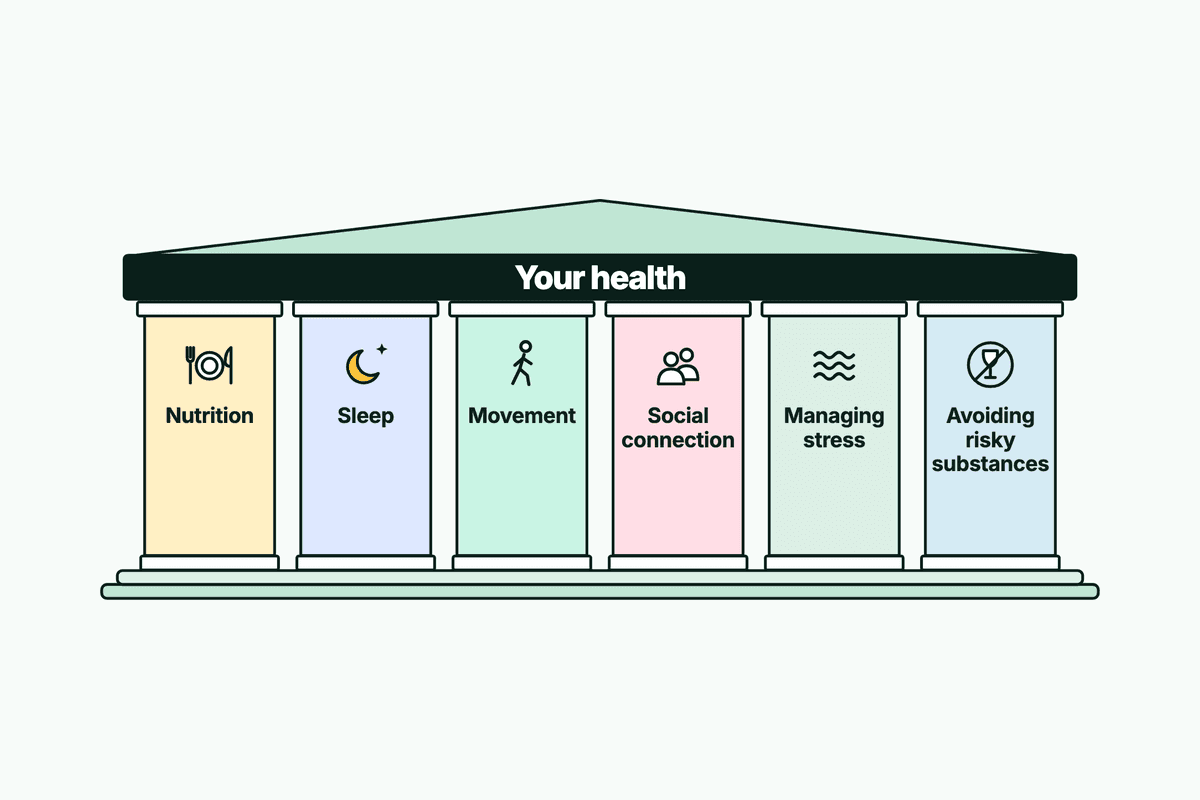
Her bigger point is that food is only one of six things that hold up your health, and that they lean on each other. Here's that idea in 49 seconds.
Short film · 49 seconds · no sound
The big picture: six pillars that hold up your health
- Nutrition
- Sleep
- Movement
- Social connection
- Managing stress
- Avoiding risky substances
What the film says
What holds up your health? Six pillars: nutrition, sleep, movement, social connection, managing stress and avoiding risky substances. They lean on each other: a glass of wine to unwind, a rough night, too tired to see friends. Saunas, supplements and gadgets are sprinkles; the pillars are the cake. Simple, not easy. Be kind to yourself.
Amati is a medical scientist and registered nutritionist, Head Nutritionist at ZOE, and she teaches at Imperial College London. Her new book is The Appetite Reset. This post is built on her ideas about calories, fullness and how we fuel ourselves, checked against the research. It covers why under-eating backfires, why calorie numbers are rougher than they look, and the six pillars in more detail.
Why under-eating all day backfires
From the inside, that evening feels like a willpower failure. You were good all day, then you blew it.
Amati sees it the other way round. The trouble starts in the morning. Eat very little and you don't give your body what it needs to feel full or, in her words, what it needs "to know that there isn't a famine coming". By the evening you're running on empty, and the quickest, most comforting food wins.
Illustration, not measured data
The same day, run two ways
What an under-fuelled day often looks like, next to one that starts with a proper breakfast
Running on empty
- BreakfastSkipped
- LunchSomething small
- DinnerChicken and vegetables
- Late eveningStarving. A Magnum and a glass of wine
Fuelled from the start
- BreakfastProtein, fibre, plants and some healthy fat
- LunchA proper lunch
- DinnerDinner
- Late eveningSatisfied, and ready for bed
Two things are worth saying clearly. The Magnum isn't the villain here. One ice cream undoes nothing, and we've written about the guilt that can follow two Magnums. The trouble is the shape of the day, and the answer is more food, earlier, rather than more willpower at ten o'clock at night. It's the same reason CBT for binge eating starts with regular meals.
And if you're sure you really are eating less, Amati doesn't buy the idea that someone eats exactly the same for years and then, in a few months, everything changes. When she digs deeper, she says, it's rarely a like-for-like picture. That isn't an accusation. Part of it is that the numbers we use to judge "less" are rougher than they look, which we'll come to.
How your body knows it's full
Your gut lining is dotted with sensor cells. The best known are L cells, which release GLP-1 and PYY, two hormones that tell your brain you've had enough (Holst, 2007; Gribble and Reimann, 2016). Yes, that GLP-1: the hormone the weight-loss injections are designed to mimic.
These cells respond to what's in your food: protein, fat, carbohydrate and fibre. Fibre takes the long way round. Bacteria in your large intestine ferment it into short-chain fatty acids, and the sensor cells pick those up. When researchers at Imperial College London delivered one of those fatty acids, propionate, straight to people's colons, they released more PYY and GLP-1 and ate less afterwards (Chambers et al., 2015). Protein raises PYY too (Batterham et al., 2006).
Diagram of how it works, not data
How your body knows it's full
Step 1: What you eat
Protein, fat, carbohydrate and fibre
Step 2: Sensor cells in your gut
L cells in the gut lining sense nutrients, and the fatty acids your gut bacteria make from fibre
Step 3: Fullness hormones
The cells release GLP-1 and PYY
Step 4: Your brain
Gets the message: that's enough for now
So two days with the same calorie total can feel completely different. A day built on protein, plants and whole grains keeps sending "enough" signals. A day with very little food in it sends far fewer. Some foods also give you a lot of eating for very little energy. As Amati says, you'd need a huge amount of spinach to reach 200 calories, which is the whole idea behind big salads.
One of the clearest tests of food quality is a 2019 trial at the US National Institutes of Health. Twenty adults lived on a research ward for four weeks: two on ultra-processed food and two on unprocessed food, with the meals on offer matched for calories, sugar, fat, fibre and salt. They could eat as much or as little as they liked. On the ultra-processed diet they ate about 500 calories a day more and gained weight. On the unprocessed diet they lost weight (Hall et al., 2019). There's more on that trial in our ultra-processed food post.
How accurate are calorie labels?
Only roughly. Amati puts the error at about 20%, and that matches the rules. In the US, a label only counts as misbranded when the real calories are more than 20% above what it says (21 CFR 101.9). Guidance from the European Commission, written in 2012 while the UK was still in the EU, lets fat, carbohydrate and protein be 20% out in either direction on most foods (European Commission, 2012).
Real food bears this out. When Tufts University researchers tested reduced-calorie meals, restaurant dishes had 18% more calories than stated on average, and supermarket frozen meals 8% more (Urban et al., 2010).
Published rules and measurements
How far off calorie labels can be
| Figure | What it means |
|---|---|
| 20% | How far above its label a US food's real calories can be before the label breaks the rules |
| 18% | More calories than stated, on average, in 29 reduced-calorie restaurant dishes |
| 8% | More calories than stated, on average, in 10 reduced-calorie supermarket frozen meals |
You don't absorb everything on the label
How much energy you actually take in depends on the form the food is in. Almonds are the best-studied example. Chew a whole almond and most of its cells stay intact, with the fat sealed inside (Grundy et al., 2015). Grind it into a butter and the fat is free.
When USDA scientists fed people almonds in different forms and measured what their bodies absorbed, whole raw almonds gave about a third less energy than almond butter, gram for gram (Gebauer et al., 2016). An earlier USDA study found the standard calculation overstated the energy people got from almonds by 32% (Novotny et al., 2012).
Published data
Same almonds, different energy
What the body absorbed from 42g of almonds a day in four forms, measured in a USDA feeding trial
| Form | Calories absorbed per gram |
|---|---|
| Whole raw almonds | 4.42 |
| Whole roasted almonds | 4.86 |
| Chopped almonds | 5.04 |
| Almond butter | 6.53 |
What's on the rest of the plate matters as well. When USDA researchers added fibre to people's diets, they absorbed less of the fat and protein, so the same meals delivered less usable energy (Baer et al., 1997).
None of this makes calories meaningless. If you're a boxer making weight for a fight, a calorie deficit will get you there, and Amati says so. But for long-term health, she calls calories an imprecise tool. They tell you roughly how much energy a food holds, and nothing about how nourishing it is. If counting has never felt accurate to you, you can keep the Healthcount diary without any numbers at all.
Can you be thin and still unhealthy?
"You can stay slim if you eat 800 calories of crisps. Sure. But you're not healthy."
(Crisps are chips, if you're in the US.) Her point is that weight tells you very little on its own. Some people carry far more fat around their organs and in their liver than their size suggests. MRI scans of 477 adults at Imperial College London found exactly that, and the researchers named the pattern TOFI: thin on the outside, fat on the inside (Thomas et al., 2012).
Muscle is the other half of the story. When muscle is very low compared with fat, the risk of metabolic disease rises, a condition now formally defined as sarcopenic obesity (Donini et al., 2022). Muscle matters because it's where much of your blood sugar goes. In lab tests where insulin is held high, about 80% of the glucose cleared from the blood ends up in muscle (DeFronzo and Tripathy, 2009). In a US survey of more than 13,000 adults, people with more muscle for their size had better insulin sensitivity and less prediabetes and diabetes (Srikanthan and Karlamangla, 2011).
If you're on a GLP-1 medicine, this is why we keep coming back to protecting your muscle.
Why weight loss stalls when you eat too little
A calorie deficit works in the short term, and Amati is clear about that. Stay in one for a long time, though, and your body adapts. "Your body is extremely clever," she says. It lowers the energy it uses, makes you more tired so you move less, and weight loss slows to a stop.
This is one of the most consistent findings in obesity research. In a classic study at Rockefeller University in New York, people holding their weight 10% or more below where they started burned less energy each day than expected for their new size (Leibel et al., 1995). Most weight-loss attempts follow the same curve: early loss, then a plateau, then regain (Hall and Kahan, 2018).
She points out that the same plateau happens on GLP-1 medicines, and that early weight loss is partly water and partly lean mass, not only fat. We've written about why GLP-1 weight loss levels off and why your body defends its weight.
Eat more of the right foods
"We've been conditioned to believe that eating as little as possible is the best way forward. And actually, that's just not the case."
Her alternative is to eat as much of the right foods as you can. And "the right foods" is about adding, not cutting: more plants, some fermented foods, nuts and seeds, and whichever food groups are missing from your week.
Make breakfast the big one
Her simplest starting point is breakfast. Morning is when willpower feels strongest, which is exactly when people skip food. Amati suggests the opposite: make breakfast your most nutritious meal, with good protein, plenty of fibre, plant foods and some healthy fat, so you don't reach the evening starving.
The evidence here is worth being honest about. Eating breakfast doesn't make you lose weight by itself. A 2019 BMJ review of 13 trials found that people told to eat breakfast ate more over the day than people who skipped it (Sievert et al., 2019). But her point is about hunger later on, and there the evidence is more encouraging, if small. In a US trial of 20 young women who usually skipped breakfast, a protein-rich breakfast made them fuller through the day, raised PYY, lowered the hunger hormone ghrelin and cut evening snacking on high-fat foods. Their total calories didn't change (Leidy et al., 2013).
So think of breakfast as a way to make the evening easier, not a weight-loss trick. There's more on the protein side in eat the protein first.
The six pillars of health
Food is only one part of this, and this was the part of the conversation I found most useful. Lifestyle medicine, the branch of medicine that treats daily habits as part of care, groups health into the six pillars from the film at the top. Lifestyle medicine bodies in the UK and the US both use them, worded slightly differently.
The six pillars, as lifestyle medicine defines them
The six pillars of health
- NutritionMostly whole, plant-rich food, and enough of it.
- SleepEnough sleep, and good quality sleep.
- MovementSpread through the day: things that get your heart going, strength and balance.
- Social connectionTime with people who matter to you. The one most often overlooked.
- Managing stressYou can't avoid stress, but you can build ways to handle it.
- Avoiding risky substancesNot smoking, not drinking too much, and no recreational drugs.
Amati makes two points about them. First, they lean on each other. Her example: without good ways to handle stress, you might reach for a glass of wine to unwind. That hits your sleep. You feel rough the next day, so you skip seeing friends. One weak pillar puts weight on the others. That's the chain in the film.
Second, the basics come before the extras. Things like regular saunas are, in her words, the sprinkles on the cupcake. If you're working on those while only two of the six pillars are in place, it doesn't make sense.
Social connection is the pillar she thinks gets overlooked. She repeated something she'd seen online: you never see longevity influencers posting about hanging out with their friends or volunteering at their local community centre. Yet relationships are one of the strongest predictors of health we have. A review of 148 studies covering more than 300,000 people found that those with stronger social relationships had a 50% greater likelihood of survival over the studies' follow-up (Holt-Lunstad et al., 2010).
Together, the habits add up. In EPIC-Norfolk, a UK study of 20,244 adults followed for about 11 years, people with four healthy habits (not smoking, being physically active, drinking moderately and eating plenty of fruit and vegetables) had the same risk of dying as people 14 years younger who had none of them (Khaw et al., 2008). This study and the review of social relationships are both observational, so they show strong links rather than proof that the habits caused the difference.
Simple, but not easy
"They're simple, but they're not easy to achieve."
The pillars are free, in theory. In practice, Amati says, we live in an obesogenic environment: one that nudges us towards eating more and moving less. You can't walk down a street in London, she says, without passing shop after shop selling frappuccinos, muffins and fast food. In England, 64% of adults are living with overweight or obesity (Health Survey for England, 2022). In the US, 40% of adults are living with obesity (CDC, 2024). Figures that size say more about the world we live in than about anyone's willpower. There's more on this in how your environment affects your weight.
So her last point is about kindness. If building these habits takes real effort, that's because it does. Give yourself credit for trying, and give other people the same. And treat time as the one thing you can't buy more of: if a proper lunch break means blocking it out in your calendar, block it out.
What to take from this
If your evenings keep ending in a rescue snack, look at the morning rather than the night. Eat enough, earlier, and build meals around protein, plants and fibre. And look after the other pillars too, because sleep, stress and the people around you all shape what ends up on your plate.
A food diary is good at showing you the shape of a day, because it puts everything in order (here's why food diaries work). A notebook works. So does Healthcount, which lays the day out for you meal by meal.
If eating less has become a rule
If you recognised yourself in the restricting part of this, and cutting back has started to feel like a rule you can't break, you don't have to sort it out on your own. Talk to a doctor, or call the eating disorder helpline for your country. The one below follows the region set at the top of the page, and all four are in the sources.
We've also written about how CBT approaches food rules.
Questions people ask
Can eating too little cause weight gain?
Not directly, because your body can't store energy you haven't eaten. But under-eating can lead there. A day of very little food often ends in strong hunger at night, when quick, energy-dense food is most tempting, and staying in a calorie deficit for a long time makes the body burn less energy than expected for its size. Calorie labels can also be 20% out, so eating less may not be as much less as it looks.
Why am I not losing weight when I'm eating less?
There are a few common reasons. After a long deficit the body lowers the energy it uses, and weight loss plateaus; most weight-loss attempts follow that curve. Calorie counts can be off: in the US a label can understate calories by up to 20%, and when Tufts researchers tested reduced-calorie restaurant dishes, they averaged 18% more calories than stated. And a day of very little food often ends with extra eating in the evening.
Hall and Kahan, 2018; Leibel et al., 1995; Urban et al., 2010
Are calorie labels accurate?
Only roughly. US rules treat a label as misbranded when the real calories are more than 20% above the figure on it, and European Commission guidance lets fat, carbohydrate and protein be 20% out either way on most foods. When Tufts University researchers measured reduced-calorie meals, restaurant dishes averaged 18% more calories than stated and supermarket frozen meals 8% more. How much energy you absorb also depends on the food: in a USDA trial, whole almonds gave people about a third less energy than almond butter.
21 CFR 101.9; European Commission, 2012; Urban et al., 2010; Gebauer et al., 2016
What are the six pillars of lifestyle medicine?
Nutrition, physical activity, sleep, stress management, social connection and avoiding risky substances such as tobacco and too much alcohol. The British Society of Lifestyle Medicine and the American College of Lifestyle Medicine both use six pillars, worded slightly differently. In a UK study of 20,244 adults, people with four healthy habits had the same risk of dying as people 14 years younger who had none of them.
British Society of Lifestyle Medicine; Lippman et al., 2024; Khaw et al., 2008
Can you be thin on the outside and fat on the inside?
Yes. MRI scans have found people of ordinary size carrying more fat around their organs and in their liver than their size suggests, a pattern researchers call TOFI: thin on the outside, fat on the inside. Low muscle matters too, because muscle takes up most of the glucose cleared from the blood when insulin is high, and people with more muscle for their size have better insulin sensitivity.
Thomas et al., 2012; DeFronzo and Tripathy, 2009; Srikanthan and Karlamangla, 2011
Is it bad to skip breakfast?
For weight alone, the trials don't show that breakfast helps: a 2019 BMJ review of 13 trials found people who ate breakfast ate more over the day than people who skipped it. But a protein-rich breakfast may make the evening easier. In a small trial of young women who usually skipped breakfast, a high-protein breakfast increased fullness and cut evening snacking on high-fat foods, without changing their total calories.
This is general information, not medical advice. If you have a medical condition, are on a GLP-1 or are being treated for an eating disorder, your own clinicians' advice comes first.
View sources (31)
- High Performance Health with Angela Foster. Dr Federica Amati: Why Eating Less Makes Perimenopause Weight Gain Worse. YouTube, 31 August 2026
- Holst. The physiology of glucagon-like peptide 1. Physiological Reviews, 2007
- Gribble and Reimann. Enteroendocrine cells: chemosensors in the intestinal epithelium. Annual Review of Physiology, 2016
- Chambers et al. Effects of targeted delivery of propionate to the human colon on appetite regulation, body weight maintenance and adiposity in overweight adults. Gut, 2015
- Batterham et al. Critical role for peptide YY in protein-mediated satiation and body-weight regulation. Cell Metabolism, 2006
- Hall et al. Ultra-processed diets cause excess calorie intake and weight gain: an inpatient randomized controlled trial of ad libitum food intake. Cell Metabolism, 2019
- US Code of Federal Regulations, 21 CFR 101.9: Nutrition labeling of food (paragraph g)
- European Commission. Guidance document for competent authorities on the setting of tolerances for nutrient values declared on a label. December 2012
- Urban et al. The accuracy of stated energy contents of reduced-energy, commercially prepared foods. Journal of the American Dietetic Association, 2010
- Novotny, Gebauer and Baer. Discrepancy between the Atwater factor predicted and empirically measured energy values of almonds in human diets. American Journal of Clinical Nutrition, 2012
- Gebauer et al. Food processing and structure impact the metabolizable energy of almonds. Food and Function, 2016
- Grundy et al. Effect of mastication on lipid bioaccessibility of almonds in a randomized human study. American Journal of Clinical Nutrition, 2015
- Baer et al. Dietary fiber decreases the metabolizable energy content and nutrient digestibility of mixed diets fed to humans. Journal of Nutrition, 1997
- Thomas et al. The missing risk: MRI and MRS phenotyping of abdominal adiposity and ectopic fat. Obesity, 2012
- Donini et al. Definition and diagnostic criteria for sarcopenic obesity: ESPEN and EASO consensus statement. Obesity Facts, 2022
- DeFronzo and Tripathy. Skeletal muscle insulin resistance is the primary defect in type 2 diabetes. Diabetes Care, 2009
- Srikanthan and Karlamangla. Relative muscle mass is inversely associated with insulin resistance and prediabetes. Journal of Clinical Endocrinology and Metabolism, 2011
- Leibel, Rosenbaum and Hirsch. Changes in energy expenditure resulting from altered body weight. New England Journal of Medicine, 1995
- Hall and Kahan. Maintenance of lost weight and long-term management of obesity. Medical Clinics of North America, 2018
- Sievert et al. Effect of breakfast on weight and energy intake: systematic review and meta-analysis of randomised controlled trials. BMJ, 2019
- Leidy et al. Beneficial effects of a higher-protein breakfast on the appetitive, hormonal, and neural signals controlling energy intake regulation in overweight/obese, breakfast-skipping, late-adolescent girls. American Journal of Clinical Nutrition, 2013
- British Society of Lifestyle Medicine (UK): What is lifestyle medicine?
- Lippman et al. Foundations of lifestyle medicine and its evolution (the American College of Lifestyle Medicine's six pillars). Mayo Clinic Proceedings: Innovations, Quality and Outcomes, 2024
- Khaw et al. Combined impact of health behaviours and mortality in men and women: the EPIC-Norfolk prospective population study. PLoS Medicine, 2008
- Holt-Lunstad, Smith and Layton. Social relationships and mortality risk: a meta-analytic review. PLoS Medicine, 2010
- NHS England (UK): Health Survey for England 2022, part 2: adult overweight and obesity
- CDC (US): Obesity and severe obesity prevalence in adults, August 2021 to August 2023. NCHS Data Brief 508, 2024
- Beat: eating disorder helpline
- ANAD: eating disorder helpline
- Bodywhys: eating disorder helpline
- The Butterfly Foundation: eating disorder helpline