How big salads earned their place
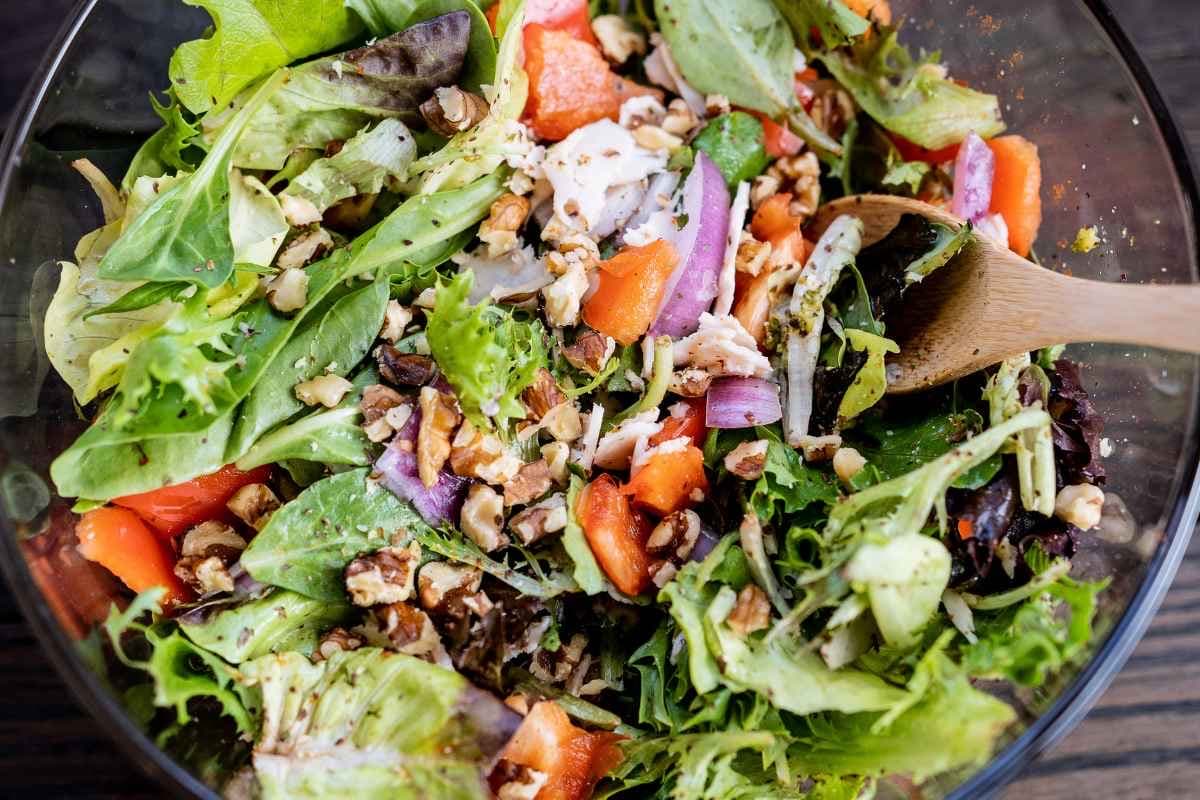
I've been really into big salads lately. Not the sad limp side salad that turns up next to something you actually wanted, but a proper enormous bowl that takes up the whole plate and takes a while to get through. They've turned out to be brilliant for both losing weight and holding it steady, which is rare. Most things that help you lose weight feel like a punishment, and most things that feel generous quietly undo your week. A big salad, built well, does neither.
The word "built" is doing a lot of work there. A bowl of leaves with nothing on it is boring and you'll be hungry in an hour. What I'm talking about is large, filling and genuinely tasty, put together so the calories stay low while the volume stays high. Once you get that ratio right, the maths does the rest, and I want to walk you through why it works before I tell you how I actually make mine.
Why volume wins: energy density
The idea underneath all of this is energy density, which is just how many calories sit in each gram of a food. Leaves and most vegetables are mostly water and fibre, so they weigh a lot and count for very little. That means you can fill a big bowl, and your stomach, for a small number of calories. The research on this is consistent: lowering the energy density of a meal, mostly by adding watery vegetables, lets people eat a satisfying volume of food while taking in fewer calories overall (Rolls, 2009).
There's a lovely study that tested exactly the big-salad idea. Women ate a first-course salad before a pasta main, and when that starter was a large, low-energy-density salad, they ended up eating about 12% fewer calories across the whole meal, not more (Rolls, Roe & Meengs, 2004). The salad didn't add to the meal. It quietly displaced part of it. That's the whole trick in one sentence: a big pile of low-calorie food takes up the room that higher-calorie food would have.
The same study had a warning in it, though, and it's worth saying plainly. Drench that salad in oily dressing and cheese and you flip it into a high-energy-density salad, and then it stops helping. A salad is only a volume tool for as long as you keep the dressing under control. More on that when I get to how I build mine.
Protein and fibre do the holding
Volume gets you full at the table. Protein and fibre are what keep you full afterwards, which is the part that actually decides whether you snack at four o'clock. Protein is the most filling macronutrient we have, gram for gram, and higher-protein meals reliably increase fullness and even burn a few more calories in digestion (Halton & Hu, 2004). So the chicken or salmon on top of a salad isn't decoration. It's doing the heavy lifting on staying satisfied.
Fibre works alongside it. It slows how fast your stomach empties and adds bulk, and across the controlled trials, higher-fibre meals tend to lower appetite and the calories people eat later (Wanders et al., 2011). That's the case for throwing in chickpeas, lentils or some roasted sweet potato: you get fibre, a bit more protein, and enough substance that the salad reads as a meal rather than a starter.
If you want the single clearest demonstration of how much the food itself matters here, the old satiety index work is worth a look, where foods were ranked by how full they left people for the same calories (Holt et al., 1995). Boiled potatoes came out near the top, which is exactly why I'm happy to bulk a salad with roasted sweet potato, and I've written more about that surprise in the potato satiety piece.
How I build one that fills me up
Here's roughly how mine come together, in the order I add things.
The base. My favourites are spinach, celery and lettuce. They're very low in calories, high in water, and they give me the volume that makes the whole thing work. One thing I only worked out recently: celery is far tastier and less stringy when you slice it really thin. Thick celery is a chore. Thin celery almost disappears into the bowl in a good way. If you've written celery off, try it sliced fine before you give up on it. For more on which vegetables pull their weight, my vegetable tier list is a decent map.
The dressing. I keep it simple and unprocessed. Olive oil in a spray bottle, salt, lemon and a bit of balsamic vinegar. The spray bottle is the quiet hero here, because oil is where a salad's calories hide, and spraying gives me the flavour and the coating without pouring a few hundred calories over the top. Lemon and balsamic do the rest of the work on taste.
The bulk. Chickpeas, lentils or roasted sweet potato, depending on what I've got. This is what turns a nice bowl of leaves into something that keeps me going for hours.
The protein. Usually chicken or salmon. This is non-negotiable for me now, because it's the difference between a salad that fills me up and one that leaves me foraging in the cupboard later. If I'm short on time and the protein isn't sorted, that's the corner I refuse to cut. And when a full plate feels like too much, the same logic that makes a protein shake handy applies, which I go into in the protein powder guide.
The knife, the mandolin, and my poor thumb
Prep is the one honest downside of eating this way, so I went looking for a shortcut. I bought a mandolin to speed things up, and it was terrible. Messy, miserable to clean, and it gave me one of the worst cuts I've ever had on my thumb. I persevered for a bit out of stubbornness, then gave up on it completely. If you're tempted by one, at least buy the cut-proof glove at the same time. Honestly, I'd skip it.
What actually works is boring and cheaper: one good sharp knife and a bit of practice. A decent chef's knife slices celery thin faster and far more safely than that machine ever did, and a salad spinner takes the faff out of washing leaves so you're not eating a wet bowl. That's the whole kit. Everything else is fresh food and a few dressings.
Kit worth having
The two things I'd actually spend on are a good 8-inch chef's knife and a large salad spinner. Not a mandolin.
Why volume beats restriction
There's a head-game reason all of this sticks, beyond the calories. Diets built on restriction ask you to sit with an empty, unsatisfied feeling and just tolerate it, which almost nobody manages for long. Volume eating flips that. You get to eat a large, generous meal and still come out with your calories where you want them, so the plan doesn't feel like something you're enduring.
That's the bit that surprised me most. Big salads now feel like something my body genuinely craves, rather than something I'm making myself eat. When the healthy option is also the big, tasty, filling option, you stop relying on willpower, and willpower was never a reliable strategy anyway. If you want a few more low-effort options for the gaps between meals, my low-calorie snacks list runs on the same principle.
The questions I get asked
Are salads actually good for weight loss, or too small to fill you up?
A well-built big salad is one of the most filling meals you can eat per calorie. In the controlled study, a large low-energy-density salad before the main course cut total lunch calories by about 12% (Rolls, Roe & Meengs, 2004). The volume fills you at the table; the protein and fibre keep you full afterwards.
What's the best base?
Any high-water, low-calorie leaf or vegetable. Spinach, lettuce and thinly sliced celery are my regulars. Slicing celery thin makes it much tastier and less stringy.
Do I need a fancy dressing?
No, and simpler is usually better. Olive oil from a spray bottle, salt, lemon and a splash of balsamic taste great and keep the calories under control, because oil is where a salad's calories usually hide.
Big salads are easy to eat and easy to underestimate, so log a few and see where your calories and protein actually land. Healthcount works that out from a plain-English description of your bowl. Start tracking free and build the habit while it still feels new.
View sources (5)
- Rolls, Roe & Meengs, Salad and satiety: energy density and portion size of a first-course salad affect energy intake at lunch. Journal of the American Dietetic Association, 2004
- Rolls, The relationship between dietary energy density and energy intake. Physiology & Behavior, 2009
- Holt, Brand-Miller, Petocz & Farmakalidis, A satiety index of common foods. European Journal of Clinical Nutrition, 1995
- Wanders et al., Effects of dietary fibre on subjective appetite, energy intake and body weight: a systematic review of randomized controlled trials. Obesity Reviews, 2011
- Halton & Hu, The effects of high protein diets on thermogenesis, satiety and weight loss: a critical review. Journal of the American College of Nutrition, 2004