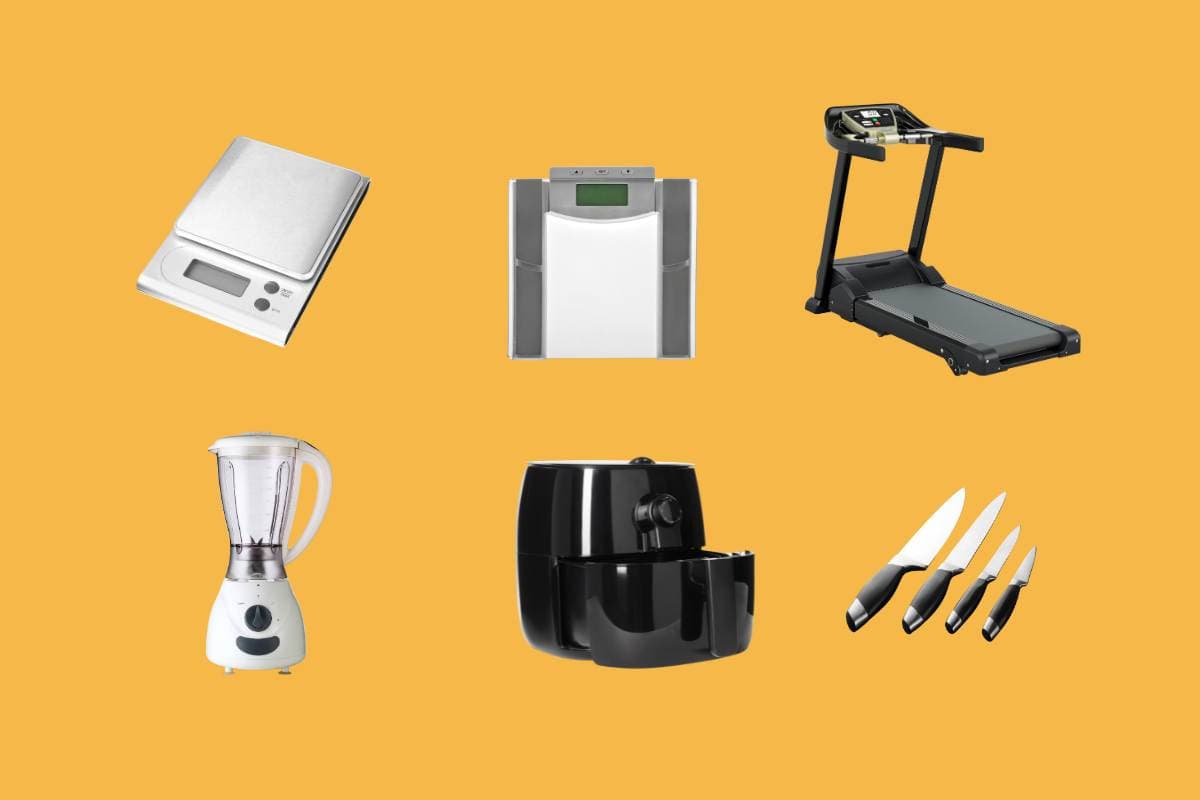
Once you start Wegovy or Mounjaro, the internet wants to sell you things. Special scales, special shakes, special pans. So let me say the honest bit first. You don't need any of it. People lose weight on these medicines with no gadgets at all. But a few well-chosen tools genuinely make the journey easier, and a lot of the rest is money you don't need to spend.
And one thing to be upfront about. There are no shopping links in this guide, and no company has paid to be in it. Where I say what to look for, it's a spec rather than a brand, so you can pick whatever fits your budget.
Here's the clinical reason the right gear matters. On a GLP-1, the medicine suppresses your appetite and drives the weight loss, but a meaningful share of what you lose can be lean muscle, not just fat. In the STEP 1 body-composition substudy, semaglutide reduced total fat mass by about 19.3% but also reduced total lean body mass by about 9.7% over 68 weeks, though lean mass as a proportion of body weight actually improved (STEP 1 body-composition substudy). So the genuinely useful kit is the stuff that helps you do three things: eat enough protein when your appetite is low, stay accountable with food and trend tracking, and keep moving to protect muscle. Everything below is judged against that.
Quick answer: if you buy nothing else, get a cheap food scale and a way to make protein shakes (a blender or even just a shaker). Those two cover the things that matter most on a GLP-1: accurate logging and getting enough protein. A basic bathroom scale for the weekly trend is the next sensible buy. Walking pads, air fryers, smart scales and meal kits are nice-to-haves, not essentials. None of it replaces the habits.
1. Kitchen food scale
Why it helps. Accurate food logging is one of the few self-monitoring habits with real evidence behind it. A systematic review found a consistent link between dietary self-monitoring and weight loss, and self-monitoring is a well-established part of standard behavioural weight-loss treatment (Burke et al., self-monitoring review). The catch is that we're genuinely bad at eyeballing portions. Research on portion-size estimation describes a "flat-slope" effect, where we under-estimate large portions and over-estimate small ones, and amorphous foods like pasta, rice, oils and cereal are the worst offenders (Lucassen et al., portion-size estimation). Weighing removes that guesswork, which matters more on a GLP-1 because you're eating less and every gram of protein counts.
What to look for. A digital readout to 1g, a flat platform that fits a dinner plate or mixing bowl, and a tare or zero function so you can weigh ingredients straight into one bowl. A g, ml and oz switch is handy, and an "add and weigh" mode lets you stack ingredients. Battery or USB, wipe-clean surface. Skip spring or analogue scales, they're not precise enough.
Is it worth it? Yes, arguably the single highest-value buy here. Cheap, often in the £8 to £15 range, durable, and it directly improves the accuracy of the logging the evidence supports. One honest caveat: it only helps if you use it. Weighing every snack forever isn't realistic, so lean on it most for calorie-dense or amorphous foods, and let the rest go.
2. Bathroom and smart scales
Why it helps. Tracking the weekly trend keeps you accountable and catches plateaus or regain early. The evidence is nuanced, and I'd rather be straight with you about it. As a standalone weight-loss tool, daily self-weighing is fairly weak. A UK trial found no significant extra weight loss from being told to weigh daily (Madigan et al., self-weighing RCT). It looks more useful for weight maintenance, the exact phase a lot of GLP-1 users worry about, where frequent self-weighing is linked to holding the loss over the longer term (Burke et al., self-monitoring review).
What to look for. Consistency over features. Same scale, same spot, same time of day (first thing, after the loo, before breakfast). An app that shows a trend line or rolling average, not just the daily number, helps you ignore the noise. Bluetooth sync is nice if you want hands-off logging. If you do want body-composition features, a 4-point model that uses your hands and feet is more reliable than a foot-to-foot one.
The body-fat caveat, plainly. Home bioelectrical-impedance (BIA) body-fat readings are rough. Consumer scales typically sit several percentage points away from a DEXA scan, and the number swings with hydration, food, alcohol and skin temperature (overview of BIA scale accuracy (consumer source)). A scale can be consistently wrong on the absolute number yet still useful for direction of travel. Use the trend, ignore the daily decimal.
Is it worth it? A basic scale, yes, useful for trend accountability, especially heading into maintenance. The smart, body-fat upgrade is optional and easy to over-trust. If you buy it, buy it for the trend graph, not for a precise body-fat figure.
3. Blender or smoothie maker
Why it helps. This is one of the most GLP-1-specific picks on the list. Appetite suppression, early fullness and nausea are common, and dietitian guidance for GLP-1 gut side effects explicitly suggests that when solid food is hard to face, protein shakes and smoothies can be easier to get down (dietary guidance for GI symptoms on GLP-1s). Blended food delivers protein and nutrients in a small, low-effort volume, which protects the muscle that medication-driven weight loss puts at risk (Kim et al., protein and lean-mass retention). On a bad day, it turns "I couldn't eat" into "I drank 30g of protein."
What to look for. Enough power to handle frozen fruit, ice and leafy veg without straining, because under-powered models leave gritty kale behind. A model you'll actually clean matters more than people admit, so single-serve "bullet" cups you blend and drink straight from win on convenience. Dishwasher-safe parts, and a jug or cup matched to one portion so you're not making a litre. For one person, a personal blender is usually the sweet spot.
Is it worth it? Genuinely useful if low appetite or nausea is a real barrier for you. Less essential if you tolerate solid food fine. One honest warning: smoothies can quietly become sugar and calorie bombs once you pile in fruit juice, honey and a couple of bananas. Keep them protein-and-veg-forward, not dessert.
4. Walking pad or under-desk treadmill
Why it helps. Two strands of evidence here. First, breaking up sitting matters. The NHS notes UK adults sit around 9 hours a day, that long sitting is linked to slower metabolism and poorer regulation of blood sugar, blood pressure and fat breakdown, and that we should break up long sedentary spells with at least light activity (NHS: why sitting too much is bad for us). Second, on a GLP-1, everyday movement plus some resistance work helps preserve the muscle the medicine puts at risk. A walking pad turns otherwise-sedentary desk hours into light activity, and trials of active workstations show meaningfully higher energy use (roughly 2 to 4 kcal a minute walking versus about 1.2 kcal a minute seated) without harming typing or thinking tasks (active workstations and cognition RCT, treadmill-desk energy meta-analysis).
What to look for. A flat, low-profile walking pad (no incline) that fits under a standing desk, a quiet motor because you'll be on calls, a sensible weight rating and belt width, and a speed range that tops out around a gentle 3 to 6 km/h. This is a walking aid, not a running machine. A remote or auto-stop is good for safety, and easy storage helps if space is tight. A height-adjustable standing desk is basically a prerequisite (NHS physical activity guidelines).
Is it worth it? Good value if you have a desk job and will actually use it, because it stacks movement onto work you're already doing and kills the "no time to exercise" excuse. The honest caveats: it needs a sit-stand desk and floor space, it replaces sitting rather than structured exercise or strength training, and the calorie burn from slow walking is modest. Don't expect it to drive weight loss on its own. Its real value is less sitting and more low-effort daily steps.
5. Air fryer
Why it helps. It makes lower-oil cooking fast and easy, which suits low-energy, low-appetite days and keeps added fat and calories down versus deep-frying, because air-fried food absorbs far less oil (acrylamide in air-fried versus deep-fried potatoes). That convenience can nudge you toward cooking at home instead of reaching for a takeaway.
What to look for. Capacity matched to your household, a basket that's easy to clean (non-stick, dishwasher-safe), simple controls, and enough wattage to actually crisp. A dual-zone model only earns its keep if you regularly cook two things at once.
Is it worth it? Honestly. It's convenience, not magic. It doesn't make food inherently healthy. Chips are still chips, and you can absolutely overeat air-fried food. The acrylamide picture is mixed too. Some studies show big reductions versus deep-frying, but at least one peer-reviewed comparison found the difference between methods wasn't statistically significant, and that temperature matters more than the appliance. Cook lower, don't burn. Worth it as a time-and-oil saver if you'll use it, not as a weight-loss device.
6. Tools that make cooking from scratch nicer (a good knife and a few decent bits)
Why it helps, honestly. Cooking from scratch is linked to better diet quality, and a large French cohort (NutriNet-Sante, around 12,800 adults) found preparing meals from scratch was prospectively linked to lower obesity risk over 5 years in women. But, and this is the important nuance, that link weakened and became non-significant after adjusting for diet quality and other factors (NutriNet-Sante, food preparation and weight change). So the mechanism is probably "cooking from scratch leads to better food choices," not the cooking itself. The practical point still stands. Tools that make cooking faster, safer and more pleasant lower the friction that pushes people toward takeaways and ultra-processed convenience food. A sharp knife and a few good bits make the from-scratch habit sustainable.
What to look for. One good chef's knife (an 8-inch is the do-everything size) that feels balanced in your hand, plus a way to keep it sharp, since a sharp knife is safer and faster than a blunt one. A sturdy board, a couple of decent non-stick or stainless pans, and a digital probe thermometer that helps you cook lean protein like chicken without drying it out. Good containers for batch cooking. Buy a few quality items, not a giant gadget set.
Is it worth it? Yes, as an enabler of the cook-at-home habit rather than a direct weight-loss tool, and I want to be clear about that difference. Low cost, high daily use, lasts years. The honest caveat: a fancy knife doesn't make you cook. The habit does.
7. Meal kits and subscription food services
Why it helps. For people who genuinely don't or won't cook, portion-controlled prepared meals or meal kits can deliver consistent, balanced, calorie- and protein-aware food with far less decision fatigue. That's useful when GLP-1 fatigue or low appetite makes cooking feel like a mountain. Meal kits also nudge people toward cooking with fresh ingredients, which links back to better diet quality (scoping review of meal-kit nutrition). The evidence base here is still thin and early, though, so I won't oversell it.
What to look for. Clear per-portion calorie and protein labelling, with protein as the priority on a GLP-1. Genuinely balanced meals with vegetables, not just small portions wearing a "diet" label. Portions you can actually finish on low appetite, or that reheat well as two small meals. Flexibility to pause or skip, because you'll have low-appetite weeks. Transparent ingredients (watch the sodium and added sugar), and a cost you can live with.
Is it worth it? Situationally. For committed non-cooks or very time-poor office workers, the convenience and built-in portion control can be worth the premium, and it may beat the default takeaway. But it's expensive versus cooking yourself, the nutrition evidence is limited, and it doesn't build any cooking skills for the long term. A reasonable starter tool, not a forever solution.
8. Protein powder (briefly)
On a GLP-1, hitting enough protein on a shrunken appetite is the central nutrition challenge, and protein supports both muscle preservation and fullness during weight loss. Guidance for older or at-risk adults losing weight points to higher protein (often cited around 1.2g per kg of body weight a day, sometimes more) to hold on to lean mass, and a shake is frequently the only easy way to close the gap on a low-appetite day (Kim et al., protein and lean-mass retention, Putra et al., protein in older adults). In one line: pick a powder you'll actually drink, with a sensible protein-per-serving and minimal added sugar. We cover types, how much, when and what to look for in depth in our dedicated protein powder guide. For most GLP-1 users, yes, it's worth it. It's the practical fix for the protein gap.
What to skip, and the order to spend in
None of this is required to succeed on Wegovy or Mounjaro. Plenty of people do brilliantly with no gadgets at all. The thing to avoid is buying kit instead of building habits. A treadmill you don't stand on, a knife you don't cook with, and a smart scale you obsess over won't help you. The behaviours do the work: logging, getting enough protein, moving more, eating regularly despite low appetite, and some resistance training to protect muscle.
If you do want to spend, here's a sensible priority order rather than buying everything at once:
- Food scale first. Cheap, and it makes your logging actually accurate.
- Blender or protein shaker next, so you can hit protein on the days you can't face a plate.
- Basic bathroom scale for the weekly trend, especially as you move toward maintenance.
- A good knife and a few cooking tools to make from-scratch cooking less of a chore.
- Optional extras after that: a walking pad, an air fryer, or a meal-kit subscription, if they fit your life.
One more thing worth saying plainly: talk to your prescriber or a dietitian about protein targets, side-effect management and exercise, especially around muscle preservation. That's the GLP-1-specific concern, and it's the part no gadget can sort for you.
The free tool that ties it together
All the gear in the world only helps if you log what you eat. Type your meals in plain English and Healthcount works out the calories, protein and fibre for you, then shows your trend. Free, no sign-up needed.
Try the free macro counterFAQs
Do I really need a food scale, or can I just eyeball portions?
You can start by eyeballing, but most people misjudge portions. Research shows we tend to under-estimate large portions and mis-estimate amorphous foods like pasta, rice and oils (portion-size study). A cheap scale makes your logging far more accurate, especially for calorie-dense foods.
Should I weigh myself every day on a GLP-1?
Daily weighing is fine for spotting your trend if it doesn't stress you, but know the evidence. Being told to weigh daily didn't significantly boost weight loss in trials, though frequent self-weighing is linked to better weight maintenance long-term (self-weighing RCT). Watch the weekly average, not the daily wobble.
Are the body-fat readings on smart scales accurate?
Treat them as rough. Home impedance scales can be off by several percentage points versus a clinical DEXA scan, and readings shift with hydration and food (BIA accuracy overview (consumer source)). Use them for direction of travel over weeks, not as a precise figure.
Are air fryers actually healthier?
They cut added oil and calories versus deep-frying, which is a real plus, and they're convenient. But they aren't magic. The food itself still matters, you can overeat air-fried food, and cooking temperature affects compounds like acrylamide more than the appliance does (air-frying study). Cook lower, don't char.
Will a walking pad or under-desk treadmill help me lose weight?
Mainly indirectly. The NHS recommends breaking up long sitting periods (NHS: sit less), and a walking pad turns desk hours into light activity without hurting your work (active workstations RCT). But slow walking burns modest calories and won't replace strength training. Think less sitting and more daily steps, not a weight-loss machine.