If you're on Wegovy or Mounjaro, you've probably had at least three people tell you to "get your protein in." Then you walk into a shop and there's a wall of tubs all shouting about being the best, and half of them have ingredient lists you need a chemistry degree to read. So let's sort it out. This is an honest guide to whether you actually need protein powder, how much protein you're really aiming for, and how to spot a good tub from an expensive one.
Quick answer: protein matters most on a GLP-1 because a big chunk of the weight you lose can be muscle, not fat. Aim for roughly 1.2 to 1.6g per kg of body weight a day, spread across meals. You don't need powder. A varied diet does the job. But when appetite is low and a plate of chicken feels impossible, a 20 to 30g shake is a genuinely useful tool. On the label, look for 20 to 30g of protein per serving, low sugar, a short ingredient list, and Informed Sport or NSF testing.
Why protein matters most on a GLP-1
Here's the part nobody tells you when you start. GLP-1 medicines cause large, fast weight loss, and a meaningful share of that loss is lean tissue, not just fat. Muscle, basically. In the STEP-1 semaglutide trial, roughly 30 to 40% of the total weight lost was lean body mass. In SURMOUNT-1 with tirzepatide, about three-quarters of the loss was fat and a quarter was lean mass. Pooled across trials, around 25% of total weight loss comes from fat-free mass, about half of which is skeletal muscle (Neeland, 2024; PMC review on muscle loss and GLP-1RAs).
That's the single strongest reason to care about protein. You want to lose fat and hold on to muscle, and protein plus resistance training is the combination that protects it. Peer-reviewed guidance puts it plainly: a daily protein intake of 1.2 to 1.6g per kg of adjusted body weight should be considered when starting a GLP-1, especially when you're cutting calories, alongside resistance training to preserve lean mass (PMC: muscle loss and GLP-1R agonist use; Medscape, 2025). Why higher protein helps in a deficit is well covered too. Across systematic reviews, eating closer to 1.2 to 1.6g per kg, rather than the 0.8g minimum, preserves lean mass and improves body composition during weight loss (Clinical Nutrition ESPEN meta-analysis; International Weight Control Registry).
What about fullness? Protein is generally the most filling and the most thermogenic macronutrient. Your body burns roughly 20 to 30% of protein's calories just digesting it, against 5 to 10% for carbs and almost nothing for fat (NiHTEK summary). But I want to be straight with you about a claim doing the rounds online. People say protein "boosts your own GLP-1, so it works with the medication." It's true that high-protein meals raise GLP-1 and PYY hormones, but the calorie-matched study that measured this found the hormone rise did not reduce how much people ate later (PMC6548554). So I won't tell you protein amplifies your injection, because the evidence doesn't back that. What is genuinely useful: because the medication blunts your appetite, the real risk is eating too little protein. The small amount of food you do manage should be protein-dense. That's the angle that holds up.
How much protein per day (and what that looks like in grams)
Start with the baseline so the bigger numbers make sense. The NHS reference intake for the general population is about 0.75g per kg a day, which works out to roughly 45g a day for women and 56g for men. Most UK adults already clear that from food without trying (BHF; NHS Eatwell Guide).
But you're not the general population right now. In a calorie deficit, or on a GLP-1, the relevant target is 1.2 to 1.6g per kg a day, the same figure echoed by the GLP-1 clinical review and the weight-loss meta-analyses (PMC GLP-1 review; ESPEN meta-analysis). One honest caveat. The NHS doesn't publish a specific protein target for GLP-1 users. That 1.2 to 1.6g figure comes from the peer-reviewed GLP-1 literature, not from the NHS, so I'm attributing it where it belongs.
Here's what that band looks like in real grams:
| Body weight | 1.2 g/kg | 1.6 g/kg |
|---|---|---|
| 60 kg | ~72 g/day | ~96 g/day |
| 75 kg | ~90 g/day | ~120 g/day |
| 90 kg | ~108 g/day | ~144 g/day |
Two things worth knowing. First, if you're carrying a lot of weight, clinicians often base the target on adjusted or goal body weight rather than your current weight, so the number doesn't come out unrealistically high (PMC GLP-1 review). Second, people who lift weights need more. The ISSN position stand puts trained individuals at 1.4 to 2.0g per kg, rising to 2.3 to 3.1g per kg to protect lean mass while dieting hard (ISSN Position Stand, 2017). Those upper figures are for lean, resistance-trained people pushing a deep cut. They're not the target for a typical GLP-1 patient, so please don't read 3g per kg and panic. For most readers here, the 1.2 to 1.6g band is your number.
On timing, the ISSN suggests about 0.25g per kg per meal, or roughly 20 to 40g, every 3 to 4 hours, with each dose ideally carrying 700 to 3000mg of leucine to switch on muscle building (ISSN Position Stand). In plain terms: spread it out rather than cramming it all into dinner.
Is powder necessary? (Food first, but a shake is practical)
Let me give you the honest answer before the sales pitch nobody asked for. No, powder isn't necessary. The NHS line is food first, and a varied diet of beans and pulses, fish, eggs, lean meat and dairy gives you the protein and the nutrients you need (NHS Eatwell Guide). The American Kidney Fund makes the same point, adding that eating more protein than you actually need doesn't generally bring extra health or performance benefits (American Kidney Fund).
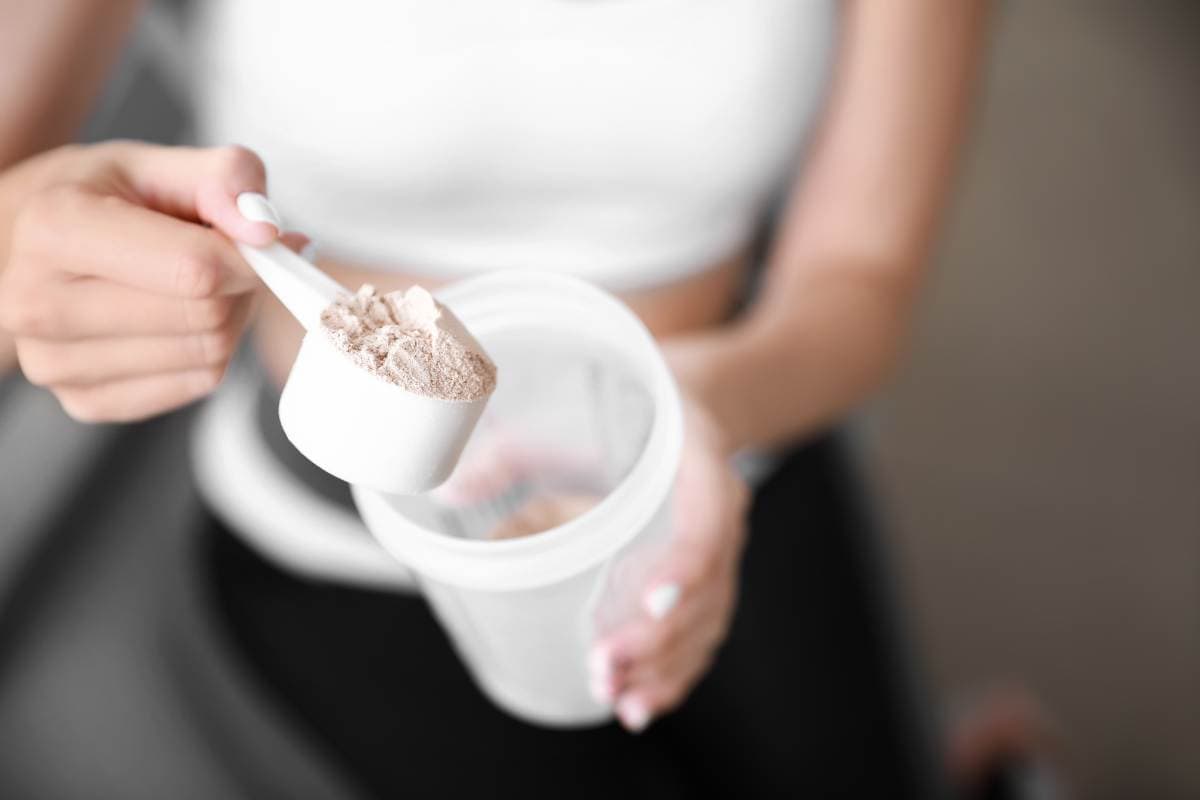
So why do so many people on a GLP-1 end up reaching for a shaker anyway? Because the appetite suppression is real. Portions shrink, and a chicken breast or a steak can genuinely feel like too much. A 20 to 30g shake delivers a meal's worth of protein in a small, low-effort volume, which is a realistic way to reach your target on the days a full plate is a no. That's positioning, not a health claim. Powder is a convenient tool to hit a food-first target. It's not a requirement, and it's not magic.
Types of protein powder
Two words to keep in your back pocket. Complete means a protein has all nine essential amino acids. Leucine is the one that triggers muscle building, so it gets its own column. Whey and soy are leucine-rich and complete. A single plant source like pea or rice is weaker on its own.
| Type | Complete? | Lactose | Notes |
|---|---|---|---|
| Whey concentrate | Yes | More | Cheapest complete option, high leucine (~2.5 to 3g per 25g). May upset a lactose-sensitive stomach. |
| Whey isolate | Yes | Minimal | More filtered, higher protein %, lower carb and fat. Better for sensitive stomachs and most lactose-intolerant people. |
| Casein | Yes | Dairy | Slow-digesting, often taken at night. |
| Soy isolate | Yes | Dairy-free | Highest leucine of the plant sources (~10 to 11%). The best single-source vegan option. |
| Pea | Technically yes, low methionine | Dairy-free | Lower leucine than whey. Good, but better blended. |
| Rice | Low in lysine | Dairy-free | Lower amino content than whey. Best blended. |
| Pea + rice blend | Effectively complete | Dairy-free | The two complement each other, giving a stronger amino profile. The go-to vegan choice. |
So the teaching point is simple. If dairy agrees with you, whey isolate is a brilliant default. If you avoid dairy, go for soy isolate or a pea and rice blend rather than a lone pea or rice powder, because the blend fixes the weaker amino profile (Glanbia; Healthline; amino acid composition, PMC5302255; pea and soy vs whey, PMC11579064).
What to look for on a UK label
Flip the tub over and check five things. Honestly, that's most of the work.
- Around 20 to 30g of protein per serving. That matches the ISSN's 20 to 40g per-meal guidance, so one scoop does a real job (ISSN Position Stand).
- Low added sugar and a short ingredient list. Be wary if corn syrup solids or maltodextrin sit high up the list in a plain protein. That's different from a deliberate mass gainer, where they're the point (Wild Field Health).
- Enough leucine. Whey is about 11% leucine, so expect roughly 2.5 to 2.7g per 25g of protein. A lot less than that is a quality red flag (Rippedbody).
- Third-party testing. In the UK the gold standard is Informed Sport, run by LGC, which batch-tests every batch for 250+ banned substances and is ISO/IEC 17025 accredited. Informed Choice and NSF Certified for Sport are valid too. This matters because as many as 1 in 10 supplements can be contaminated (Informed Sport; Bolt Pharmacy).
- Manufacturer details on the label. A real company name and address. If they're hiding, that tells you something.
Marketing to ignore
Now the bit the packaging would rather you skipped. Most of the loud claims on the front are there to separate you from your money, not to build muscle.
- Proprietary blends. These hide how much of each ingredient is actually in the tub, which makes them a handy vehicle for cheap fillers and amino spiking (Rippedbody; PEScience).
- Amino spiking. If you see free-form glycine, taurine or creatine listed inside a protein powder, it can be there to inflate the "protein" number on a nitrogen test rather than to help you. A suspiciously cheap price per 25g of protein is another tell (Rippedbody).
- Mass gainers. Mostly sugar, maltodextrin and calories. That's the wrong product for someone in a deficit on a GLP-1.
- BCAAs over whole protein. BCAAs on their own can't sustain muscle building. You need all nine essential amino acids, so a complete protein, or just whole food, beats BCAAs and usually costs less (PMC5568273; BarBend).
- Miracle claims. "Burns fat while you sleep," "replaces all food," or any wild "clinically proven" promise. Walk on by (Wild Field Health).
How to use protein powder on a GLP-1
Knowing what to buy is half of it. Using it well is the other half, especially on days when food just doesn't appeal.
- Spread it out. The ISSN points to about 20 to 40g per dose, every 3 to 4 hours, rather than one giant hit, to keep muscle building ticking over through the day (ISSN Position Stand).
- Pair it with resistance training. Protein plus 2 to 3 weekly resistance sessions is the combination with the evidence behind it for keeping muscle on a GLP-1 (PMC GLP-1 review; Medscape).
- Lean on it when appetite is very low. Early after a dose, a shake often goes down easier than solid food. A "protein first" approach, where you take your protein at the start of a meal while you've still got room, helps when you fill up fast. That one's practical experience, not a specific trial, so treat it as a sensible habit rather than a rule.
- Use it alongside food, not instead of it. A shake is great for topping up a meal that fell short. It's a worse idea as a permanent meal replacement, because food still comes first (NHS Eatwell).
Where to buy
We don't recommend specific brands, because the right tub depends on your budget, your stomach and whether you can stand the flavour. Here's what to search for instead, going by the specs above.
- If dairy agrees with you: whey isolate with Informed Sport testing.
- If you avoid dairy: soy protein isolate or a pea and rice blend, not a lone pea or rice powder.
Supermarkets, sports nutrition shops and online retailers all sell perfectly good powders. Check the label against the five-point list before you buy. The rules are the same wherever the tub comes from.
Want to see if you're hitting your protein target?
Log your meals and shakes in plain English and Healthcount works out your protein, calories and fibre for you. Free, no sign-up needed.
Try the free macro counterFAQs
How much protein should I eat on Mounjaro or Wegovy?
Aim for about 1.2 to 1.6g per kg of body weight a day, which is roughly 90 to 120g for a 75kg person, spread across meals to protect muscle during fast weight loss (PMC).
Do I need protein powder if I'm on a GLP-1?
No, food comes first. But because appetite is suppressed, a 20 to 30g shake is a practical way to hit your target when meals feel too big (NHS; American Kidney Fund).
Is whey or plant protein better?
Whey and soy are complete and leucine-rich. Single pea or rice is weaker, so people who avoid dairy should pick soy isolate or a pea and rice blend (Healthline; PMC5302255).
Is protein powder safe, or will it damage my kidneys?
For healthy kidneys, normal protein supplement use is generally fine. If you have, or are at risk of, kidney disease, check with a doctor first (American Kidney Fund).
What should I look for when buying protein powder?
Around 20 to 30g of protein per serving, low added sugar, a short ingredient list, roughly 2.5g or more of leucine per serving, and Informed Sport or NSF third-party testing (Informed Sport; Bolt Pharmacy).