This is the companion to our fruit tier list, and the same rule applies. All vegetables are good for you. This isn't a "good veg, bad veg" list. The tiers group vegetables by what they bring to a meal: water and fibre that fill you up, protein, or starch. Eat the ones you enjoy, and as wide a mix as you like.
Quick answer: leafy greens, cucumber, courgette, mushrooms and tomatoes are mostly water and fibre, so a big pile of them fills you up. Broccoli, cauliflower, cabbage and peppers are the all-rounders, with fibre, vitamins and a little protein. Beans, lentils and peas bring protein as well as fibre, which makes them some of the most filling foods there are. Potatoes and sweetcorn are starchy, so they work best as the carb part of a meal.
How the tiers work
The tiers sort vegetables by what they do on your plate, not by how good they are. Every vegetable here is worth eating, and different ones bring different flavours, textures and nutrients, so variety helps.
The first thing is water and fibre. Most vegetables are mostly water and fibre, which adds bulk to a meal and helps you feel full. In controlled studies, when meals were bulked out with water-rich foods like vegetables, people naturally ate less without feeling any hungrier, and still had satisfying portions (Rolls, 2017).
Fibre also slows digestion. In a large weight-loss trial, people who ate more fibre lost more weight and kept more closely to the trial's eating plan (POUNDS Lost, 2019). The next thing is protein, which peas, beans and lentils bring alongside their fibre. The last is starch. A few vegetables, like potatoes and sweetcorn, hold a lot more of it, so they work more like rice or pasta than like a side of greens. Harvard's long-running cohort found non-starchy veg and cauliflower were linked to weight loss over time, while starchy potatoes, corn and peas were linked to weight gain (Harvard Nutrition Source).
The volume tier: leafy greens and watery veg
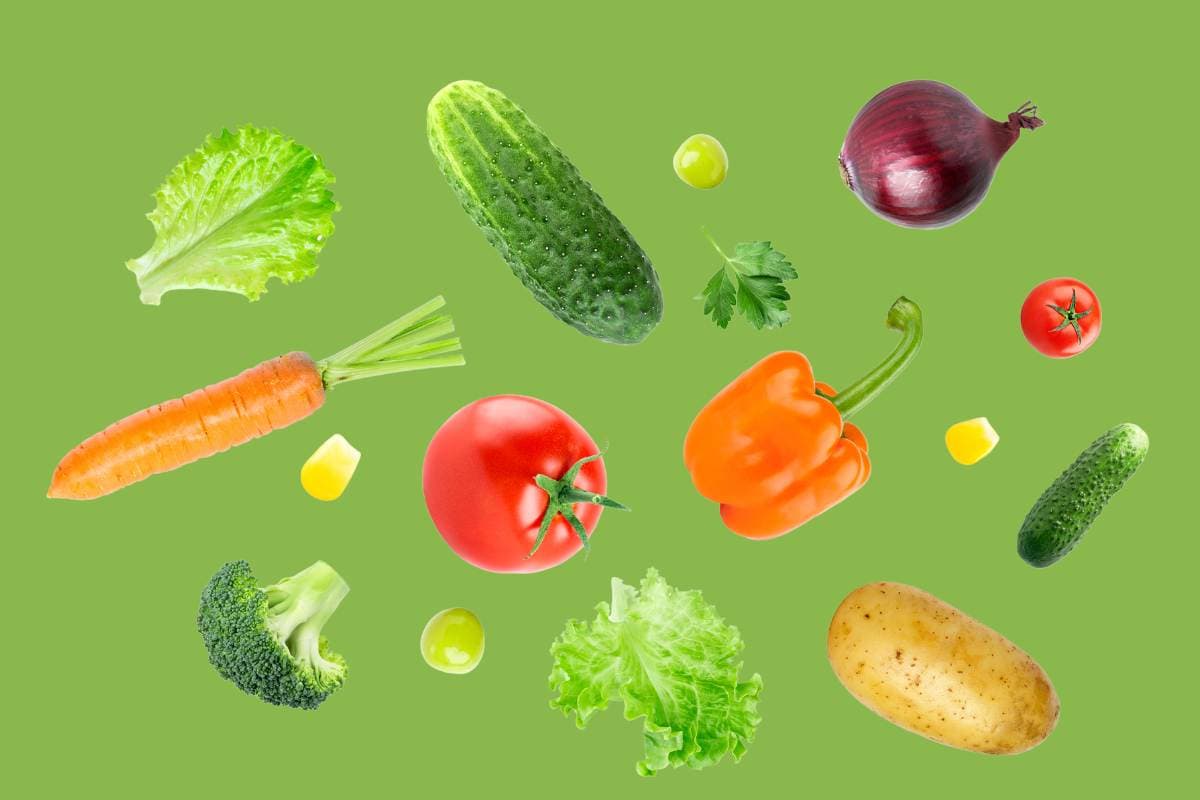
- Leafy greens (spinach, kale, lettuce, rocket): lots of volume, raw in a salad or wilted into almost anything.
- Cucumber: roughly 96% water. Cool, crunchy and refreshing.
- Courgette: mild, quick to cook, and brilliant spiralised, on its own or mixed through pasta.
- Mushrooms: a savoury, meaty depth that makes sauces and stews feel hearty.
- Tomatoes, celery, radish, watercress: light, watery and endlessly useful for bulking out a plate.
Pile these on freely. They add colour, crunch and bulk, and help a meal fill you up.
The all-rounders: fibre, vitamins and a little protein
- Broccoli: fibre and a little protein. A genuine all-rounder.
- Cauliflower: mild and versatile, lovely roasted or in a curry, and one of the foods linked with weight loss over time in the Harvard data.
- Cabbage and Brussels sprouts: cheap and filling.
- Peppers: sweet, crunchy and loaded with vitamin C.
- Green beans and asparagus: good fibre and real staying power.
- Carrots, onions and squash: naturally sweet and very filling. Lovely roasted.
Eat these freely too, and mix them up.
The protein tier: peas, beans and lentils
- Peas: high in protein and fibre for a vegetable, and handy from the freezer.
- Beans, lentils and chickpeas: the protein and fibre make them some of the most filling food you can eat. In a study of more than 15,000 US adults, people who ate more beans and other legumes had gained less weight over the previous ten years, and their extra fibre explained most of the link (Tucker, 2023).
For anyone on a GLP-1, the protein and fibre pulses add are exactly what you want.
The starchy tier: potatoes and sweetcorn
Potatoes and sweetcorn are starchy, so they work best as the carb part of a meal, in place of rice, pasta or bread. That's no mark against them. The NHS calls potatoes a great source of energy, fibre, B vitamins and potassium, and counts them as a starchy food rather than towards your 5 A Day. Sweet potatoes do count, because they're usually eaten alongside the starchy part of a meal (NHS). Plain boiled potatoes are filling, too: they topped a well-known study of how full different foods keep people (Holt et al., 1995).
In Harvard's long-term data, starchy vegetables like potatoes, peas and corn were linked with more weight gain through middle age than non-starchy ones (Harvard Gazette, 2023). Keep the skins on for extra fibre, and enjoy them boiled, baked or roasted as the starchy part of the meal. There's more on why in our potatoes piece.
If you're on a GLP-1
Vegetables do two specific jobs when you're on Wegovy or Mounjaro. First, they help you protect muscle. A large share of the weight you lose on these medications can be lean mass, so the guidance is to prioritise protein, often around 1.2 to 1.6g per kg of body weight a day, plus resistance training. Vegetables fill the plate around that protein rather than replacing it (University of Cambridge, 2025). Pulses and peas pull double duty here, because they bring protein as well as fibre.
Second, they help with side effects. GLP-1s slow the gut, so constipation is common. More fibre and fluids help, but build the fibre up gradually, or it can backfire into bloating (British Dietetic Association). When nausea is bad, go gentler. Well-cooked, peeled veg like courgette, carrot and cooked spinach are far easier to tolerate than a big bowl of raw broccoli.
Getting more veg in (without it being a chore)
- Aim for around 30g of fibre a day. UK adults average 16.4g to 16.9g a day, depending on age, in the latest national survey (National Diet and Nutrition Survey 2019 to 2023), so veg, pulses and wholegrains are the gap-fillers (NHS).
- Fill half your plate with veg. A simple way to make any meal more filling.
- Frozen and tinned count. They keep their fibre and nutrients and are perfect for busy weeks. Choose tinned in water, no added salt or sugar.
- Start with soup or salad. In studies, a big vegetable soup or salad as a first course left people fuller, and they ate less at the meal overall (Rolls, 2017).
- Cook them in ways you enjoy. Steamed, roasted, stir-fried or in a soup, a vegetable you like eating is one you'll come back to.
If you like numbers
Numbers are optional, and you don't need them to eat well. If they help you, leafy greens are around 15 to 30 kcal per 100g and cucumber about 10, and you can type any meal into the free macro counter to see its fibre, protein and calories. No sign-up needed.
Try the free macro counterFAQs
What are the best vegetables for weight loss?
There isn't one. Water- and fibre-rich veg like leafy greens, cucumber, courgette, broccoli, cauliflower, peppers, mushrooms and tomatoes help meals fill you up, and peas, beans and lentils bring protein too. The best ones for you are the ones you enjoy.
Are potatoes bad for weight loss?
No. They're filling, and a good source of energy, fibre, B vitamins and potassium. They just work best as the carb part of a meal, in place of rice or pasta, rather than as your veg.
Do vegetables have enough protein?
On their own, not usually. Pulses, peas and broccoli add useful plant protein, but on a GLP-1 you still want a proper protein source at each meal, with veg around it.
Can you eat too many vegetables?
Rarely a problem, but increasing fibre too fast can cause bloating, especially on a GLP-1 or with IBS. Build up gradually and drink plenty of water.