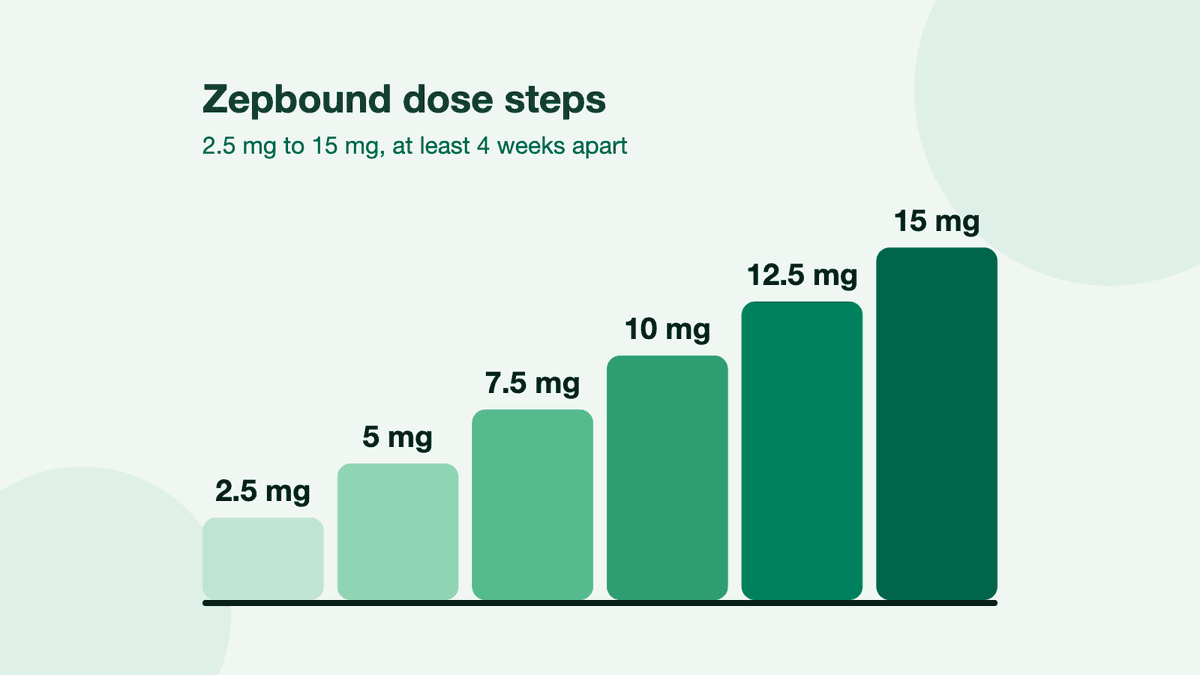
Zepbound (tirzepatide) starts at 2.5 mg once a week for 4 weeks, then goes to 5 mg. After at least 4 weeks on a dose, your prescriber can raise it by 2.5 mg at a time: 7.5 mg, 10 mg, 12.5 mg and 15 mg. According to the FDA label, the maintenance dose for weight loss is 5, 10 or 15 mg a week, and 15 mg is the maximum.
Zepbound comes in four forms and six strengths, but only two dose volumes: 0.5 mL in the single-dose pen and vial, and 0.6 mL in the multi-dose vial and KwikPen. If you've just picked up your first box, it's a lot. Here's the whole schedule on one page, straight from the FDA label, with how each form works.
Your prescriber sets your doses. Plenty of people stay on a dose longer than the minimum 4 weeks, and the label allows for that.
The Zepbound dosage schedule
One injection a week, on the same day, at any time of day, with or without food. You start low and move up no faster than every 4 weeks. Stepping up like this is called titration, so this table is also the Zepbound titration schedule.
| Step | When | Weekly dose | Note |
|---|---|---|---|
| Starting dose | Weeks 1 to 4 | 2.5 mg | To get used to it. Not a maintenance dose |
| Step 2 | From week 5 | 5 mg | Can be a maintenance dose |
| Step 3 | Week 9 at the earliest | 7.5 mg | |
| Step 4 | Week 13 at the earliest | 10 mg | Can be a maintenance dose |
| Step 5 | Week 17 at the earliest | 12.5 mg | |
| Step 6 | Week 21 at the earliest | 15 mg | Maintenance dose and the maximum |
From the FDA label
The Zepbound steps, to scale
Each step lasts at least 4 weeks.
- A maintenance dose on the label (dot underneath)
- A step on the way up
| Dose | How long | Maintenance dose on the label |
|---|---|---|
| 2.5 mg | weeks 1 to 4 | No |
| 5 mg | 4+ weeks | Yes |
| 7.5 mg | 4+ weeks | No |
| 10 mg | 4+ weeks | Yes |
| 12.5 mg | 4+ weeks | No |
| 15 mg | maximum | Yes |
Before you take Zepbound
- Don't take Zepbound if you or anyone in your family has had medullary thyroid cancer, or if you have multiple endocrine neoplasia syndrome type 2 (MEN 2).
- Tell your healthcare provider about a lump or swelling in your neck, hoarseness, trouble swallowing or shortness of breath.
- If you also take insulin or a sulfonylurea, ask whether those doses need lowering, because low blood sugar is more likely.
- Tell your prescriber if you're pregnant or planning to be. The label says to stop Zepbound when a pregnancy is confirmed.
From the Zepbound prescribing information (boxed warning, sections 4, 5 and 8.1), revised August 2026.
Maintenance doses: you don't have to reach 15 mg
For weight loss, the label lists three maintenance doses: 5 mg, 10 mg or 15 mg. For obstructive sleep apnea it's 10 mg or 15 mg. 2.5 mg is only for starting: the label says it isn't approved as a maintenance dose. If a maintenance dose doesn't agree with you, the label suggests a lower one.
How much difference does the dose make? According to the Zepbound label (section 14), in the 72-week SURMOUNT-1 trial people lost 15.0% of their body weight on average on 5 mg, 19.5% on 10 mg and 20.9% on 15 mg, against 3.1% on placebo. Those are averages across everyone who started, including people who stopped, so your own numbers could land anywhere around them.
Pens, vials and the KwikPen
Every form comes in all six strengths: 2.5, 5, 7.5, 10, 12.5 and 15 mg. What changes is how you take it and how much liquid each dose is.
| Form | How it works | One dose | Lasts |
|---|---|---|---|
| Single-dose pen | Press it on your skin and it injects the whole dose. Needle built in. | 0.5 mL | 4 pens = 4 weeks |
| Single-dose vial | Draw 0.5 mL with a new syringe and needle, then throw the vial away, even if some liquid is left. | 0.5 mL (50 units on a U-100 syringe) | 1 vial = 1 week |
| Multi-dose vial | 4 weekly doses in one vial. You draw each one with a new syringe. | 0.6 mL (60 units on a U-100 syringe) | 1 vial = 4 weeks |
| KwikPen | 4 weekly doses in one pen. Attach a new needle, prime the pen, then dial your dose. Never draw it into a syringe. | 0.6 mL | 1 pen = 4 weeks |
The label adds two rules worth knowing. Never share a KwikPen, even with a new needle. And if your prescription switches you from one form to another, ask for a quick run-through of the new one, because each has its own Instructions for Use.
A full vial dose, in units
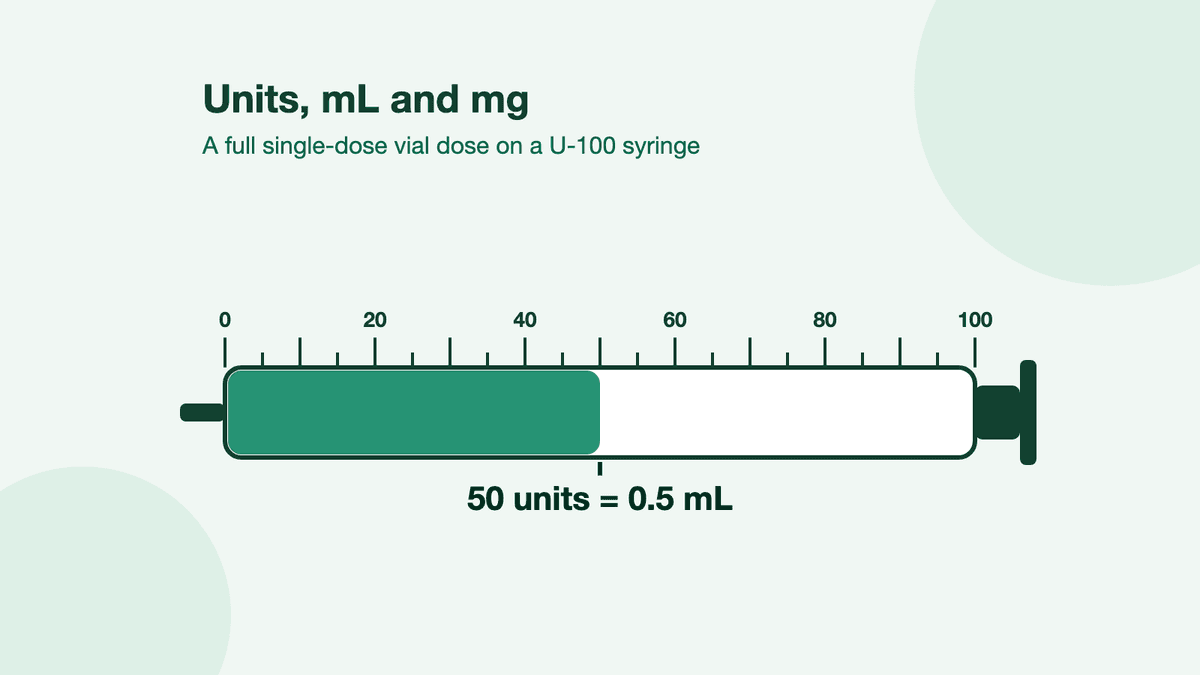
If you use vials, you draw your dose with a syringe. The label suggests a 1 mL syringe that can measure 0.5 mL or 0.6 mL, and a new syringe and needle every time. On a U-100 insulin syringe, 100 units is 1 mL. So a full single-dose vial dose (0.5 mL) is 50 units, and a full multi-dose vial dose (0.6 mL) is 60 units:
Diagram, not to scale
A full single-dose vial: 50 units
0.5 mL. The same at every strength.
Diagram, not to scale
One dose from the multi-dose vial: 60 units
0.6 mL. The vial holds 4 of these.
Prescribed something other than a full dose? Your prescriber or pharmacist should tell you the exact volume. Our Zepbound units, mL and mg converter shows the math for each vial strength.
Where to inject
From the Instructions for Use
Where the label says to inject Zepbound
The label reports similar amounts of tirzepatide in the blood whether it went into the stomach, thigh or upper arm, so pick whichever spot you find easiest and keep moving it around.
Missed doses and changing your day
From the FDA label
Missed a Zepbound dose?
Missed it 4 days (96 hours) or less ago
Take it as soon as you can.
More than 4 days ago
Skip it and take your next dose on your usual day.
Changing your injection day
Fine, as long as there are at least 3 days (72 hours) between the two doses.
Side effects at each dose
Stomach and gut side effects are the common ones. The label says most nausea, vomiting and diarrhea in the trials happened while people were stepping up, and eased over time. Here's how often each was reported at each maintenance dose, next to placebo.
According to the label, nausea was the most common: 25% of people on 5 mg, 29% on 10 mg and 28% on 15 mg reported it, against 8% on placebo. Between 4.8% and 6.7% stopped Zepbound because of side effects, against 3.4% on placebo. If eating is the hard part, see what to eat on Zepbound.
Published data
Side effects reported with Zepbound, by dose
Share of people in the weight-loss trials who reported each one at least once
- Placebo (no medicine)
- 5 mg
- 10 mg
- 15 mg
| Side effect | Placebo | 5 mg | 10 mg | 15 mg |
|---|---|---|---|---|
| Nausea | 8% | 25% | 29% | 28% |
| Diarrhea | 8% | 19% | 21% | 23% |
| Vomiting | 2% | 8% | 11% | 13% |
| Constipation | 5% | 17% | 14% | 11% |
| Stomach pain | 5% | 9% | 9% | 10% |
| Indigestion | 4% | 9% | 9% | 10% |
| Injection site reaction | 2% | 6% | 8% | 8% |
| Tiredness | 3% | 5% | 6% | 7% |
| Burping | 1% | 4% | 5% | 5% |
| Hair loss | 1% | 5% | 4% | 5% |
From the Zepbound Medication Guide
When to stop, call or get help
Severe stomach pain that won't go away
With or without nausea or vomiting, and it can spread to your back. Stop Zepbound and call your healthcare provider right away. It can be a sign of pancreatitis.
Signs of a serious allergic reaction
Swelling of your face, lips, tongue or throat, trouble breathing or swallowing, severe rash or itching, fainting or feeling dizzy, or a very fast heartbeat. Stop Zepbound and get medical help right away. Call 911 if you need to.
Nausea, vomiting or diarrhea that won't go away
Tell your healthcare provider right away. Losing fluids can lead to kidney problems.
Signs of gallbladder problems
Pain in your upper stomach, fever, yellowing of your skin or eyes, or clay-colored stools. Tell your healthcare provider.
And tell any doctor planning surgery or a procedure with anesthesia or deep sedation that you take Zepbound, because it slows how fast your stomach empties.
Birth control: the 4-week rule
This one surprises a lot of people. Zepbound slows how fast your stomach empties, and that can make birth control pills work less well. The effect is biggest after the first dose. Methods that aren't pills, such as an IUD, implant or patch, shouldn't be affected.
From the FDA label
Birth control pills and Zepbound
Your first 4 weeks on Zepbound
Switch to a method that isn't a pill, or add a barrier method such as condoms.
4 weeks after every dose increase
The same again, each time your dose goes up.
Storing your doses
From the FDA label
Storing Zepbound
All forms
Keep in the fridge (36°F to 46°F) in the original carton, out of light. Never freeze it, and don't use it if it has frozen.
Single-dose pens and vials
Can be kept out of the fridge, up to 86°F, for a total of 21 days. Throw them away after that.
Multi-dose vial and KwikPen, once opened
Throw away 30 days after first use, after 4 doses, or after a total of 30 days at room temperature (counting any days before you opened it), whichever comes first, even if some liquid is left.
Multi-dose vial and KwikPen, unopened
Good until the expiration date in the fridge. If kept at room temperature, throw it away after 30 days.
Insurance, Medicare and CVS Caremark
- With commercial insurance: coverage depends on your plan, and most plans need prior authorization. Lilly runs a savings card for people whose insurance covers Zepbound. Paying yourself? See what Zepbound costs without insurance.
- With Medicare Part D: since July 1, 2026, the Medicare GLP-1 Bridge covers the Zepbound KwikPen (not single-dose pens or vials) for people who meet its health criteria, with prior authorization. It runs through December 31, 2027.
- CVS Caremark: Zepbound went back onto Caremark's commercial formularies on October 1, 2026, though your employer's plan decides what you can get, so check yours. If you were moved to Wegovy in 2025, it may be worth asking whether you can switch back.
Frequently asked questions
What is the Zepbound dosage schedule?
What is the maintenance dose of Zepbound?
Do you have to go up to 15 mg on Zepbound?
What if I miss a Zepbound dose?
Can I change my Zepbound injection day?
How many units is a Zepbound dose from a vial?
What is the Zepbound dosage for sleep apnea?
Is there a different Zepbound dose after you reach your goal weight?
Does Zepbound affect birth control pills?
This page is general information from the FDA label, not medical advice. Your prescriber sets your doses and may move you up more slowly than the schedule.