The Medicare GLP-1 Bridge is a short-term Medicare program that lets people with Part D drug coverage get Wegovy (the pen, the pill or Wegovy HD), Foundayo or the Zepbound KwikPen for weight management for $50 a month. It runs from July 1, 2026 to December 31, 2027. You must be 18 or older with a BMI of 35 or more, or a BMI of at least 27 with certain health conditions, and your prescriber has to get approval first, called prior authorization. If you have type 2 diabetes, moderate-to-severe sleep apnea or the fatty liver disease MASH, or your Part D plan already pays for a GLP-1 for you, you go through your plan instead.
If you're on Medicare and you've been told GLP-1s for weight loss aren't covered, that changed on July 1, 2026. Medicare's GLP-1 Bridge brings Wegovy, Foundayo and the Zepbound KwikPen down to $50 a month for people who qualify. It sits outside your drug plan, so it works a little differently from anything else in Medicare. Here's how, from CMS's own rules.
What the Medicare GLP-1 Bridge is
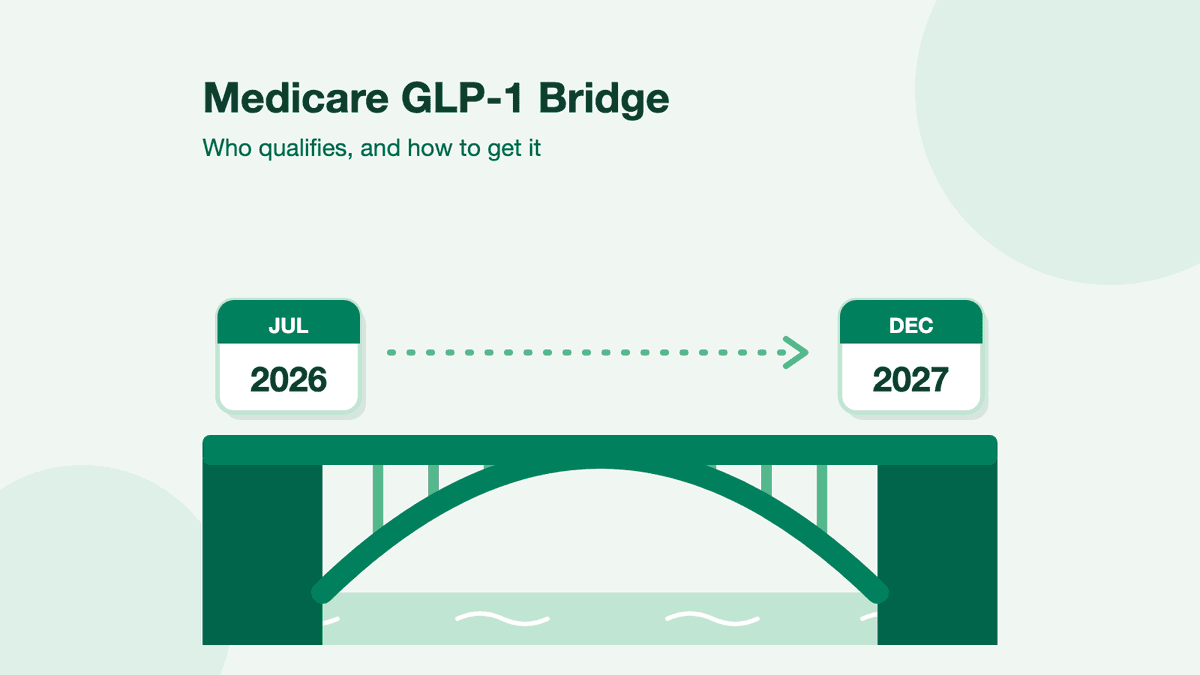
The Medicare GLP-1 Bridge is a short-term program from the Centers for Medicare & Medicaid Services (CMS), the federal agency in charge of Medicare. It started on July 1, 2026. It was due to end in December 2026, but CMS has extended it to December 31, 2027.
It works outside your Part D drug plan. CMS uses one central processor to handle the approvals and pay the pharmacies, so your plan isn't involved and doesn't have to opt in. KFF Health News reports that the processor is Humana, the CMS contractor that already runs another Medicare drug program.
KFF estimated that about 3.8 million people on Part D could have been eligible, based on 2023 records. That's 8% of everyone on Part D. More than 500,000 people were using the Bridge by the end of August 2026, according to the White House, as reported by AARP on September 8, 2026.
From CMS and Medicare.gov
The Medicare GLP-1 Bridge at a glance
$50 a month
For a 28-day or 30-day supply, depending on the medicine, whatever your income.
July 1, 2026 to December 31, 2027
CMS extended it in April 2026. It had been due to end in December 2026.
Wegovy, Foundayo and the Zepbound KwikPen
Prescribed for weight management. Zepbound single-dose pens and Zepbound vials aren't covered.
Prior authorization first
Your prescriber asks for approval through the Bridge, not through your Part D plan.
Which medicines the Bridge covers
Three medicines, prescribed to lose weight or keep it off: Wegovy (the single-dose pens, Wegovy HD and the pill), Foundayo, and Zepbound in the KwikPen only. Your prescriber decides which, if any, is right for you.
| Medicine | Form | Covered? |
|---|---|---|
| Wegovy single-dose pens | Weekly injection, 0.25 mg to 2.4 mg | Yes |
| Wegovy HD | Weekly injection, 7.2 mg | Yes |
| Wegovy pill | Daily tablet, 1.5 mg to 25 mg | Yes |
| Foundayo | Daily tablet, every strength | Yes |
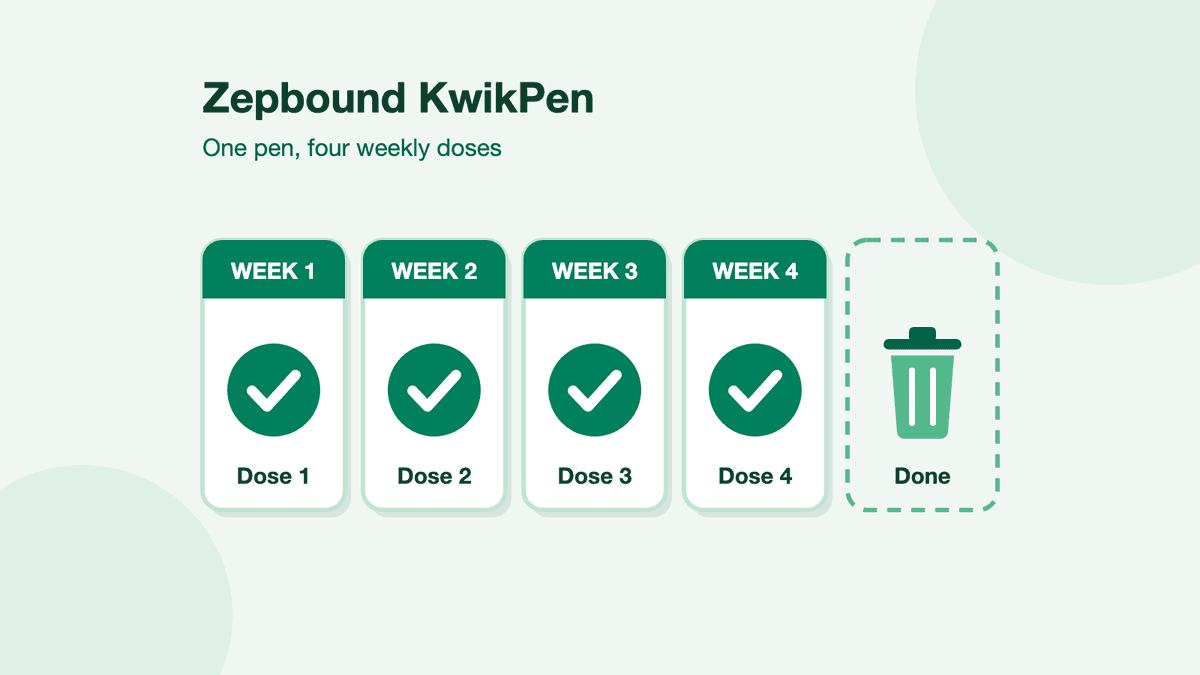
| Zepbound KwikPen | One pen with 4 weekly doses | Yes |
| Zepbound single-dose pens, and Zepbound vials | Weekly injection | No |
| Pen needles for the KwikPen | Bought separately | No |
| Ozempic (injection or pill) and other type 2 diabetes GLP-1s | Weekly injection or daily tablet | No. Your Part D plan decides |
The Zepbound rule surprises people. Medicare.gov says the Bridge "doesn't cover single-dose Zepbound vials or pens," and Medicare's fact sheet says Zepbound vials aren't covered. Which form you use is your prescriber's decision, and the label says you need training before any change of form. Our KwikPen guide explains how that pen works.
One detail for Wegovy. CMS says the Bridge covers all forms of Wegovy, but its list of covered products (June 2026) names only the single-dose pens, Wegovy HD and the tablets. If you use the newer Wegovy FlexTouch pen or single-dose syringes, ask your pharmacy whether they go through the Bridge.
Who qualifies for the Medicare GLP-1 Bridge
Medicare's fact sheet lists four requirements, and you need all four. That's about the Bridge, not about whether a GLP-1 is right for you, which is your prescriber's call.
From the Medicare.gov fact sheet
Do you qualify for the Medicare GLP-1 Bridge?
You need all four
Medicare Part D drug coverage
A standalone drug plan, or a Medicare health plan that includes drug coverage, of a type the Bridge works with.
No GLP-1 through your plan
If you've been using a GLP-1 paid for by your Part D plan, for any reason, you keep getting it through your plan.
No type 2 diabetes, sleep apnea or MASH
Not type 2 diabetes, moderate-to-severe sleep apnea or MASH (a fatty liver disease with liver scarring). If you have one, contact your Part D plan, which may cover a GLP-1.
18 or older, with a qualifying BMI
A BMI of 35 or more, or a BMI of at least 27 with certain health conditions.
The BMI rules
You need to be 18 or older and meet one of these:
- A BMI of 35 or more
- A BMI of 30 or more, plus heart failure with preserved ejection fraction (sometimes called diastolic heart failure), uncontrolled high blood pressure (a top number above 140 or a bottom number above 90, despite two blood pressure medicines), or chronic kidney disease at stage 3a or above
- A BMI of 27 or more, plus prediabetes, a past heart attack or stroke, or peripheral artery disease with symptoms (blocked arteries in your legs or arms)
If you already take a GLP-1, the BMI that counts is the one you had when you started. CMS gives the example of someone who started in September 2024 with a BMI of 37 and had a BMI of 34 by July 2026. They still meet the "35 or more" rule. The Bridge form also asks your prescriber to confirm you're using the medicine alongside changes to what you eat and how active you are, unless activity isn't suitable for you. Our GLP-1 eligibility checker goes through the FDA label's BMI rules for each medicine.
Who can't use the Bridge
- People with no Medicare drug coverage. Original Medicare (Parts A and B) on its own isn't enough.
- People whose only Medicare coverage is a private fee-for-service plan, a cost plan or a PACE organization. CMS lists a few rarer plan types too. If you're not sure what you have, call 1-800-MEDICARE (1-800-633-4227, TTY 1-877-486-2048).
- People who've been using a GLP-1 paid for by their Part D plan, for any reason.
- People with type 2 diabetes, moderate-to-severe obstructive sleep apnea or MASH (a fatty liver disease with liver scarring). Their Part D plan may already cover a GLP-1.
- People prescribed Wegovy to lower the risk of a heart attack or stroke because they already have heart disease. That request goes to the Part D plan too.
- Anyone under 18.
The plan types the Bridge does work with are standalone Part D plans, Medicare Advantage plans with drug coverage (HMO, HMO-POS and PPO plans), Special Needs Plans, employer or union group plans (EGWPs) and Medicare's temporary LI NET drug coverage.
What you pay on the Bridge
You pay the pharmacy $50 for a one-month supply, which is 28 or 30 days depending on the medicine. It's the same at every dose: moving up a dose doesn't change it.
From CMS and Medicare.gov
The $50 copay, and what it doesn't do
$50 at every dose
For a one-month supply of 28 or 30 days, no matter your income level.
It doesn't count toward your Part D limits
Not toward your deductible, and not toward your yearly out-of-pocket limit ($2,100 in 2026).
Extra Help doesn't lower it
Everyone pays $50, including people who normally get Extra Help.
One month at a time
Only 28-day or 30-day fills, never 60 or 90 days, and you can't spread the cost with the Medicare Prescription Payment Plan.
Here's the math for a year. Pens come in 28-day months and tablets in 30-day bottles, so either way a year takes 13 fills: 13 × $50 = $650.
Two more things to know. The Bridge doesn't cover pen needles, which the Zepbound KwikPen needs, so you buy them separately. And it won't show up on your Part D Explanation of Benefits, so keep your pharmacy receipts if you track what you spend.
For people on a small income, $50 still adds up. "It's a lot of money for somebody who's living on a $750-a-month Social Security check," Juliette Cubanski of KFF told KFF Health News in May 2026, because Extra Help can't be used.
How to apply for the Medicare GLP-1 Bridge, step by step
There's no application form for you to fill out. It starts with your prescriber and your pharmacy. In the words of CMS Administrator Dr. Mehmet Oz, when it launched: "If you think a GLP-1 medication may be right for you, talk with your doctor and learn whether you qualify."
From CMS and Medicare.gov
How a Bridge prescription works
- Talk to your doctor
Ask whether a covered GLP-1 is right for you and whether you meet the Bridge rules.
- Prescription to the pharmacy
If one is right for you, your prescriber sends the prescription to your pharmacy.
- The pharmacy checks
Your pharmacy sends it to the Bridge. It may ask for your Medicare number or the last 4 digits of your Social Security number.
- Prior authorization
If you're eligible, your prescriber gets a form to fill out. A decision should come within 72 hours of sending it.
- Pick it up
Medicare sends you a letter. You pay $50 at the pharmacy for a month's supply.
Refills are simpler. Once you're approved, you don't need a new approval for each fill, even when your dose goes up. Medicare.gov says the approval lasts through December 31, 2027, unless you change to a different GLP-1. Switching medicine means a new prior authorization.
The pharmacy usually sends the request to your prescriber within 24 to 72 hours of trying the prescription. If nothing has arrived after 72 hours, CMS says your prescriber can download the form and send it directly.
The Medicare GLP-1 Bridge prior authorization form
Prior authorization means your prescriber has to get approval before Medicare pays. For the Bridge, it's one CMS form, the "Medicare GLP-1 Bridge Prior Authorization Request Form," and only prescribers can send it. They send it online through CoverMyMeds, or by fax to 1-800-530-2404. CMS strongly encourages sending it electronically.
The form starts with which medicine: Foundayo tablets, Wegovy injection, Wegovy HD injection, Wegovy tablets or the Zepbound KwikPen. Then it asks your prescriber:
- To confirm that requests for type 2 diabetes, sleep apnea, MASH or heart risk go to your Part D plan instead
- Whether you have moderate-to-severe obstructive sleep apnea, MASH or type 2 diabetes
- That you're 18 or older and using it with changes to what you eat and how active you are
- Your BMI range when you started a GLP-1: under 27, 27 to 29.9, 30 to 34.9, 35 to 39.9, or 40 or more
- Whether you have prediabetes, a past heart attack or stroke, peripheral artery disease with symptoms, heart failure with preserved ejection fraction, uncontrolled high blood pressure or chronic kidney disease stage 3a or above
A few rules your prescriber's office may not know yet. The pharmacy goes first: the form only works after the pharmacy has tried the prescription with the Bridge, and sending it earlier gets a "patient not found" error. Your prescriber doesn't have to be enrolled in Medicare. They sign the form under penalty of perjury, and CMS may check answers such as type 2 diabetes against Medicare's records. The office can call the Bridge call center at 855-273-0102, Monday to Friday, 8 a.m. to 7 p.m. Eastern.
If the answer is no, you and your prescriber are told why. There's no appeals process, but your prescriber can send the form again with corrected or new information.
Medicare open enrollment and the Bridge: October 15 to December 7
Medicare's open enrollment runs from October 15 to December 7, 2026. It's when you can join, switch or drop a drug plan or a Medicare Advantage plan, and new coverage generally starts on January 1, 2027. The Bridge runs until December 31, 2027, so it lasts the whole of the year you're choosing for.
From CMS and Medicare.gov
Open enrollment and the GLP-1 Bridge
October 15 to December 7, 2026, for coverage from January 1, 2027
No drug coverage yet?
You need Part D for the Bridge. Open enrollment is when you can join a drug plan, with coverage from January 1, 2027. If you went 63 days in a row or more without creditable drug coverage after you first became eligible, a late enrollment penalty may be added.
Switching drug plans?
The Bridge sits outside Part D plans, so it's $50 in any eligible plan. Check that your new plan is a type the Bridge works with.
On private fee-for-service, a cost plan or PACE?
Those don't qualify on their own. Before changing anything, ask 1-800-MEDICARE or your SHIP what a switch means for the rest of your coverage.
GLP-1 for diabetes, sleep apnea or your heart?
That goes through your Part D plan, not the Bridge. Check the new plan's drug list and prior authorization rules before you switch.
Free, one-on-one help is there if you want it. Your State Health Insurance Assistance Program (SHIP) gives free Medicare counseling, and 1-800-MEDICARE (1-800-633-4227) can tell you what type of plan you have.
What to ask your doctor, your plan and your pharmacy
Your doctor or prescriber
- Do I meet the Bridge rules, using my BMI from when I started a GLP-1?
- Is a covered GLP-1 right for me, and which one?
- Will you fill out the Bridge prior authorization when the pharmacy sends it? (It goes to the Bridge, not my Part D plan.)
- Do I have type 2 diabetes, sleep apnea, MASH or heart disease that means my Part D plan should cover it instead?
Your Part D plan, or 1-800-MEDICARE
- Is my plan a type that works with the Bridge?
- Do you cover a GLP-1 for me now? If so, I keep getting it through the plan.
- If my GLP-1 is for diabetes, sleep apnea or my heart: is it on your drug list for 2027, and does it need prior authorization?
Your pharmacy
- Can you send my prescription to the Medicare GLP-1 Bridge?
- Do you have my medicine and strength in stock?
- On the Zepbound KwikPen: what do pen needles cost, since the Bridge doesn't cover them?
One warning. Because there's no form for you to fill out, be wary of anyone who offers to sign you up for the Bridge or asks for your Medicare number out of the blue. You can report suspected fraud to 1-800-MEDICARE.
Does Medicare cover Zepbound, Wegovy or Foundayo?
For weight management, yes, through the Bridge, if you qualify.
Does Medicare cover Zepbound?
Yes, the Zepbound KwikPen, at $50 a month through the Bridge. Single-dose pens and vials aren't covered. If you have moderate-to-severe obstructive sleep apnea, Zepbound goes through your own Part D plan instead, and its rules apply. For the self-pay route, see what Zepbound costs without insurance.
Does Medicare cover Wegovy?
Yes, the Wegovy pen, the Wegovy pill and Wegovy HD, at $50 a month through the Bridge. If you take Wegovy to lower your heart risk because you already have heart disease, or for MASH, your Part D plan handles it. For the self-pay route, see what Wegovy costs without insurance.
Does Medicare cover Foundayo?
Yes, every strength, at $50 a month through the Bridge. Our Foundayo guide covers how to take it.
Does Medicare cover Ozempic?
Not through the Bridge. Ozempic, the injection or the pill, is a type 2 diabetes medicine, so your own Part D plan decides. Our Ozempic pill guide explains how it differs from the Wegovy pill.
On Medicare, you can't get Lilly's or Novo Nordisk's $25 copay offers, but you can pay their self-pay prices instead, outside your Part D plan. Our US GLP-1 price page has them side by side.
What happens after 2027?
Nobody knows yet. The Bridge was meant to lead into a longer-term program called the BALANCE Model, run through Part D plans. KFF Health News reported that not enough insurers signed on by the April deadline. In April 2026, CMS said BALANCE wouldn't launch in 2027 and extended the Bridge instead. CMS says the extra year lets it collect data before a possible BALANCE Model in Part D. It hasn't said what happens after December 31, 2027. We'll update this page when it does.
Frequently asked questions
What is the Medicare GLP-1 Bridge program?
Who qualifies for the Medicare GLP-1 Bridge?
Does Medicare cover weight loss drugs?
Does Medicare cover Zepbound?
Does Medicare cover Wegovy?
Does Medicare cover Foundayo?
Does Medicare cover Ozempic?
How much does the Medicare GLP-1 Bridge cost?
How do I apply for the Medicare GLP-1 Bridge?
How long does Medicare GLP-1 Bridge approval take?
When does the Medicare GLP-1 Bridge end?
Does Extra Help lower the $50 copay?
What if my Medicare GLP-1 Bridge prior authorization is denied?
Do I need to do anything about the Bridge during open enrollment?
General information from CMS and Medicare.gov, checked October 9, 2026. It isn't medical, legal or financial advice. Your prescriber decides whether a GLP-1 is right for you and which one, and CMS can change the Bridge rules. For a medicine's doses, see the GLP-1 dosage chart.
View sources (14)
- Medicare GLP-1 Bridge, Centers for Medicare & Medicaid Services (page updated July 13, 2026)
- Medicare GLP-1 Bridge: information for providers, Centers for Medicare & Medicaid Services (page updated August 6, 2026)
- Medicare GLP-1 Bridge: information for pharmacies, CMS Product No. 12236, June 2026 (PDF)
- Medicare GLP-1 Bridge prior authorization request form, Centers for Medicare & Medicaid Services (PDF)
- Medicare GLP-1 Bridge: weight loss drugs, Medicare.gov (read October 9, 2026)
- Medicare GLP-1 Bridge: GLP-1 drugs for $50 a month, fact sheet, CMS Product No. 12234, June 2026 (PDF)
- CMS launches Medicare GLP-1 Bridge, expanding access to GLP-1 medications, CMS press release, July 1, 2026
- Joining a plan: open enrollment dates, Medicare.gov
- Avoid late enrollment penalties, Medicare.gov
- CMS extends Medicare's short-term Bridge program for GLP-1 obesity drug coverage, Juliette Cubanski, KFF, April 23, 2026
- Nearly four million Medicare beneficiaries met the eligibility criteria in 2023 for the Medicare GLP-1 Bridge, Juliette Cubanski and Nolan Sroczynski, KFF, June 29, 2026
- A new Medicare option for weight loss drugs: what older Americans should know, Jackie Fortiér, KFF Health News, May 6, 2026
- Medicare's $50 GLP-1 program coincides with rise in weight loss prescriptions for older adults, Tony Pugh, AARP, September 8, 2026
- State Health Insurance Assistance Program (SHIP): free Medicare counseling