Without insurance, Zepbound (tirzepatide) costs $299 a month at 2.5 mg (a 4-week starting dose), $399 at 5 mg and $449 at 7.5 mg to 15 mg. That's Eli Lilly's LillyDirect price for vials or the KwikPen. The $449 holds only if you refill within 45 days. After that, it's $499 at 7.5 mg and $699 at 10 mg to 15 mg. Single-dose pens have no self-pay price. A year at 10 mg or 15 mg, refilled on time, is 13 × $449 = $5,837. The list price is $1,086.37 a month. LillyDirect prices checked October 6, 2026.
Zepbound's list price, the price before any discounts, is $1,086.37 a month. Without insurance, you can pay less by buying from Eli Lilly, the company that makes it. Its LillyDirect service sells vials and the KwikPen for $299 to $449 a month, by dose. Two things to watch: a 45-day refill rule at the higher doses, and extra costs such as needles.
Zepbound cost per month without insurance, by dose
These are LillyDirect's self-pay prices. Vials and the KwikPen cost the same at every dose, and a month is 28 days: 1 KwikPen, or 4 vials. Lilly's terms add that taxes and fees may apply.
| Dose | Within 45 days | After 45 days |
|---|---|---|
| 2.5 mg | $299 | $299 |
| 5 mg | $399 | $399 |
| 7.5 mg | $449 | $499 |
| 10 mg | $449 | $699 |
| 12.5 mg | $449 | $699 |
| 15 mg | $449 | $699 |
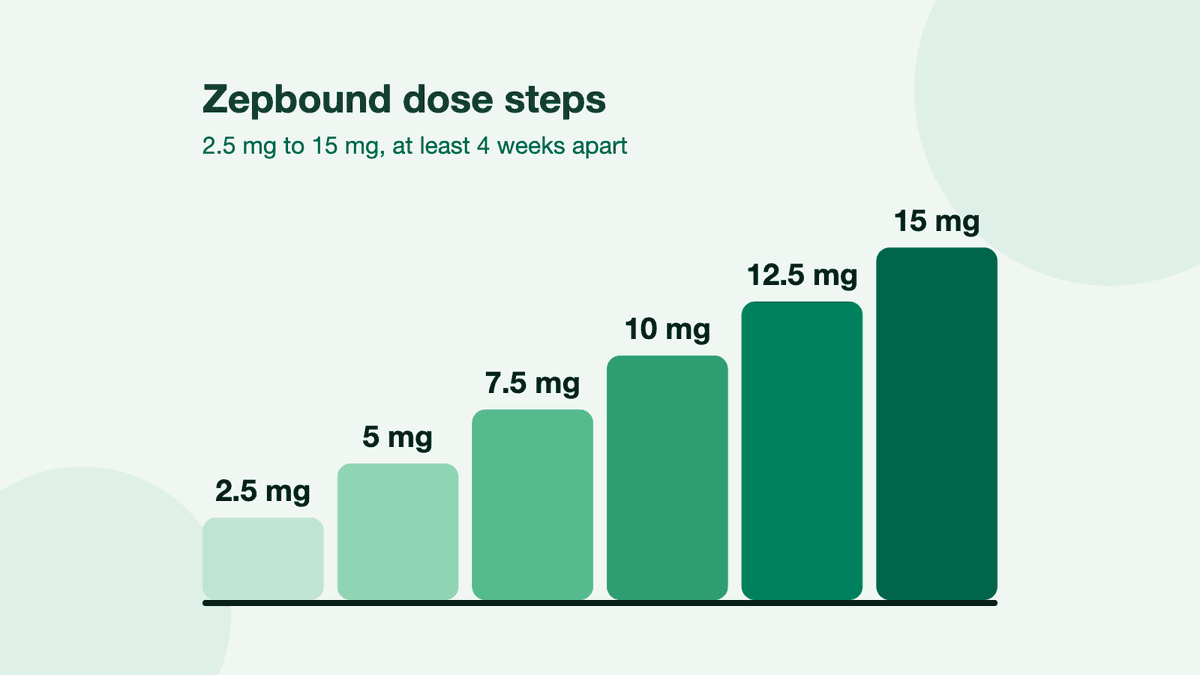
Refilling after 45 days only costs more at 7.5 mg and up. And in Lilly's words, "2.5 mg is a starting dose and is not approved as a maintenance dose." The label's maintenance doses for weight loss are 5 mg, 10 mg and 15 mg; 7.5 mg and 12.5 mg are steps on the way up.
Zepbound vial and KwikPen prices, and single-dose pens
The form you're prescribed matters too, because only two forms of Zepbound have a self-pay price. Which form you use is your prescriber's call.
From LillyDirect, checked October 6, 2026
Which forms of Zepbound have a self-pay price
Vials: yes
Single-dose vials of 0.5 mL, sold only through LillyDirect. A month is 4 vials, and you buy needles and syringes separately.
KwikPen: yes
One pen holds 4 doses of 0.6 mL, which is a month. Same prices as vials, and you buy pen needles separately.
Single-dose pens: no
There's no self-pay price. You get them through insurance: your plan's coverage, or Lilly's savings card if you have commercial insurance.
The 45-day refill rule
At 7.5 mg and up, the $449 price depends on timing. Lilly charges $449 "when you refill within 45 days" and calls this the Zepbound Journey Program. Refill later and the regular price applies: $499 at 7.5 mg, and $699 at 10 mg, 12.5 mg or 15 mg.
The difference is $499 minus $449 = $50 a month at 7.5 mg, and $699 minus $449 = $250 a month at 10 mg and above. A month's supply lasts 28 days, so refilling on your usual schedule keeps you inside the 45 days. If your prescriber pauses your doses, follow that rather than the refill date.
What a year of Zepbound costs
Zepbound comes in 28-day months, so a year takes 13 fills, not 12: 13 × 28 = 364 days.
From LillyDirect, checked October 6, 2026
What a year of Zepbound costs without insurance
13 fills of 28 days
10 mg or 15 mg, refilled on time
13 × $449 = $5,837
5 mg
13 × $399 = $5,187
2.5 mg, your first 4 weeks
$299 for one fill. It's a starting dose, and every dose after it costs more.
At the list price
13 × $1,086.37 = $14,122.81
These assume the same dose and the same prices all year, and Lilly can change or end the 45-day offer at any time. Your first year starts at 2.5 mg and steps up, so it won't match any one line. Your prescriber decides how fast you move up and where you stay.
Zepbound cost with insurance
With commercial (private, not government) insurance, it depends on your plan. Plans that cover these medicines usually want your prescriber to get approval first, called prior authorization. Some also want you to try another treatment first, called step therapy.
If your plan covers the single-dose pen, Lilly's savings card can bring a fill down to as little as $25. The card takes off up to $100 a month and $1,300 a calendar year. So with a $300 copay, you'd pay $300 minus $100 = $200. If your plan doesn't cover Zepbound, the card has set prices instead. For a month of single-dose pens (4 pens, 28 days), it's as low as $499. Our Zepbound savings card guide walks through each case.
Bigger employers are more likely to cover GLP-1s for weight loss. In KFF's 2025 survey of employers, 16% of firms with 200 to 999 workers covered them. It was 30% at firms with 1,000 to 4,999 workers, and 43% at firms with 5,000 or more.
If your plan uses CVS Caremark, Zepbound went back on select Caremark commercial formularies (its lists of covered drugs) on October 1, 2026. Each employer plan still decides, so check with your plan.
Medicare and Medicaid
Medicare
The Medicare GLP-1 Bridge runs from July 1, 2026 to December 31, 2027. If you have Part D and qualify, you pay a flat $50 a month for the Zepbound KwikPen. Single-dose pens and vials aren't included.
To qualify, you need to be 18 or older, on Part D, prescribed it for weight management and not already getting a GLP-1 through your Part D plan. You also need a BMI of 35 or more, or a BMI of at least 27 or 30 with certain health conditions (your BMI when you started a GLP-1 counts). Our Zepbound savings card guide lists them.
Your prescriber has to get approval first, through one central processor. The $50 doesn't count toward your Part D deductible or your yearly out-of-pocket limit ($2,100 in 2026), and Extra Help doesn't apply.
People with moderate-to-severe sleep apnea, type 2 diabetes or MASH (fatty liver disease with liver scarring) can't use the Bridge, even for weight management. Their Part D plan may already cover a GLP-1 instead.
Medicare open enrollment runs from October 15 to December 7, 2026. The Bridge sits outside Part D plans, so the $50 is the same whichever drug plan you pick. If your only Medicare coverage is a private fee-for-service plan, a cost plan or PACE, you don't qualify.
Nobody on Medicare, Medicaid, TRICARE, VA or another government plan can use Lilly's main savings card. Its separate KwikPen Self-Pay Savings Card, for people paying cash, is open to you, and so are LillyDirect's self-pay prices. That money can't count toward a deductible or out-of-pocket costs.
Medicaid
It's state by state. As of January 2026, 13 state Medicaid programs covered GLP-1s for obesity, according to KFF, and several states have cut coverage since. Check with your state's program.
Paying with an HSA or FSA
Zepbound prescribed for diagnosed obesity is generally eligible for your health savings account (HSA) or flexible spending account (FSA). IRS Publication 502 counts amounts you pay to lose weight as a medical expense "if it is a treatment for a specific disease diagnosed by a physician (such as obesity, hypertension, or heart disease)". Prescribed drugs count too.
Your plan may ask for a letter of medical necessity. Medicines imported from other countries generally aren't eligible.
Other costs to plan for
The monthly price is for the medicine itself. On top of it, you may need:
- Needles and syringes, if you use vials. LillyDirect says "Needle and syringe purchase required."
- Pen needles, if you use the KwikPen. LillyDirect says "Pen needle purchase required."
- Visit fees, if you pay a doctor or a telehealth service for the prescription.
Your pharmacy can tell you what needles and syringes cost.
Where these prices apply
The prices on this page are LillyDirect's, and vials are sold only there. You may also come across these:
- Lilly's KwikPen Self-Pay Savings Card, for people paying cash at a pharmacy other than LillyDirect, including people with no insurance or on Medicare. It brings the KwikPen as low as the same prices, for up to 11 fills a calendar year, until December 31, 2026. Our Zepbound savings card guide explains how to enroll.
- GoodRx said on April 9, 2026 that the Zepbound KwikPen is available "from $299" with self-pay pricing at more than 70,000 US pharmacies. Ask your pharmacy for the price at your dose.
- TrumpRx.gov, a government site, lists the same self-pay prices and sends Lilly prescriptions to LillyDirect.
For other GLP-1 prices, see our US GLP-1 price page.
Cheap compounded copies: a caution
Compounded tirzepatide is made by a pharmacy, not by Lilly, and it isn't FDA-approved: the FDA doesn't review compounded drugs for safety, effectiveness or quality before they're sold. Mass-made copies were allowed while Zepbound was in shortage. The FDA declared the tirzepatide shortage over on December 19, 2024, so mass-made copies are no longer lawful. The FDA advises filling your prescription at a state-licensed pharmacy. Be especially wary of tirzepatide priced below Lilly's own self-pay prices.
Ways to keep the cost down
From Lilly, CMS and the IRS
Ways to keep the cost of Zepbound down
Refill within 45 days
At 7.5 mg and up, that keeps a month at $449 instead of $499 or $699. If your prescriber pauses your doses, follow that instead.
Check your coverage first
If your commercial plan covers the single-dose pen, the savings card can bring a fill down to as little as $25.
Use your HSA or FSA
Prescribed for diagnosed obesity, Zepbound is generally eligible under IRS Publication 502.
On Medicare Part D? Ask about the Bridge
If you qualify, the KwikPen is a flat $50 a month through December 31, 2027.
Leave your dose to your prescriber
Don't stretch, split or skip doses to make a supply last longer. If the cost is a problem, tell your prescriber.
Whether Zepbound is right for you is your prescriber's call. Our GLP-1 eligibility checker goes through the BMI rules for Zepbound.
Frequently asked questions
How much does Zepbound cost without insurance?
How much does Zepbound cost a year?
Are Zepbound vials cheaper than the KwikPen?
What is the list price of Zepbound?
What is the Zepbound 45-day rule?
How much is Zepbound with insurance?
Can I buy Zepbound single-dose pens without insurance?
Does Medicare cover Zepbound?
Can I use my HSA or FSA for Zepbound?
What about cheap compounded tirzepatide?
General information from Lilly's published prices and terms, not medical or financial advice. Prices change, so check the current price before you order. Your prescriber decides your dose and which form you use, so never change either to save money. For the dose steps, see the Zepbound dosage schedule.
View sources (14)
- FDA's concerns with unapproved GLP-1 drugs used for weight loss, US Food and Drug Administration
- FDA clarifies policies for compounders as national GLP-1 supply begins to stabilize, US Food and Drug Administration (updated April 1, 2026)
- Zepbound self-pay prices, LillyDirect, Eli Lilly (read October 6, 2026)
- Zepbound savings card: full terms, Eli Lilly (read October 6, 2026)
- Zepbound list price, GoodRx (checked October 5, 2026)
- TrumpRx.gov (checked October 5, 2026)
- GoodRx Expands Access to Eli Lilly and Company's New Oral GLP-1 Foundayo and Zepbound KwikPen with Self-Pay Pricing at More Than 70,000 Pharmacies Nationwide, Business Wire, April 9, 2026
- CVS Caremark to put Zepbound back on formulary and add Foundayo, Managed Healthcare Executive, May 28, 2026
- 2025 Employer Health Benefits Survey, KFF
- Medicare GLP-1 Bridge, Centers for Medicare & Medicaid Services
- Medicare GLP-1 Bridge prior authorization form, Centers for Medicare & Medicaid Services
- Medicare GLP-1 Bridge fact sheet (CMS Product No. 12234), Medicare.gov
- Medicaid coverage of and spending on GLP-1s, KFF
- Publication 502, Medical and Dental Expenses, Internal Revenue Service