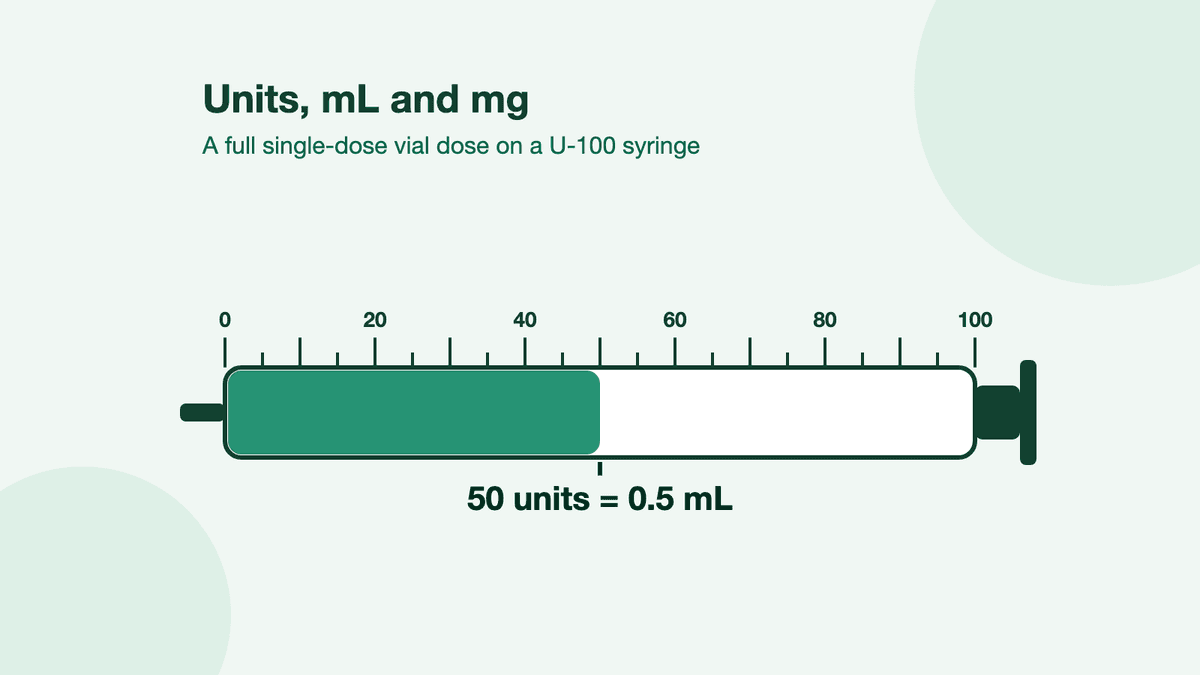
A full dose from a Zepbound (tirzepatide) single-dose vial is 0.5 mL, which is 50 units on a U-100 insulin syringe, at every strength from 2.5 mg to 15 mg. One dose from the multi-dose vial is 0.6 mL, or 60 units. The strength changes how many milligrams are in the liquid, not how much liquid you draw. The KwikPen is dialed, never drawn into a syringe.
Heads-up: this is general information for US readers. Always follow your prescriber's advice and the FDA-approved Instructions for Use that come with your medication.
Why this matters: if you get Zepbound (tirzepatide) as single-dose vials through LillyDirect, you draw each dose yourself with a syringe. Most people use a U-100 insulin syringe, and those syringes are marked in units, not mL. The good news is that the US conversion is unusually simple: a full dose from a single-dose vial is 0.5 mL, which is 50 units, and a dose from the multi-dose vial is 0.6 mL, which is 60 units. The tables below show how units, mL, and mg relate for each vial strength, so the numbers on the syringe actually make sense.
US quick facts
- Volume per dose: 0.5 mL for every strength in the single-dose pen and single-dose vial; 0.6 mL in the multi-dose vial and KwikPen
- Full single-dose vial on a U-100 syringe: 50 units (one multi-dose vial dose is 60 units)
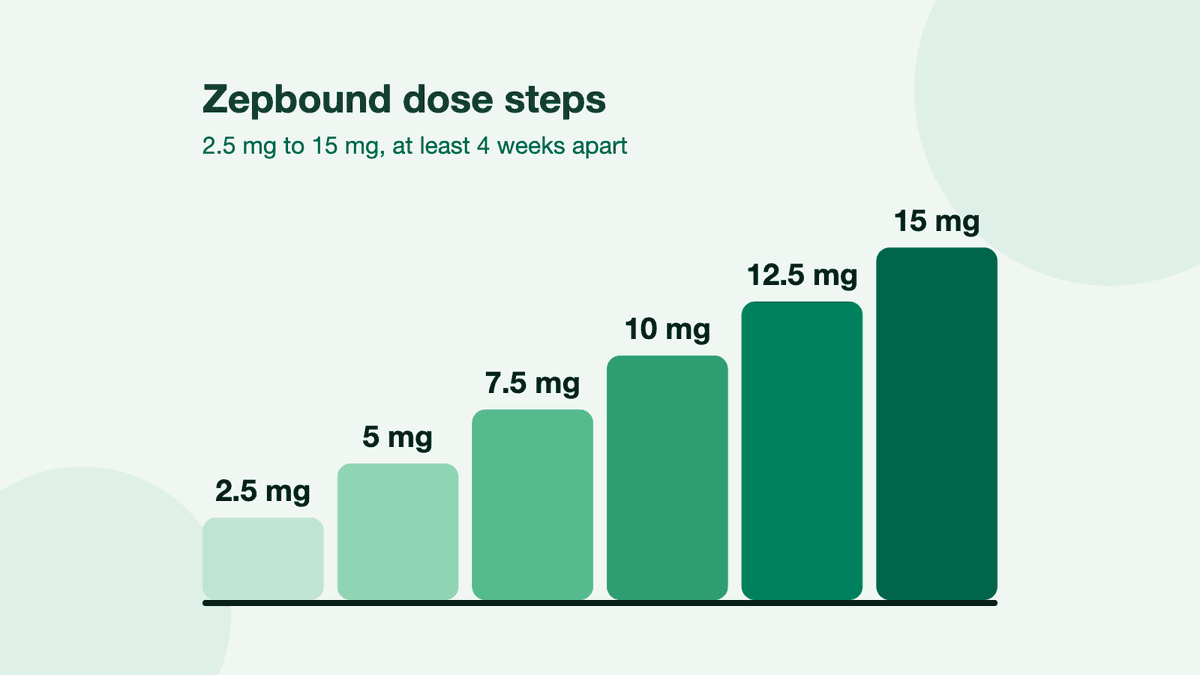
- Available strengths: 2.5 mg, 5 mg, 7.5 mg, 10 mg, 12.5 mg, 15 mg (2.5 mg is a starter dose, not maintenance)
- Vials: a single-dose vial holds one 0.5 mL dose (4 vials last 4 weeks). Since the 2026 label update there's also a multi-dose vial holding four 0.6 mL doses, 60 units each
- Brand note: in the US, tirzepatide for weight loss is Zepbound. Mounjaro is the same molecule branded for type 2 diabetes
Pens, vials, and the KwikPen
Zepbound comes in four formats in the US, and only the two vials involve any measuring on your part:
- Single-dose autoinjector pen. The classic retail-pharmacy format. Each pen holds one preset 0.5 mL dose. You press it against your skin and it injects everything. No units, no drawing, nothing to convert.
- Single-dose vial. Sold through LillyDirect's self-pay program in all six strengths. You draw 0.5 mL (50 units) with a new syringe and needle, inject it, then throw the vial away, even if some liquid is left. Most of this article is about this format. The multi-dose vial is the other one where syringe units matter.
- Multi-dose vial. Added to the label in 2026. One vial holds four weekly 0.6 mL doses, and you draw each one with a new syringe: 60 units for a full dose. Throw it away 30 days after first use, after 4 doses, or after a total of 30 days at room temperature, whichever comes first, even if liquid is left.
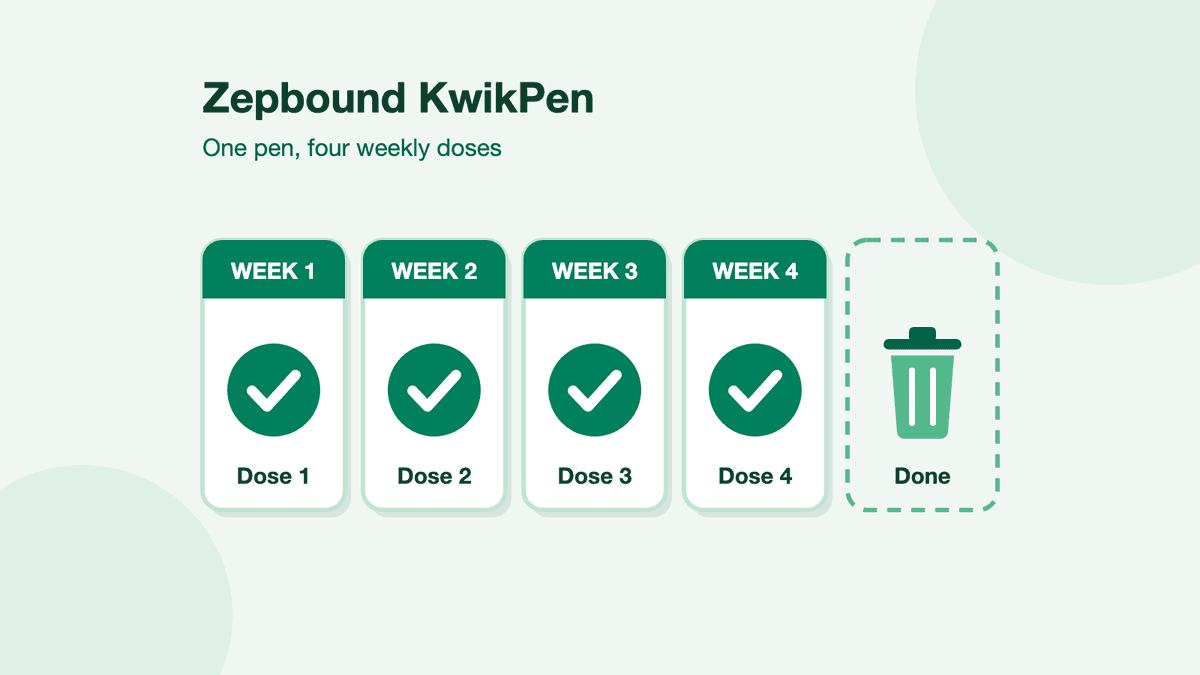
- Zepbound KwikPen. Launched in the US in February 2026. It's a multi-dose pen holding four weekly doses, and you dial and inject rather than draw anything. Its instructions say never to transfer the medicine into a syringe. One thing worth knowing: each KwikPen dose is 0.6 mL, not 0.5 mL. UK patients have used this format since early 2024 (tirzepatide for weight loss is sold as Mounjaro there), which is why unit charts written for UK readers say 60 units per dose. Those charts don't fit US single-dose vials, which hold 0.5 mL.
On cost, since vials are why most people end up doing draws: LillyDirect's self-pay prices run from $299 to $449 a month depending on dose (checked October 5, 2026), against a list price of roughly $1,086. On the 7.5 mg dose and above, the discounted price depends on refilling within a 45-day window, so check the current terms on lilly.com before you rely on a number.
The three quantities: units, mL, mg
- mL is the volume of liquid.
- mg is the amount of medicine in that liquid.
- Units on a U-100 insulin syringe are just another way to show volume: 100 units = 1.00 mL.
A simple analogy:
Think of mixing lemonade from a powdered drink mix.
- The water you pour is measured in mL.
- How strong it tastes depends on how much mix went in. That's mg per mL in a vial.
- The tick marks on your measuring cup help you pour precisely. A U-100 syringe is a measuring cup with 100 tiny ticks per mL.
So 1 unit = 0.01 mL.
Every Zepbound single-dose vial gives the same 0.5 mL dose (each multi-dose vial dose is 0.6 mL). What changes between strengths is how much medicine is dissolved in it. A 15 mg vial isn't fuller than a 5 mg vial; it's three times more concentrated.
Diagram, not to scale
A 15 mg vial isn't fuller than a 5 mg vial
Like lemonade: the same amount in the glass, three times the mix in the stronger one.
What is a U-100 syringe?
A U-100 syringe shows volume in units where:
- 100 units = 1.00 mL
- 10 units = 0.10 mL
- 50 units = 0.50 mL
That last line is the one to remember. Lilly's own Instructions for Use for the vial tell you to use a syringe that can measure a 0.5 mL dose, and a standard 1 mL (100-unit) insulin syringe does exactly that. Use a new syringe and needle for every injection.
One caution: these are volume units, not insulin. Zepbound is not insulin, and the "units" on the syringe don't measure medicine strength. They only measure liquid.
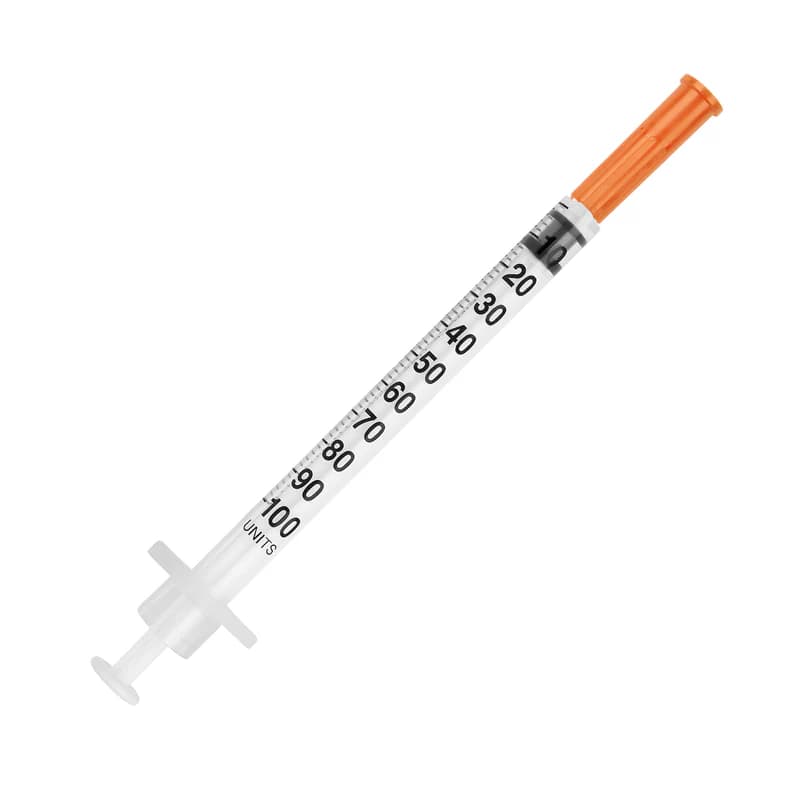
The 50-unit rule for single-dose vials
Here's the part that surprises people coming from forums full of UK screenshots. In the US there's one number to know for a full single-dose vial:
Full single-dose vial = 0.5 mL = 50 units. Every strength. Every time.
The multi-dose vial is the exception: each of its four doses is 0.6 mL, or 60 units.
Your prescribed mg is set by which vial you were sent, not by how far you pull the plunger. On a 2.5 mg vial, 50 units delivers 2.5 mg. On a 10 mg vial, the same 50 units delivers 10 mg. The draw never changes; the concentration does.
Where the tables below earn their keep is reading things back the other way. People want to know what 20 units from a 5 mg vial works out to in mg, usually because a draw came up short, a syringe had dead space, or they're double-checking something they read online. That's arithmetic worth understanding even though the label only ever asks you for the full 50-unit draw.
Worked examples
Example 1: the full draw
You're on 7.5 mg and your LillyDirect box has four 7.5 mg vials. Each week you draw to the 50-unit line, which is 0.5 mL, and that delivers the full 7.5 mg. Next month your prescriber moves you to 10 mg. The draw is still 50 units. Only the vial label changed.
Example 2: reading back from units to mg
Say you only got 40 units out before the vial ran dry against the stopper. 40 units is 0.40 mL. A 5 mg vial holds 5 mg in 0.5 mL, so 0.40 mL is 4 mg, and you'd know you were about 1 mg short. (If that happens regularly, mention it to your pharmacist. Technique and syringe choice both play a part.)
Example 3: same mg, different vials
The same 30 units is 3 mg from a 5 mg single-dose vial but 6 mg from a 10 mg one, because the stronger vial packs twice the mg into every unit. This is why you should never borrow someone else's units number without knowing their vial strength.
Prefer a calculator over manual look-ups?
Enter your vial strength and units, mL, or mg and get an instant conversion with our free US calculator.
Open the Zepbound units calculator →Conversion table (US single-dose vials only)
How to read this: find your units in the left column, then read across to your vial strength. For example, 20 units from a 5 mg vial is 2.00 mg, while the same 20 units from a 12.5 mg vial is 5.00 mg.
U-100 syringe; rows are units (5 to 50). "mL" is the same for every vial. Each column shows what that volume contains in mg for that strength (0.5 mL per single-dose vial). 50 units is the full labeled dose.
Don't use this table for the multi-dose vial. Its doses come in 0.6 mL, so it's less concentrated: a 5 mg multi-dose vial is about 8.3 mg per mL, not 10.
| Units | mL | 2.5 mg vial | 5 mg vial | 7.5 mg vial | 10 mg vial | 12.5 mg vial | 15 mg vial |
|---|---|---|---|---|---|---|---|
| 5 | 0.05 | 0.25 | 0.50 | 0.75 | 1.00 | 1.25 | 1.50 |
| 10 | 0.10 | 0.50 | 1.00 | 1.50 | 2.00 | 2.50 | 3.00 |
| 15 | 0.15 | 0.75 | 1.50 | 2.25 | 3.00 | 3.75 | 4.50 |
| 20 | 0.20 | 1.00 | 2.00 | 3.00 | 4.00 | 5.00 | 6.00 |
| 25 | 0.25 | 1.25 | 2.50 | 3.75 | 5.00 | 6.25 | 7.50 |
| 30 | 0.30 | 1.50 | 3.00 | 4.50 | 6.00 | 7.50 | 9.00 |
| 35 | 0.35 | 1.75 | 3.50 | 5.25 | 7.00 | 8.75 | 10.50 |
| 40 | 0.40 | 2.00 | 4.00 | 6.00 | 8.00 | 10.00 | 12.00 |
| 45 | 0.45 | 2.25 | 4.50 | 6.75 | 9.00 | 11.25 | 13.50 |
| 50 | 0.50 | 2.50 | 5.00 | 7.50 | 10.00 | 12.50 | 15.00 |
Notice the bottom row: 50 units delivers exactly the labeled strength of whichever vial you're holding. That's the whole system.
Track your doses free in Healthcount. Log units, mL, and mg with automatic conversions, alongside weight, food, and side effects.
Get StartedWhy the label limits the math
The tables above are pure arithmetic based on volume and concentration. Real-world use has rules the arithmetic doesn't know about:
- Single-dose vials are preservative-free and used once. Lilly's Instructions for Use say to throw the vial away after your injection, even if liquid is left. Splitting one across several injections is off-label and raises sterility risk. The multi-dose vial contains a preservative and holds four doses.
- The 2.5 mg strength is for starting, not staying. The prescribing information is explicit that 2.5 mg is a treatment-initiation dose, not approved maintenance.
- Partial draws aren't a dosing method. If you and your prescriber decide a lower dose makes sense, the clean route is a prescription for a lower-strength vial or pen, not drawing less from a stronger one.
- Fresh syringe every time. New syringe and needle for each injection, per the Instructions for Use.
So use the math the way it's meant to be used: to understand what the 50-unit line means, to sanity-check numbers you see online, and to catch a short draw. The label decides the rest.
View sources (6)
Zepbound US Prescribing Information (FDA label)
Strengths, 0.5 mL dose volume, and single-dose pen/vial presentations
Zepbound single-dose vial Instructions for Use (Lilly)
Syringe requirements, drawing the dose, and discarding opened vials
Eli Lilly announcement: all approved Zepbound doses in single-dose vials
LillyDirect Zepbound self-pay terms
Zepbound KwikPen US launch
HCPLive reporting on the multi-dose KwikPen (four 0.6 mL doses per pen)
Zepbound list price context