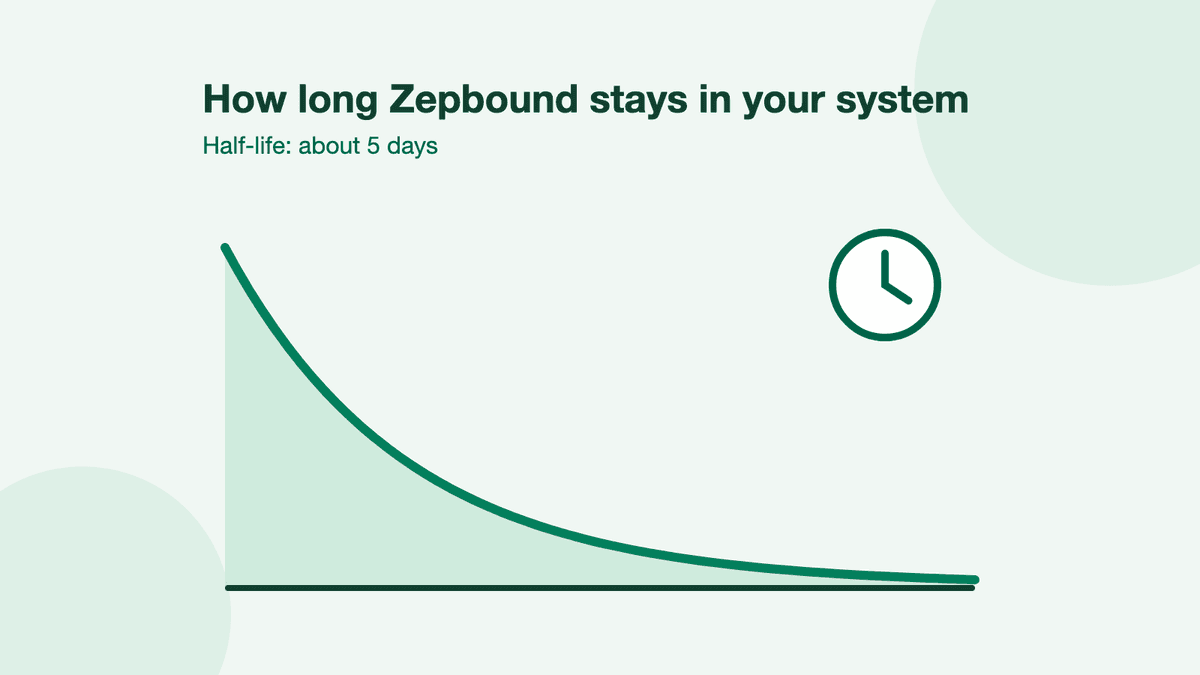
Tirzepatide, the medicine in Zepbound, has a half-life of about 5 days, so roughly half of a dose is left 5 days after you take it and about a quarter after 10 days. It peaks in your blood about a day after the injection (8 to 72 hours, according to the label), and nearly all of it is gone about 25 to 30 days after your last dose.
This article is for information only and is not medical advice. Don't change your dose or timing without talking to the clinician who knows your history.
If you're on Zepbound (tirzepatide), it's completely normal to wonder:
- "How much of this dose is still in me after a few days?"
- "How long does it take to clear if I stop?"
- "Is there still tirzepatide in my body when I take my next weekly shot?"
Let's walk through the numbers in plain English, using what we know from the FDA prescribing information and the drug maker's own pharmacology data. Then we'll turn that into everyday scenarios, including a worked example.
One quick note on names, because it trips people up. In the US, tirzepatide for weight loss is sold as Zepbound. Mounjaro is the same molecule, but in the US that brand is for type 2 diabetes. (In the UK, the weight-loss version is sold as Mounjaro, which is why you'll see that name in a lot of online forums.) Same science either way, so everything below applies to any tirzepatide.
Quick answer: how long does Zepbound stay in your system?
Let's get straight to it.
From the Zepbound prescribing information and pharmacology data:
- Tirzepatide has an elimination half-life of about 5 days.
- Lilly's own medical information says that because of this, once you stop, tirzepatide should be gone from your body in about 30 days.
In practice, that means:
- After 5 days, roughly 50% of a dose is still in you.
- After 10 days, roughly 25%.
- After 20 to 30 days, only a small percentage is left, then it becomes negligible.
If your real question is: "How much tirzepatide is left in my body after 1 to 7 days?"
You can think in rough terms like this (there's a table just below):
- 1 day: most of the dose is still there
- 2 days: about three-quarters
- 3 to 4 days: roughly half to two-thirds
- 5 days: about half
- 7 days (1 week): a little over one-third
Make your timing easy to keep track of
When you log how much you injected and on which day, it's simple to see how many days it's been since your last dose. No mental math, no squinting at the calendar.
Track your doses freeWhat "half-life" actually means for tirzepatide
You'll see "half-life about 5 days" quoted everywhere, but it's rarely explained in a way that's easy to picture.
Here's the simple version. Half-life is the time it takes for the amount of drug in your body to fall by half.
For tirzepatide, that's about 5 days on average.
So starting from a single dose:
- At the start: 100% of that dose is in you.
- After 5 days: about 50% is left.
- After 10 days: about 25% is left.
- After 15 days: about 12.5% is left.
It's a curve, not a straight line. The amount drops faster at the beginning, then tails off slowly.
Where these numbers come from
They come from:
- The Zepbound prescribing information (revised August 2026), which gives a half-life of approximately 5 days (section 10), approximately 5 to 6 days in people with overweight or obesity (section 12.3), and a clearance of about 0.06 L/hour, which is what makes once-weekly dosing work. The tables here assume 5 days.
- Independent pharmacology reviews, which also describe a half-life of around 5 days for tirzepatide.
There's normal human variation, of course. Body weight, kidney and liver function, other medicines and genetics can all nudge those numbers a little. But this is the basic pattern.
Day-by-day: how much tirzepatide is left after 1 to 7 days?
Let's make this concrete.
Below is a simplified day-by-day breakdown for a single dose, assuming:
- An elimination half-life of about 5 days
- That we're looking at the percentage of that one dose still in your body
These are rounded values from the standard half-life equation. Treat them as useful approximations, not lab-grade measurements.
Approximate % of a single dose remaining over the first week
| Time since injection | Approx. % of that dose left | If the dose was 5 mg, approx. mg left |
|---|---|---|
| 1 day | ~87% | ~4.4 mg |
| 2 days | ~76% | ~3.8 mg |
| 3 days | ~66% | ~3.3 mg |
| 4 days | ~57% | ~2.9 mg |
| 5 days | ~50% | ~2.5 mg |
| 7 days (1 week) | ~38% | ~1.9 mg |
So if you're thinking, "I injected on Tuesday, what's left by the weekend?", you can match your day count to this table and get a ballpark figure.
These figures line up with the reported half-life and the standard first-order elimination that clinical pharmacology uses.
Use your dose log as a timeline
Instead of trying to remember when you injected last week, log the exact day and dose, then glance back and count the days in seconds.
Start a free dose logWorked example: "I dosed Tuesday and want to re-dose Thursday"
Here's a very common real-world scenario:
"I took my 5 mg Zepbound shot on Tuesday evening. I've got a weekend full of dinners out, and I'm tempted to re-dose Thursday evening to top myself back up to 100% and keep the food noise down."
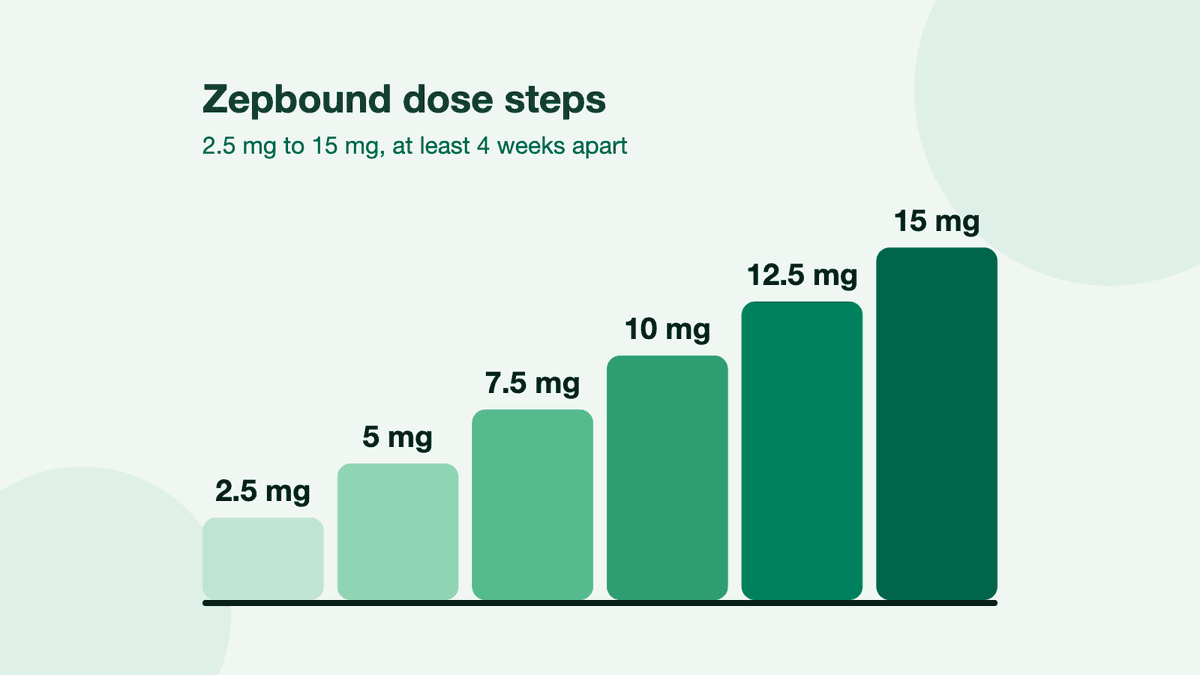
One thing worth knowing first: in the US, every Zepbound dose is a fixed weekly dose (2.5, 5, 7.5, 10, 12.5 or 15 mg), whether it comes from a single-dose pen or vial, the 4-dose KwikPen or the multi-dose vial. So "topping up" would mean an extra full or partial dose on top of what's already on board. Let's unpack what that actually does.
1. How much of that 5 mg dose is left on Thursday evening?
From the table, Tuesday evening to Thursday evening is 2 days.
After 2 days, we estimate about 76% of that dose is still in you. For a 5 mg dose, that's roughly 3.8 mg still on board.
So the key point is this. By Thursday evening you're nowhere near empty. You still have about three-quarters of that dose in your system.
As a rough rule of thumb: two days after a dose, around 75 to 80% of it is still there.
2. Why "topping up" is more complicated than it looks
It's tempting to think, "If about 3.8 mg of my 5 mg is still there, I'll just take a little extra to get back to a full 5 mg." From a pharmacology point of view, there are some complications.
You're still absorbing the first dose
Tirzepatide reaches its peak concentration a median of 24 hours after the injection (anywhere from 8 to 72 hours, according to the label), because it's absorbed slowly from the injection site. At 48 hours you may still be inside that window, so the picture isn't a clean "peak, then decline."
If you've been dosing weekly for a while, older doses are still in the background
Weekly dosing plus a 5-day half-life means the drug accumulates. Even before Tuesday's dose, there was a tail left over from previous weeks. Pharmacology reviews put that accumulation at roughly 1.5 to 1.7 times a single dose once you reach steady state.
Changing the timing changes your total exposure
The schedules tested in the Zepbound trials were structured once-weekly, not early top-ups. Bringing doses closer together, or stacking extras, pushes your total exposure outside those tested patterns.
Side effects and risk can climb
Higher drug levels can mean more GI symptoms like nausea, vomiting and diarrhea. And if you have type 2 diabetes and take other glucose-lowering medicines, the risk of low blood sugar goes up too.
So while the math of "how much is left" is genuinely interesting and worth understanding, it isn't a safe basis for designing your own dosing schedule.
What this example is good for
It's a great way to see that most of your dose is still there just a couple of days later. And any urge to "boost" is really a signal to have a dose-review conversation with your prescriber, not to make a DIY change.
How long does it take to clear tirzepatide completely?
Now let's flip the question: "If I stop Zepbound, how long until it's basically out of my system?"
The "5 half-lives" rule
A standard rule of thumb in medicine is:
- After 1 half-life: about 50% is left
- After 2 half-lives: about 25%
- After 3 half-lives: about 12.5%
- After 4 half-lives: about 6.25%
- After 5 half-lives: about 3%
Because tirzepatide's half-life is about 5 days, that works out to:
- 5 half-lives is about 25 days, leaving roughly 3% of the last dose
- 6 half-lives is about 30 days, closer to 1 to 2%, which is usually treated as negligible in everyday practice
Lilly's own medical information puts it simply:
Because the half-life is about 5 days, tirzepatide should be gone from your body in about 30 days after you stop using it.
So roughly:
- 1 week after your last dose: still a meaningful amount left
- 2 weeks: a lot lower, but not zero
- 3 to 4 weeks: very low levels
- Around 30 days: generally treated as "cleared" for most practical purposes
Why this matters for real decisions
That long tail is exactly why timing questions matter. Planning a pregnancy, prepping for surgery, or switching to a different medicine all depend on how much drug is still in you, not just on when you took your last shot.
This is also why those decisions should go through your clinician. They're thinking in half-lives and risk windows, not single doses, and they can match the timing to your situation.
The label's rule for a late dose (take it within 4 days, otherwise skip it) and the full dose ladder are in our Zepbound dosage schedule.
Why there's still tirzepatide in you on the day of your next injection
Another common question: "If I inject once a week, is there still tirzepatide from the last dose when I take the next one?"
Short answer: yes, and that's by design.
With a weekly injection and a 5-day half-life:
- At 7 days, just before your next dose, about 38% of that last dose is still in you.
- On top of that, there's a smaller tail from previous weeks.
The prescribing information and pharmacology reviews show that:
- Tirzepatide's half-life is around 5 days.
- Steady state is usually reached after about 4 weeks of once-weekly injections.
- Accumulation is modest, roughly 1.5 to 1.7 times a single dose, so steady-state levels sit meaningfully above what one shot alone would give you.
This is why:
- Side effects and appetite changes can feel different in Week 4 or 5 than they did after your very first injection.
- If you pause Zepbound, levels drift down over several weeks rather than dropping to zero right away.
Common questions about tirzepatide in your system
How long does 2.5 mg of Zepbound stay in your system?
On the same timeline as any other dose. The half-life doesn't depend on the dose, so about half of a 2.5 mg dose is left after 5 days, about a quarter after 10 days, and nearly all of it is gone about 25 to 30 days after your last injection. The label also notes that the amount in your blood rises in proportion to the dose, so a 2.5 mg dose leaves less in your blood at every point than a 5 mg dose does.
1. Is it safe to re-dose early to top up before a big weekend?
It's very human to want extra support when you've got a social weekend or a trip coming up. But from a safety angle:
- The schedules that were tested are structured once-weekly regimens, not early boosts.
- Re-dosing early raises your total exposure and can increase side effects and risk, especially if you have diabetes and take other glucose-lowering medicines.
- Understanding "how much is left" is useful, but any change in dose or timing should go through your prescriber.
2. Why do I sometimes feel Zepbound "wear off" before my next shot, if there's still drug in me?
Two things can be true at once:
- There's still a measurable amount of tirzepatide in your system.
- Your experience of appetite, cravings and food noise can shift faster than the drug level itself.
That reflects brain, gut and hormone biology, not just the concentration of drug in your blood.
What you can do:
- Note which day after your injection tends to feel harder (say, Day 5 or 6).
- Bring that pattern to your prescriber as part of a proper review.
- A simple dose log, what you took and when, is enough to anchor that conversation.
3. Does my weight change how long tirzepatide stays in my body?
Population pharmacokinetic analyses haven't found big shifts in half-life across different body sizes. It stays around 5 days across the studied groups, with exposure broadly similar in people with type 2 diabetes and people with obesity.
That said, your dose, response and tolerability are still very individual, which is why the dose is stepped up gradually.
4. What about kidney or liver problems?
In the studies that supported approval, mild to moderate kidney or liver impairment didn't call for major dose changes, and the half-life stayed broadly similar. Still, severe impairment, a long list of other medicines, or a more complex medical history are all good reasons to build a tailored plan with your clinician rather than assuming the standard schedule fits you perfectly.
Turn your dosing history into something useful
You don't need anything fancy. Just a clear record of how much you took and when. That's enough to:
- know how many days it's been since your last dose
- talk through patterns with your prescriber
View sources (4)
Zepbound (tirzepatide) prescribing information
Eli Lilly and Company. Reports a mean elimination half-life of about 5 days, clearance of about 0.06 L/hour, peak concentration 8 to 72 hours after injection, absolute bioavailability about 80%, and steady state after about 4 weeks of once-weekly dosing.
Lilly Medical Information
How long will Zepbound (tirzepatide) be in the body after the last dose? States that, with a half-life of about 5 days, tirzepatide should be gone from the body in about 30 days after you stop.
FDA label, Zepbound (tirzepatide) injection
Full prescribing information (accessdata.fda.gov). Includes the clinical pharmacology section with the half-life, clearance and time-to-peak figures used above.
StatPearls / NCBI Bookshelf
Farzam K, et al. Tirzepatide. Summarizes tirzepatide as a once-weekly dual GIP/GLP-1 receptor agonist with a long half-life, metabolized and cleared as metabolites in urine and feces.