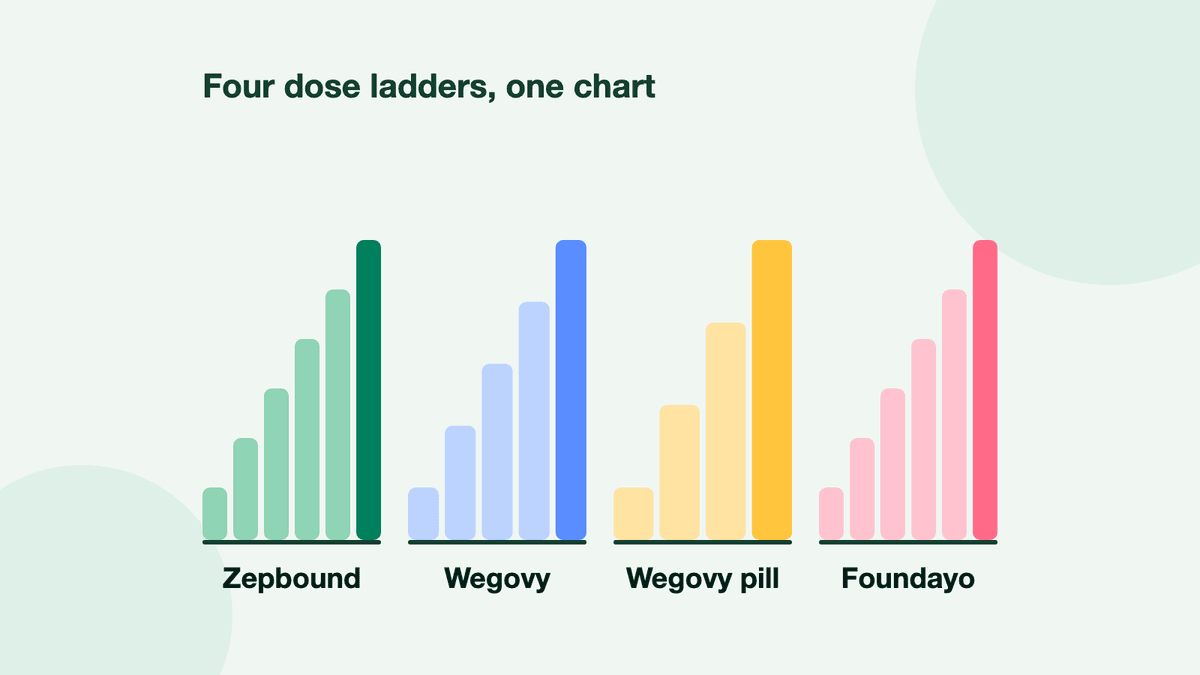
The main GLP-1 medicines for weight loss in the US are Zepbound (tirzepatide) and Wegovy (semaglutide), both weekly injections, and two daily pills: the Wegovy pill (oral semaglutide), taken on an empty stomach, and Foundayo (orforglipron), which you can take any time. In each FDA label's main trial, average weight loss was 20.9% on Zepbound 15 mg, 14.9% on Wegovy 2.4 mg, 13.6% on the Wegovy pill and 11.1% on Foundayo 17.2 mg, in separate trials. Saxenda (liraglutide), an older daily injection, is also approved; Ozempic and Mounjaro are the diabetes brands.
If you keep hearing about GLP-1 weight loss drugs and feel like everyone else already understands them, you're not behind. The names alone are a mess. Wegovy is an injection and also a pill now. Ozempic is the drug everyone talks about, except it's not actually approved for weight loss. Zepbound and Mounjaro are the same molecule with different labels. And since April 2026 there's a new daily pill called Foundayo.
This guide untangles it for a US audience. The chart comes first, so you can see every option side by side. Then what each brand is, how these drugs work, what the trials showed, what you'll pay and how to keep track without it becoming a second job.
Quick safety note: these are prescription medications. This article is general education for US readers, not medical advice. If you're taking one already, or thinking about it, talk with a clinician who knows your history.
GLP-1 comparison chart
The four main GLP-1 medicines approved for weight loss in the US, from their FDA labels. Tap a name for its full dose chart.
Zepbound
- What it is
- tirzepatide (works on GLP-1 and GIP)
- How you take it
- Injection, once a week
- Doses
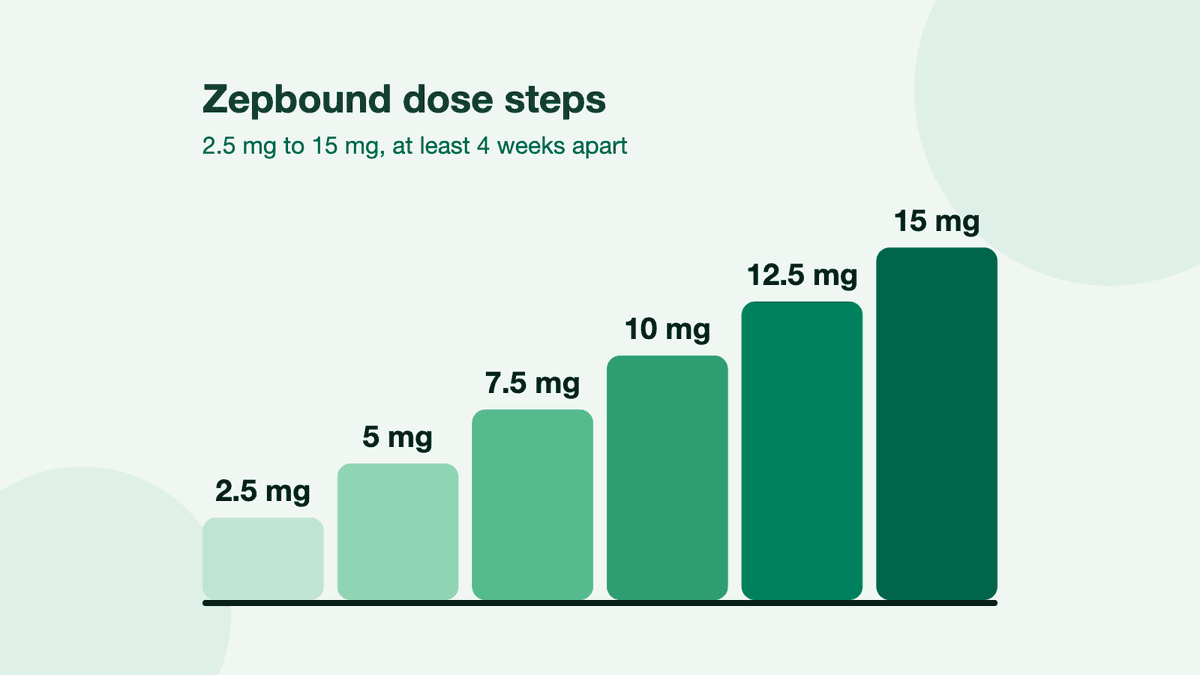
- Starts at 2.5 mg; maintenance 5, 10 or 15 mg
- Average weight loss (dose shown)
- 20.9% at 72 weeks (15 mg)
- Most common side effects
- Nausea, diarrhea, vomiting, constipation
Wegovy
- What it is
- semaglutide
- How you take it
- Injection (pen), once a week
- Doses
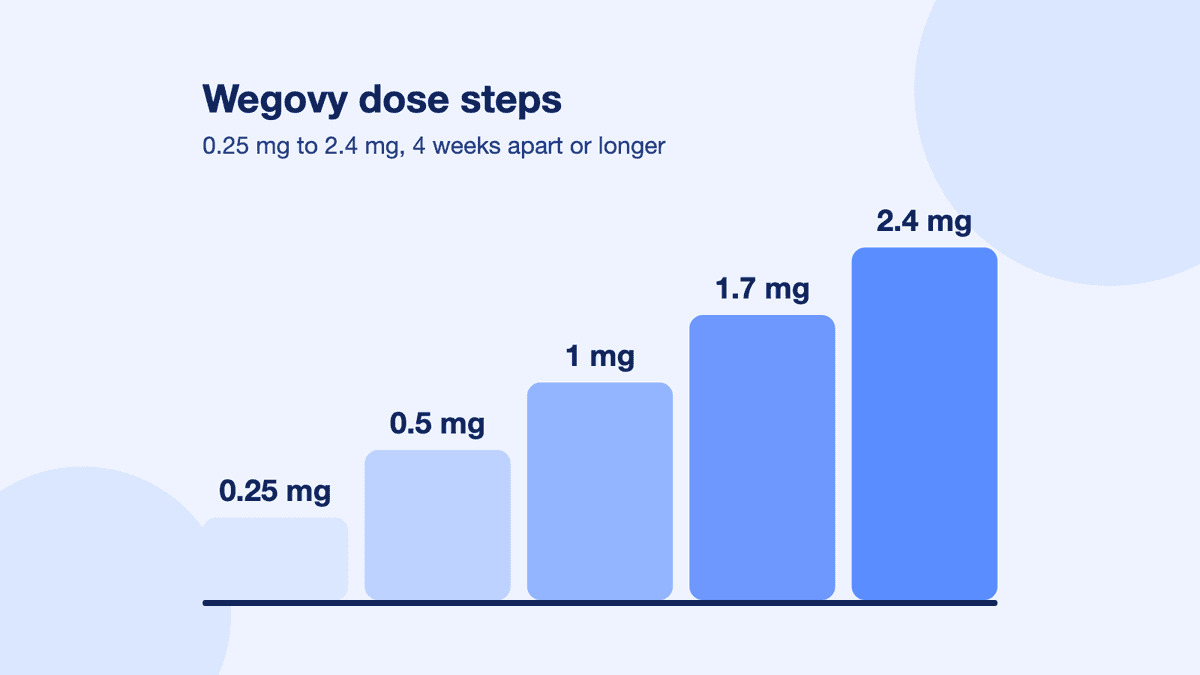
- Starts at 0.25 mg; maintenance 2.4 mg (or 1.7 mg); 7.2 mg as Wegovy HD
- Average weight loss (dose shown)
- 14.9% at 68 weeks (2.4 mg); 18.8% at 72 weeks on 7.2 mg (Wegovy HD)
- Most common side effects
- Nausea, diarrhea, vomiting, constipation
Wegovy pill
- What it is
- semaglutide, as a tablet
- How you take it
- Tablet, every morning on an empty stomach, then wait at least 30 minutes
- Doses
- Starts at 1.5 mg; maintenance 25 mg
- Average weight loss (dose shown)
- 13.6% at 64 weeks (25 mg)
- Most common side effects
- Similar to the Wegovy pen, says the label
Foundayo
- What it is
- orforglipron (a small molecule, not a peptide)
- How you take it
- Tablet, once a day, any time, with or without food
- Doses
- Starts at 0.8 mg; can go up to 17.2 mg
- Average weight loss (dose shown)
- 11.1% at 72 weeks (17.2 mg)
- Most common side effects
- Nausea, constipation, diarrhea, vomiting
How to read the results column: each figure is from the medicine's own label and counts everyone who started the trial, including people who stopped. They come from separate trials with different people and lengths, so they're landmarks, not a scoreboard.
For reference: the diabetes brands
Ozempic and Mounjaro are the names you hear most, but in the US neither is approved for weight loss. Each is the diabetes brand of a molecule in the chart above.
| Medicine | What it is | Approved for (US) | Doses |
|---|---|---|---|
| Ozempic | semaglutide, the same molecule as Wegovy | Type 2 diabetes (and lowering kidney and heart risks in type 2 diabetes) | Starts at 0.25 mg a week; up to 2 mg |
| Mounjaro | tirzepatide, the same molecule as Zepbound | Type 2 diabetes (and lowering heart risks in type 2 diabetes) | Starts at 2.5 mg a week; up to 15 mg |
Saxenda and generic liraglutide, a daily injection, are also approved for weight loss in the US. They aren't in this chart. For every step of every dose ladder, see the GLP-1 dosage chart.
Which one fits your week
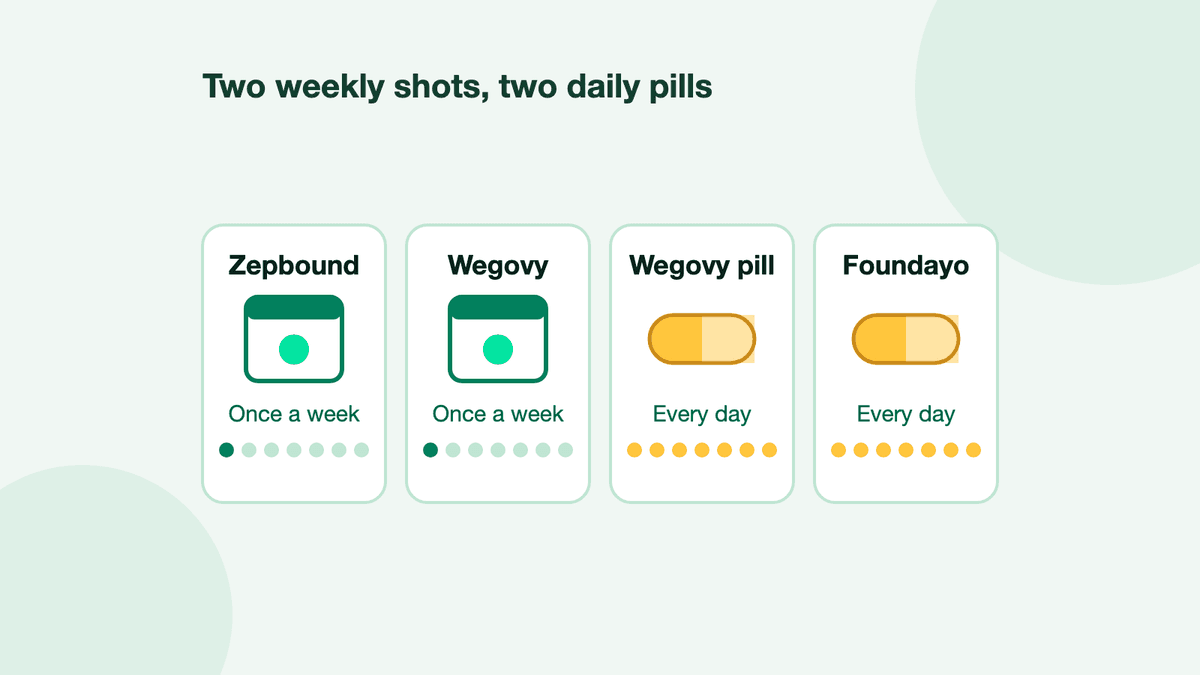
Two of these are weekly shots and two are daily pills, and the pills have different rules. If you and your prescriber are choosing, the routine can matter as much as the trial numbers.
Once a week, as a shot
Zepbound or Wegovy
One injection on the same day each week. You can change the day if you need to.
Every morning, as a pill
Wegovy pill
When you wake up, with up to 4 oz of plain water. Then wait at least 30 minutes before food, drinks or other pills.
Every day, any time, as a pill
Foundayo
With or without food or water. Some other medicines change the dose, so tell your pharmacist what you take.
Quick answers
- GLP-1 weight loss drugs are prescription medications that reduce appetite and slow stomach emptying. They're used alongside diet and activity changes.
- For weight loss in the US, the approved brands are Wegovy (injection and pill), Zepbound (injection), Foundayo (pill), and Saxenda (daily injection).
- Ozempic and Mounjaro are the diabetes brands of the same molecules. Doctors sometimes prescribe them off-label, but the weight loss labels belong to Wegovy and Zepbound.
- Almost nobody pays the list price. With commercial insurance and a savings card you might pay as little as $25 a month; self-pay through LillyDirect or NovoCare runs $149 to $449 a month (checked October 5, 2026).
- Tracking doesn't need to be perfect. Dose plus a weekly weight is a strong start, and it doubles as evidence when your insurer asks for proof the medication is working.
What are GLP-1 weight loss drugs?
GLP-1 is a hormone your gut releases after you eat. It tells your brain you're full and slows down how fast food leaves your stomach. GLP-1 drugs, properly called GLP-1 receptor agonists, are medicines that switch on the same signal, more strongly and for much longer.
People say "GLP-1" like it's one drug. It's a family. The members you'll actually run into in the US:
- semaglutide (Wegovy and Ozempic, including the Ozempic pill that replaced Rybelsus)
- tirzepatide (Zepbound, Mounjaro)
- orforglipron (Foundayo)
- liraglutide (Saxenda, an older once-daily injection)
Technically tirzepatide is a dual agonist (it works on GLP-1 and a second hormone signal called GIP), but everyone lumps it into the GLP-1 conversation, so we will too.
Which brand is which: the US cheat sheet
This table settles most of the confusion. When in doubt, look at the compound name in parentheses. That tells you what the medication actually is.
| Brand | What it is | Approved for (US) |
|---|---|---|
| Wegovy | semaglutide, weekly injection | Weight management |
| Wegovy pill | oral semaglutide 25 mg, daily tablet | Weight management (approved December 2025) |
| Ozempic | semaglutide, weekly injection | Type 2 diabetes |
| Ozempic pill (Rybelsus until May 2026) | oral semaglutide, daily tablet (lower doses) | Type 2 diabetes |
| Zepbound | tirzepatide, weekly injection | Weight management and obstructive sleep apnea |
| Mounjaro | tirzepatide, weekly injection | Type 2 diabetes |
| Foundayo | orforglipron, daily pill | Weight management (approved April 2026) |
| Saxenda | liraglutide, daily injection | Weight management |
The Zepbound and Mounjaro split trips up almost everyone, especially anyone reading advice from abroad. In the UK, the same tirzepatide injection is sold as Mounjaro for weight loss too, which is why British articles talk about "Mounjaro for weight loss" while American ones say Zepbound. Same molecule, different label rules.
The two new pills
Until late 2025, every weight loss GLP-1 was an injection. Now there are two pills, and they're different from each other in ways that matter.
Wegovy pill (oral semaglutide 25 mg)
The FDA approved it on December 22, 2025, making it the first oral GLP-1 for weight loss. It's the same molecule as the Wegovy injection, taken as a once-daily tablet that steps up from 1.5 mg to a 25 mg maintenance dose. According to the Wegovy label, in the 64-week OASIS 4 trial people on the 25 mg pill lost 13.6% of their body weight on average, against 2.4% on placebo, counting everyone who started. That's close to the weekly injection's 14.9% in its own trial. It's a peptide, so it comes with the classic oral-semaglutide rule: take it on an empty stomach with a small amount of water, then wait before eating.
Foundayo (orforglipron)
Eli Lilly's once-daily pill, FDA-approved on April 1, 2026. It was the first new molecular entity (a brand-new drug) approved under the FDA's National Priority Voucher program, which is why it moved so fast. Unlike the Wegovy pill, orforglipron is a small molecule rather than a peptide, so it can be taken any time of day with no food or water restrictions. According to the Foundayo label, in its main obesity trial (ATTAIN-1) people on the top 17.2 mg dose lost 11.1% of their body weight on average at 72 weeks, against 2.1% on placebo, counting everyone who started.
One correction worth making because it comes up constantly online: Foundayo is not retatrutide. Retatrutide is a separate Lilly drug, a triple agonist still in trials, not approved anywhere as of mid-2026. Anything sold online as "retatrutide" today is unapproved research-grade material, and that's a hard no for something you'd put in your body.
How they work
The simplest explanation that's still true: these drugs reduce appetite by making you feel full sooner and keeping food in your stomach longer.
From the FDA labels
How GLP-1 medicines work, in three steps
- In your stomach
Food leaves your stomach more slowly.
- After you eat
You feel full sooner, and stay full longer.
- Through the day
Your appetite is lower, so you tend to eat less.
Which is why people on them say things like:
- "I get full halfway through a normal plate"
- "The food noise just... stopped"
- "I walked past the pantry without thinking about it"
The changes can be subtle at first, especially at the low starter doses. That's one reason tracking helps. Your brain is terrible at remembering how hungry you used to be.
What the trials show
These numbers come from separate trials with different people, different lengths, and different designs. Each is the figure on the medicine's FDA label, which counts everyone who started, including people who stopped. The number in parentheses is what people on placebo lost in the same trial.
| Medication | Trial | Average weight loss (placebo in parentheses) |
|---|---|---|
| Wegovy injection (2.4 mg weekly) | STEP 1 | 14.9% at 68 weeks (2.4%) |
| Wegovy pill (25 mg daily) | OASIS 4 | 13.6% at 64 weeks (2.4%) |
| Zepbound (15 mg weekly) | SURMOUNT-1 | 20.9% at 72 weeks (3.1%) |
| Foundayo (17.2 mg daily) | ATTAIN-1 | 11.1% at 72 weeks (2.1%) |
Two things to hold onto. First, averages hide a huge spread; some people lose far more, some far less. Second, the "best" drug on paper isn't automatically the best for you. Tolerability, price, coverage, and whether you'd rather take a daily pill or a weekly shot all count.
Insurance, prior authorization, and what you'll actually pay
The list prices are scary on purpose: roughly $1,349 a month for Wegovy and $1,086 for Zepbound. Almost nobody pays them. As of October 5, 2026 there are four realistic ways Americans pay for these drugs.
1. Commercial insurance plus a savings card
If your plan covers the drug, the manufacturer savings card stacks on top: as little as $25 a month for Wegovy, Zepbound or Foundayo. The Wegovy and Zepbound cards save you at most $100 a month, so a big copay can still leave a bill. The catch written into every card: they're for commercially insured patients only. If you're on Medicare, Medicaid, or TRICARE, you legally can't use them. How each card works: the Zepbound savings card and the Wegovy savings card.
2. Prior authorization (the paperwork step)
Coverage usually isn't automatic. Your insurer will want a prior authorization (PA) from your prescriber, and some plans add step therapy, meaning you have to try a cheaper option first. PAs typically ask for your BMI history, any weight-related conditions like high blood pressure or sleep apnea, and evidence you've tried lifestyle changes. Renewals then ask whether the drug is working. This is where a clean log of your doses and weekly weights stops being a nice-to-have and becomes the document your appeal is built on.
3. Self-pay direct from the manufacturer
Both manufacturers now sell direct at cash prices that would have sounded like typos two years ago:
- Zepbound via LillyDirect: $299 a month for 2.5 mg, $399 for 5 mg, $449 for 7.5 mg and up, as single-dose vials or a KwikPen. On the 7.5 mg and higher doses, refills have to stay inside a 45-day window or the price goes back up to $499 for 7.5 mg and $699 for 10 mg and up.
- Foundayo via LillyDirect: $149 to $299 a month depending on dose. The 2.5 mg and 5.5 mg prices ($149 and $199) are offers that end December 31, 2026, and the top two doses stay at $299 only if you refill within 45 days.
- Wegovy injection via NovoCare Pharmacy: $349 a month at any dose from 0.25 mg to 2.4 mg, and $399 for the 7.2 mg Wegovy HD dose. New patients pay $199 for their first two fills of the 0.25 mg and 0.5 mg doses, an offer that runs to December 31, 2026.
- Wegovy pill via NovoCare: $149 for the 1.5 mg starter dose, $199 for 4 mg, and $299 for 9 mg and the 25 mg maintenance dose. GoodRx has agreed to match these prices at retail pharmacies.
Every dose and a full year's cost: what Zepbound costs without insurance and what Wegovy costs without insurance.
Telehealth services like Hims & Hers, Ro, Noom, and WeightWatchers Clinic now sell these same branded medications at roughly the manufacturer cash prices, bundled with their own prescribing and support fees. And a caution: mass-market compounded semaglutide and tirzepatide are effectively finished. The FDA shortages that allowed copies ended in 2024 and 2025, and copies became unlawful for compounding pharmacies after that. If someone's still offering a suspiciously cheap "compounded" version, be skeptical about what's in it.
4. Medicare and Medicaid
Medicare Part D has long excluded weight loss drugs, but from July 1, 2026 through the end of 2027 the Medicare GLP-1 Bridge changes that: eligible Part D enrollees can get Wegovy (injection or pill), Foundayo, and the Zepbound KwikPen for a flat $50 monthly copay. Those copays don't count toward your Part D deductible or the annual out-of-pocket cap, which is worth knowing when you plan your year. Medicaid coverage for obesity is still decided state by state.
Prices in this market have changed twice in the past year, so verify the current numbers on lilly.com or novocare.com before you commit to anything.
Common side effects
Most people don't quit these drugs because they "don't work". They quit because side effects made them miserable, usually during a dose increase. The common ones are stomach-related, because slowing digestion is literally how these drugs work.
| What you might notice | What often helps |
|---|---|
| Nausea | Smaller meals, eating slowly, going easy on greasy food for a while |
| Constipation | More fluids, adding fiber gradually, gentle movement |
| Reflux or heartburn | Smaller portions, avoiding late meals |
| Feeling "too full" | Don't force big meals; split them into smaller ones |
Two things your care team should always know: these drugs slow stomach emptying, which matters if you're scheduled for surgery or anything involving anesthesia, and they're not recommended in pregnancy. If side effects are persistent or severe, call your prescriber rather than pushing through.
What to track in Healthcount (minimum effective tracking)
Here's what happens if you track nothing: you hit a stall week, decide the drug stopped working, forget the three good weeks before it, and start changing everything at once. Your memory is not a reliable narrator on this journey.
You don't need to log everything. Start with the level that fits your life.
Level 1: "I'm busy, but I want to start"
| Track this | How often | Why it's worth it |
|---|---|---|
| Dose | Every time you take it | Keeps your timeline clear, ends the "did I take it?" panic, and builds the record your insurer wants at PA renewal |
| Weight | Once a week (or daily if you prefer) | Shows the trend even when individual days bounce around |
One US-specific bonus: if you're buying through LillyDirect self-pay, a dose log also tells you when to reorder so your refills stay inside the 45-day window that keeps the lower price on the higher doses.
Level 2: "I want better insight without obsessing"
| Track this | How often | Why it's worth it |
|---|---|---|
| Food | Most days (rough is fine) | Helps you spot patterns, not chase perfection |
| Active calories | Most days | One simple movement number you can actually stick with |
Level 3: "I want proof, even when the scale lies"
| Track this | How often | Why it's worth it |
|---|---|---|
| Body measurements | Monthly | Captures shape change even during scale stalls |
| Progress photos | Monthly | Visual proof you can't argue with |
Healthcount keeps all of this in one place: doses (weekly shots or daily pills), weight, food, measurements, and photos, so your whole journey reads as one clean timeline instead of five scattered apps.
Track your GLP-1 journey in Healthcount
Get StartedFAQs
Which GLP-1 leads to the most weight loss?
In the main trials behind each FDA label, counting everyone who started, the largest average loss was with Zepbound 15 mg: 20.9% of body weight at 72 weeks. Wegovy 2.4 mg averaged 14.9% at 68 weeks, the Wegovy pill 13.6% at 64 weeks and Foundayo 17.2 mg 11.1% at 72 weeks. Wegovy HD (7.2 mg) averaged 18.8% at 72 weeks in its own trial. These were separate trials with different people, so they're a rough guide, not a head-to-head result.
What's the difference between Wegovy and Zepbound?
They're different medicines. Wegovy is semaglutide, which works on the GLP-1 signal. Zepbound is tirzepatide, which works on GLP-1 and a second signal, GIP. Both are weekly injections for weight loss, and there's no official dose conversion between them.
What's the difference between the Wegovy pill and Foundayo?
The Wegovy pill is semaglutide. You take it when you wake up, with up to 4 oz of plain water, then wait at least 30 minutes before food, drinks or other pills. Foundayo is orforglipron, a different molecule, and you can take it any time of day, with or without food.
What is the brand name for tirzepatide?
In the US, tirzepatide is sold as Zepbound, for weight loss and obstructive sleep apnea, and as Mounjaro, for type 2 diabetes. Both are weekly injections made by Eli Lilly.
What is the brand name for semaglutide?
In the US, semaglutide is sold as Wegovy (a weekly injection or a daily pill, for weight loss), Ozempic (a weekly injection for type 2 diabetes, and since May 2026 a daily tablet for type 2 diabetes that replaced Rybelsus). All are made by Novo Nordisk.
What are GLP-1 weight loss drugs?
Prescription medications that support weight loss by reducing appetite and slowing stomach emptying, used alongside diet and activity changes.
What's the difference between Wegovy and Ozempic?
Both are semaglutide, but Wegovy is approved for weight management and Ozempic for type 2 diabetes. If your goal is weight loss, Wegovy is the on-label option.
Is Zepbound the same as Mounjaro?
Same drug (tirzepatide), different labels. In the US, Zepbound covers weight loss and obstructive sleep apnea; Mounjaro covers type 2 diabetes.
Is Foundayo the same as retatrutide?
No. Foundayo is orforglipron, a daily GLP-1 pill approved by the FDA on April 1, 2026. Retatrutide is a different drug that's still in trials and isn't approved anywhere.
Pill or injection: which is better?
Whichever one you'll actually take consistently. The weekly injections posted the biggest trial numbers, but a daily pill you never skip beats a weekly shot you dread.
Will my insurance cover a GLP-1 for weight loss?
Check your plan's formulary. Many commercial plans cover at least one, usually behind a prior authorization and sometimes step therapy. With coverage plus a manufacturer savings card, copays can drop to as little as $25 a month.
What if my prior authorization gets denied?
Appeals succeed more often than people expect, especially with documentation: BMI history, weight-related conditions, and a dated log showing doses taken and weight change. Your prescriber's office handles the filing, but your records make their case stronger.
How much will I pay without insurance?
Checked October 5, 2026: $149 to $449 a month buying direct from the manufacturers, depending on the drug and dose. Check lilly.com or novocare.com before you pay, because prices have changed more than once this year.
Does Medicare cover these drugs?
The Medicare GLP-1 Bridge (July 1, 2026 through December 31, 2027) gives eligible Part D enrollees Wegovy, Foundayo, and the Zepbound KwikPen at a flat $50 monthly copay.
What should I track while taking a GLP-1?
Minimum effective tracking is dose plus weight. If you can do more, add what you eat, then monthly photos and measurements. A clean dose and weight log also helps with prior authorization renewals.
How often should I weigh myself?
Anywhere from weekly to daily works. Pick whatever keeps you consistent without stressing you out, and judge progress by the trend, not any single morning.
Do I need to track everything to succeed?
No. If you only log dose and weight for the first month, that's a real start, and you can build from there.
One calm dashboard for your whole journey
Weight, food, doses, and side effects in one place. Free, and no app download needed.
Sign up freeView sources (17)
- Wegovy (semaglutide) injection and tablets US prescribing information, Novo Nordisk, revised 06/2026
- Zepbound (tirzepatide) US prescribing information, Eli Lilly, revised 08/2026
- Foundayo (orforglipron) US prescribing information, Eli Lilly, revised 07/2026
- Ozempic (semaglutide) US prescribing information, Novo Nordisk, revised 05/2026
- Mounjaro (tirzepatide) US prescribing information, Eli Lilly, revised 08/2026
- FDA approves Novo Nordisk's Wegovy pill, the first oral GLP-1 for weight loss, December 2025
- FDA approves Lilly's Foundayo (orforglipron), April 2026
- FDA approves first new molecular entity under National Priority Voucher program, FDA press announcement
- STEP 1 trial: once-weekly semaglutide in adults with overweight or obesity, NEJM 2021
- SURMOUNT-1 trial: tirzepatide once weekly for the treatment of obesity, NEJM 2022
- Zepbound self-pay terms and conditions, LillyDirect
- NovoCare Pharmacy self-pay pricing, Novo Nordisk
- Wegovy savings offer, NovoCare
- Zepbound savings card, Lilly
- What to know about the BALANCE model for GLP-1s in Medicare and Medicaid and the Medicare GLP-1 Bridge, KFF
- Medicare GLP-1 Bridge, CMS
- Medicare GLP-1 Bridge: GLP-1 drugs for $50 a month, Medicare.gov (PDF)