Medical Disclaimer: This is general information for US readers, not medical advice. The Wegovy pill is a prescription medication. Dosing decisions belong to you and your prescriber; a tracker just helps you both see what's actually happening.
The Wegovy pill reached US pharmacies in early January 2026, a few weeks after the FDA approved it on December 22, 2025. It's the first oral GLP-1 for weight loss, which means a lot of people are now running a routine nobody had before: a daily tablet with strict morning rules, instead of a weekly shot.
That routine is exactly why tracking matters more with the pill than with an injection. This guide covers what to log, how the empty-stomach rule fits into it, what to watch during dose step-ups, and how to handle missed doses without lying to yourself.
Quick facts (30 seconds)
| Question | Quick answer |
|---|---|
| What is the Wegovy pill? | Once-daily oral semaglutide, taken up to a 25 mg maintenance dose. FDA approved December 22, 2025. |
| How is it taken? | First thing in the morning, empty stomach, swallowed whole with no more than 4 ounces of plain water. Then nothing to eat or drink for at least 30 minutes. |
| How well does it work? | About 16.6% average weight loss over 64 weeks for people who stayed on it in the OASIS 4 trial. Comparable to the weekly injection. |
| What does it cost? | As of October 5, 2026: $149 to $299 a month cash via NovoCare Pharmacy, as little as $25 with commercial insurance plus the savings offer, or a $50 copay for eligible Medicare Part D enrollees. |
| What should I track? | The daily pill (taken or not, and when), weight trend, rough food logs, and side effects around dose step-ups. |
A daily pill changes what tracking means
A weekly injection gives you 52 medication events a year. The pill gives you 365, and each one comes with rules attached. That's the trade you make for skipping needles.
With that many small decisions, adherence quietly becomes the whole story. Miss two mornings a week and you've taken about 70% of your doses without ever feeling like you skipped anything. Your memory will smooth that over. A log won't.
So the questions a tracker answers for you are simple:
- Did I actually take it today? (Harder to answer at 9 pm than you'd think.)
- How consistent has my morning routine been this month?
- Is my weight trend moving the way it should at this dose?
- Do my side effects cluster right after a step-up, or are they constant?
None of this needs to be obsessive. Two minutes a day covers it.
The empty-stomach morning routine
Oral semaglutide is poorly absorbed, so the label is strict. When you first wake up: take the tablet on an empty stomach, swallow it whole with no more than 4 ounces of plain water, then wait at least 30 minutes before you eat, drink anything else, or take other oral medications.
In practice that means coffee waits. Breakfast waits. Your morning vitamins and any other oral meds wait their turn. The 30 minutes isn't arbitrary; food and other drinks cut how much of the medicine your body absorbs, which is the whole reason the rule exists.
Two tracking habits make this routine much easier to hold:
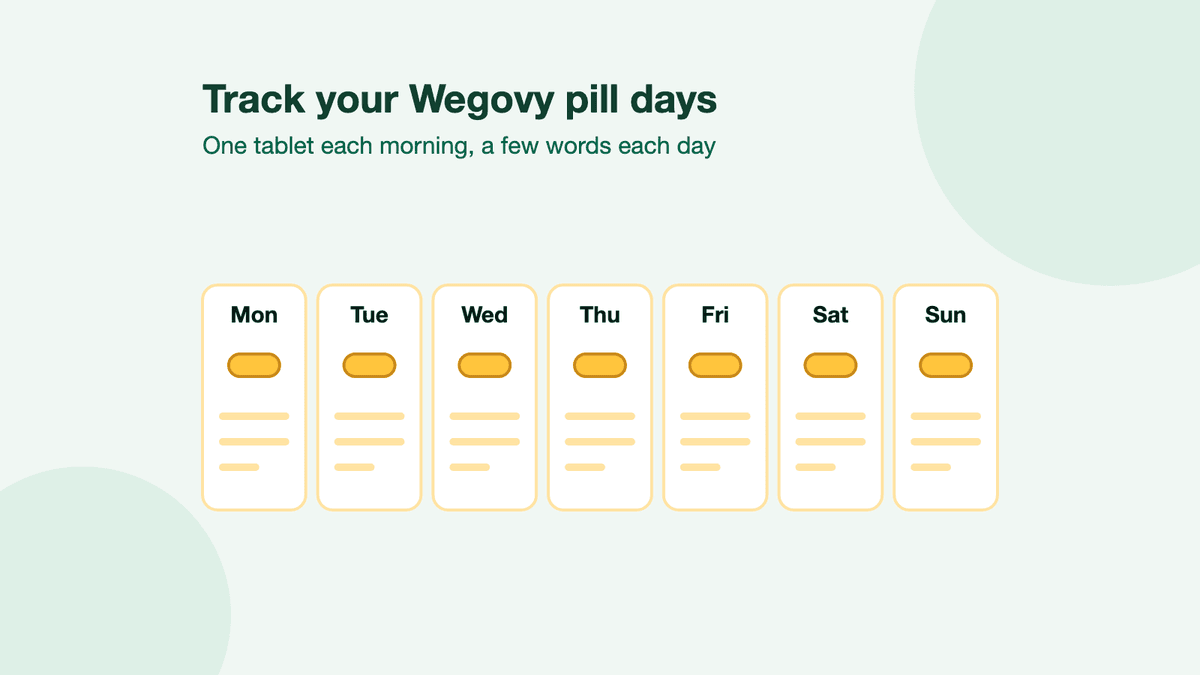
- Log the time you take it. One tap. Over a month you'll see whether "first thing in the morning" is really 6:45 am on weekdays and 10:30 am on weekends.
- Note the sloppy mornings. A quick "only waited 15 minutes" or "took it with juice, oops" is genuinely useful. If your progress slows, you and your prescriber can check whether the routine slipped before assuming the dose stopped working.
And if the morning ritual turns out to be the thing you hate most? That's worth knowing too. Foundayo (orforglipron), the other weight loss pill, approved April 1, 2026, has no food or water restrictions at all. It lost less weight in its trial, about 12.4% at the top dose over 72 weeks, but for some people an easier routine they'll actually stick to beats a stricter one they won't. That's a prescriber conversation, and your adherence log is the evidence to bring to it.
The routine is the hard part. Tracking it is the easy part.
Healthcount logs your daily pill, weight, food, and side effects in about two minutes a day. No app download needed.
Start Tracking FreeWhat to track (and how often)
Here's the plan that works in real life. Not everything, every day, forever. Just the things that tell you whether this is working.
| What to track | Best frequency | Why it helps |
|---|---|---|
| Your daily pill | Every morning, with the time | Adherence is the number one variable with a daily tablet. This is the log everything else gets read against. |
| Weight | Daily if you can, judged weekly | Daily weight bounces around with water, salt, and sleep. The weekly average is the real trend. |
| Food | Daily, rough is fine | "Chicken salad" is enough. Patterns show up fast: weekends, snacks, the 4 pm slump. |
| Side effects | When they happen | Nausea and stomach trouble usually cluster after dose step-ups. A dated log turns "I've felt off lately" into something your prescriber can use. |
| Measurements (waist, hips) | Monthly | The tape measure moves slower than the scale but tells a steadier story. |
| Progress photos | Monthly, optional | Photos catch changes the scale misses. Start whenever you feel ready, or never. Your call. |
Notice what's missing: calorie targets, macro splits, streaks. If you want those, plenty of apps offer them. This plan is built to survive a busy week, because a tracking habit you abandon in March tells you nothing in June.
The dose ladder: 1.5 to 25 mg
The pill comes in four strengths: 1.5 mg, 4 mg, 9 mg, and 25 mg. You start at 1.5 mg once daily and step up every 30 days as tolerated until you reach the 25 mg maintenance dose. Same slow-ramp idea as the injection, stretched over a few months.
Each step-up is the moment to pay attention. Side effects like nausea, vomiting, and constipation are most likely in the weeks after a dose increase, and "as tolerated" is doing a lot of work in that schedule. If your log shows rough days stacking up after a step, your prescriber may hold you at the lower dose longer. Without a log, that conversation is guesswork on both sides.
One number worth flagging because it confuses almost everyone: 25 mg of the pill is not a bigger dose than the 2.4 mg weekly injection. Pills are absorbed far less efficiently than injections, so the milligram numbers aren't comparable across formats. We wrote a whole piece on this: why the 25 mg pill and the injection doses aren't the same thing.
Missed doses: log them, don't hide them
The rule from the prescribing information is simple: if you miss a dose, skip it and take your next dose the following day. Never take two tablets in one day to catch up.
The tracking rule is just as simple: log the miss. This is where most self-tracking quietly fails. People log the good days and skip the bad ones, and the record turns into a highlight reel instead of data.
Three missed mornings in a week isn't a moral failing. It's information. Maybe the routine doesn't fit your shift pattern. Maybe the pill bottle lives in the wrong room. An honest log spots the pattern early, while it's still a tweak rather than a stalled few months.
Cost and access in the US
Short version, checked October 5, 2026, because these numbers have moved several times this year:
- Cash: through NovoCare Pharmacy, the 1.5 mg starter dose runs $149 a month, 4 mg is $199, and 9 mg and the 25 mg maintenance dose are $299. GoodRx has agreed to match Novo's cash price at retail pharmacies.
- Commercial insurance: with coverage plus Novo's savings offer, it can be as little as $25 a month. Savings cards aren't available to people on Medicare or Medicaid.
- Medicare: from July 1, 2026, eligible Part D enrollees can get Wegovy, including the pill, for a flat $50 monthly copay under the Medicare GLP-1 Bridge, which runs through the end of 2027.
- Telehealth: platforms like Ro, WeightWatchers Clinic, and Hims & Hers now sell the branded pill at cash prices in line with NovoCare's. Compounded "copies" are a dead end. Hims tried a $49 compounded version in February 2026, pulled it within days under FDA pressure, and now sells the branded pill instead.
For the full picture across Wegovy, Zepbound, and Foundayo, see our US GLP-1 price guide. And if you want the deeper background on the pill itself, we've covered what the Wegovy pill is and how it compares to the injection separately.
How Healthcount fits in
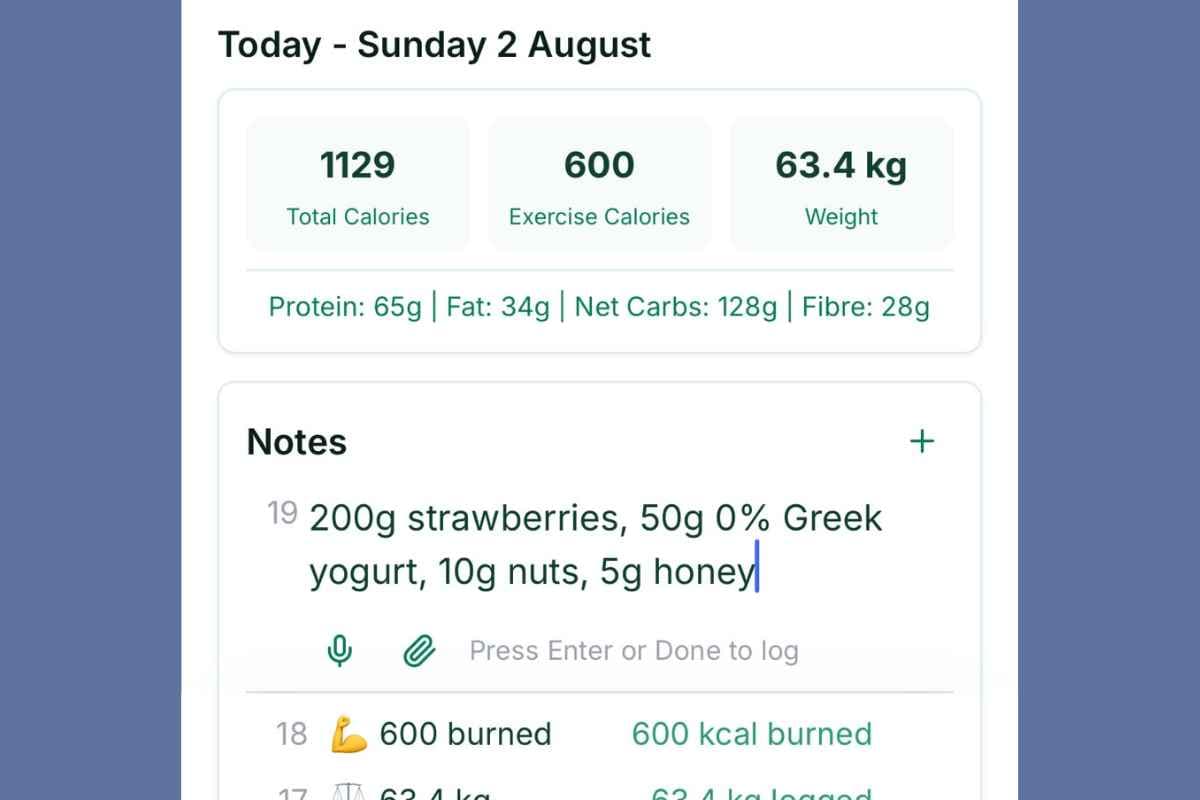
Healthcount is a calm, simple dashboard for exactly this. Day one takes about three minutes:
- Sign up with email. No app download, no long forms.
- Log today: your pill, your weight, one meal.
- Check your snapshot: dose, weight trend, and food on one screen.
After that, come back for your two-minute check-in most days. Measurements and progress photos are there when you want them, ignored when you don't.
I built this because I'm on a weight loss journey myself. I went from 170 pounds and 32% body fat to 141 pounds and 23% in six months, and the thing that made the difference wasn't willpower. It was tracking the right things consistently instead of juggling screenshots, notes apps, and a memory that flattered me. This is the dashboard I wish I'd had from day one.
Ready to see your whole Wegovy pill journey on one page?
Weight, food, doses, and side effects in one place. Free, and it takes about 30 seconds to start.
Sign Up FreeFAQs
Do I have to log every single thing I eat?
No. Rough logs beat perfect ones you quit. Most people jot down breakfast, lunch, and dinner in plain words, and that's plenty to spot patterns over a few weeks.
What if I forget whether I took today's pill?
This is the classic daily-medication problem, and it's the strongest argument for logging at the moment you take it. If you genuinely can't remember and didn't log it, don't take a second tablet; the never-double rule applies. Skip forward and log tomorrow's dose the moment it goes down.
Can I use Healthcount if I'm on Zepbound or Foundayo instead?
Yes. Zepbound (tirzepatide, the same medicine as the diabetes drug Mounjaro) is a weekly injection, so the rhythm is different, but the habit is the same. Foundayo is also a daily pill, minus the food and water rules. Healthcount handles all three.
Is this medical advice?
No. Healthcount is a tracking and awareness tool, not a medical service. It doesn't prescribe doses or diagnose anything. Follow your prescriber's guidance for all medical decisions; the tracker's job is to make those conversations better informed.
Is my data private?
Yes. Your data is encrypted in transit and at rest, it's never sold, and it isn't used to train AI models. You can delete your account and everything in it at any time. Details are in our privacy policy.
View sources (10)
- FDA approves Novo Nordisk's Wegovy pill, the first and only oral GLP-1 for weight loss in adults, Novo Nordisk press release, December 2025
- Wegovy (semaglutide) US prescribing information, Novo Nordisk
- Wegovy pill guide and dosing information, wegovy.com
- Oral semaglutide at a dose of 25 mg in adults with overweight or obesity (OASIS 4), NEJM 2025
- Novo's Wegovy pill makes US debut, starter dose launching at $149 a month, Fierce Pharma, January 2026
- NovoCare Pharmacy self-pay pricing, Novo Nordisk
- GoodRx to match Novo Nordisk price for oral semaglutide, AJMC, 2026
- Medicare GLP-1 Bridge: GLP-1 drugs for $50 a month, Medicare.gov (PDF)
- What to know about the BALANCE model for GLP-1s in Medicare and Medicaid, KFF
- FDA approves Lilly's Foundayo (orforglipron), Eli Lilly press release, April 2026