Cronometer is a genuinely good nutrition tracker. If you want to know your selenium intake to two decimal places, it might be the best tool ever built for the job. This isn't a takedown.
But the free version shows ads, removing them costs about $132 a year if you pay monthly, and there's a bigger issue for a lot of American users in 2026: Cronometer wasn't built for GLP-1 medications. No dose schedule, no missed-dose logic, no side effect tracking out of the box. If you're on Zepbound, Wegovy, or one of the new pills, that's most of your health life happening outside your tracker.
Healthcount is a free alternative that keeps food, weight, doses, symptoms, and progress photos in one place. No ads, no premium tier, no credit card. Here's an honest comparison so you can decide whether it fits.
What Cronometer does well
Credit where it's due, because Cronometer earned its reputation:
- Micronutrient depth. It tracks up to 95 nutrients and compounds, including 82 micronutrients, and that depth is available on the free tier. Nobody else goes this deep.
- Data quality. The database has over a million verified foods, leaning on lab-analyzed sources like the USDA and NCCDB rather than crowdsourced guesses.
- Barcode scanning for packaged foods.
- Device syncing with Fitbit, Garmin, and Apple Health.
- A recipe builder for meals you cook on repeat.
If deep micronutrient data is the main thing you want, stay put. Sincerely. Cronometer is excellent at that specific job.
Where it falls short
The gaps show up when your tracking needs go beyond nutrients:
- Ads on the free tier. Removing them means Cronometer Gold at $10.99 a month, or $59.88 a year if you pay annually.
- No GLP-1 medication tracking. There's no dose ladder, no injection day reminder, no missed-dose rules, and no countdown on how many doses you have left before a refill.
- Symptom tracking is do-it-yourself. Gold subscribers can build custom biometrics to chart nausea or fatigue, but you're assembling the system yourself, behind the paywall.
- No progress photos. The scale is one measure of progress. Photos and a tape measure often tell you more, and Cronometer stores neither.
- Cycle tracking needs extra hardware or DIY. Cronometer's cycle insights come from an Oura ring integration, with custom biometrics as the manual fallback.
- Logging can feel slow. Everything runs through database search. Fine for a weighed chicken breast, tedious for a mixed plate at a restaurant.
Healthcount vs Cronometer: feature by feature
Both apps are honest products. They're just aimed at different people.
| Feature | Healthcount | Cronometer |
|---|---|---|
| Price | Free, every feature | Free with ads; Gold $10.99/mo or $59.88/yr |
| Ads | None, ever | Yes, on the free tier |
| Nutrition tracking | Calories, protein, carbs, fats, fiber, net carbs | Up to 95 nutrients, including 82 micronutrients |
| Barcode scanning | Not yet | Yes |
| AI meal photo analysis | Yes | No |
| Natural language logging | Yes | No, search-based entry |
| GLP-1 dose tracking and reminders | Yes, weekly injections and daily pills | No |
| Side effect logging | Built in, 11 GLP-1 symptoms with severity | DIY custom biometrics (Gold) |
| Progress photos and measurements | Yes | No |
| Period tracking | Built in, with phase predictions | Via Oura ring or custom biometrics |
| AI guide for your diary | Yes | No |
| Wearable syncing | Not yet | Fitbit, Garmin, Apple Health |
Notice Healthcount loses two rows. If barcode scanning or Garmin syncing is non-negotiable for you, that matters, and pretending otherwise would be silly. The trade is depth on nutrients for breadth across your whole routine: food, weight, medication, and side effects together.
Try Healthcount free
Every feature included. No ads, no credit card, no upgrade prompts.
Start tracking freeWhat you actually pay
Cronometer's free tier is usable, ads and all. To remove the ads and unlock Gold extras like custom biometrics, you pay $10.99 a month, or $59.88 for a year upfront. Over three years of monthly billing that's just under $400 for a food diary.
Healthcount is free. Not free-with-a-catch, not a trial. The whole app.
The subscription math hits differently if you're on a GLP-1, which brings us to the real gap.
The GLP-1 gap
The US market moved fast over the past year, and trackers haven't kept up. Here's the current lineup for weight loss:
- Zepbound (tirzepatide): a once-weekly injection from Eli Lilly, available as pens or lower-cost single-dose vials through LillyDirect. One naming quirk: in the US, Mounjaro is the type 2 diabetes brand of the same molecule, while UK readers know Mounjaro as the weight loss brand. If you found dosing advice written for a UK audience, that's why it reads strangely.
- Wegovy (semaglutide): Novo Nordisk's once-weekly pen, plus, since its FDA approval in December 2025, a once-daily 25 mg pill. In the OASIS 4 trial the pill averaged around 16.6% weight loss at 64 weeks, in the same range as the injection.
- Foundayo (orforglipron): Lilly's once-daily pill, FDA approved on April 1, 2026, with no food or water restrictions around dosing. Trials showed roughly 12.4% average weight loss at 72 weeks on the top dose.
Each of these comes with its own tracking burden. Weekly injections have a dose ladder to climb and a 4-day missed-dose window to respect. Daily pills live or die on streaks, because a pill you forget three times a week is a pill that isn't working.
And the money side rewards good records. As of October 5, 2026, cash prices through the manufacturers' own pharmacies run $299 to $449 a month for Zepbound, $349 for the Wegovy injection ($199 for a new patient's first two fills of the starter doses, through the end of 2026), $149 to $299 for the Wegovy pill, and $149 to $299 for Foundayo. Lilly's discounted prices require refills within a 45-day window; let it lapse and the price jumps. With commercial insurance and a manufacturer savings card, many people pay as little as $25 a month, though those cards exclude anyone on Medicare, Medicaid, or TRICARE. Medicare Part D enrollees got their own route on July 1, 2026: a flat $50 monthly copay under the Medicare GLP-1 Bridge.
A note on prices: the medicine prices above are the published cash and copay prices, checked October 5, 2026. They've changed several times this year, so check lilly.com and novocare.com before making decisions. And nothing here is medical advice; dosing decisions belong with your prescriber.
So you're managing a medication schedule, a side effect pattern, a refill deadline worth real dollars, and a weight trend. None of that fits in a micronutrient spreadsheet. It needs dose logs sitting next to weight charts, symptoms tied to dose changes, and a countdown to your next refill.
One more piece of math. If you're paying $149 to $449 a month for the medication, plus maybe a telehealth membership on top, another $60 a year for the food diary is the easiest line item to cut.
What Healthcount adds
These are the pieces Cronometer doesn't have, and they're all free:
AI meal photo analysis
Snap a photo of your plate and get calorie and macro estimates in seconds. No searching a database for each ingredient of a burrito bowl. Take the photo, confirm, done.

Natural language logging
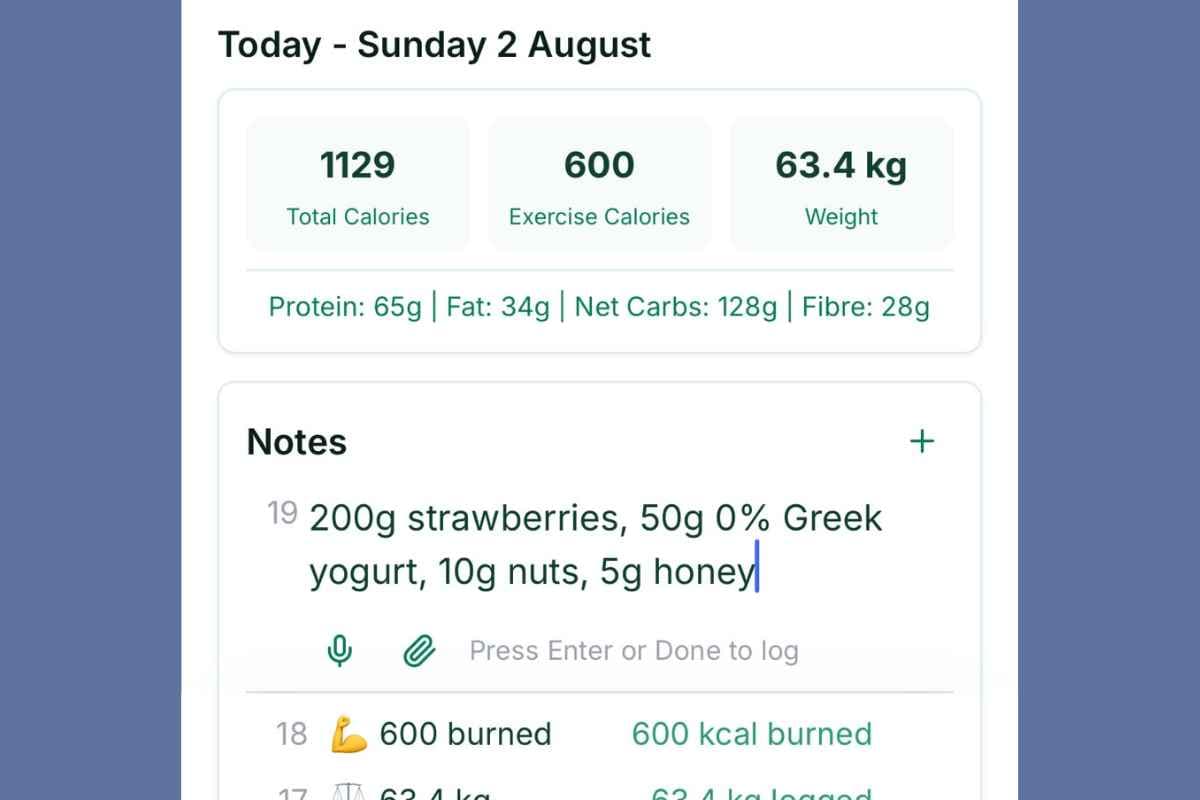
Type "2 eggs, toast with butter" and it's logged with macros. On days when even that feels like too much, the photo option has your back.
GLP-1 dose tracking
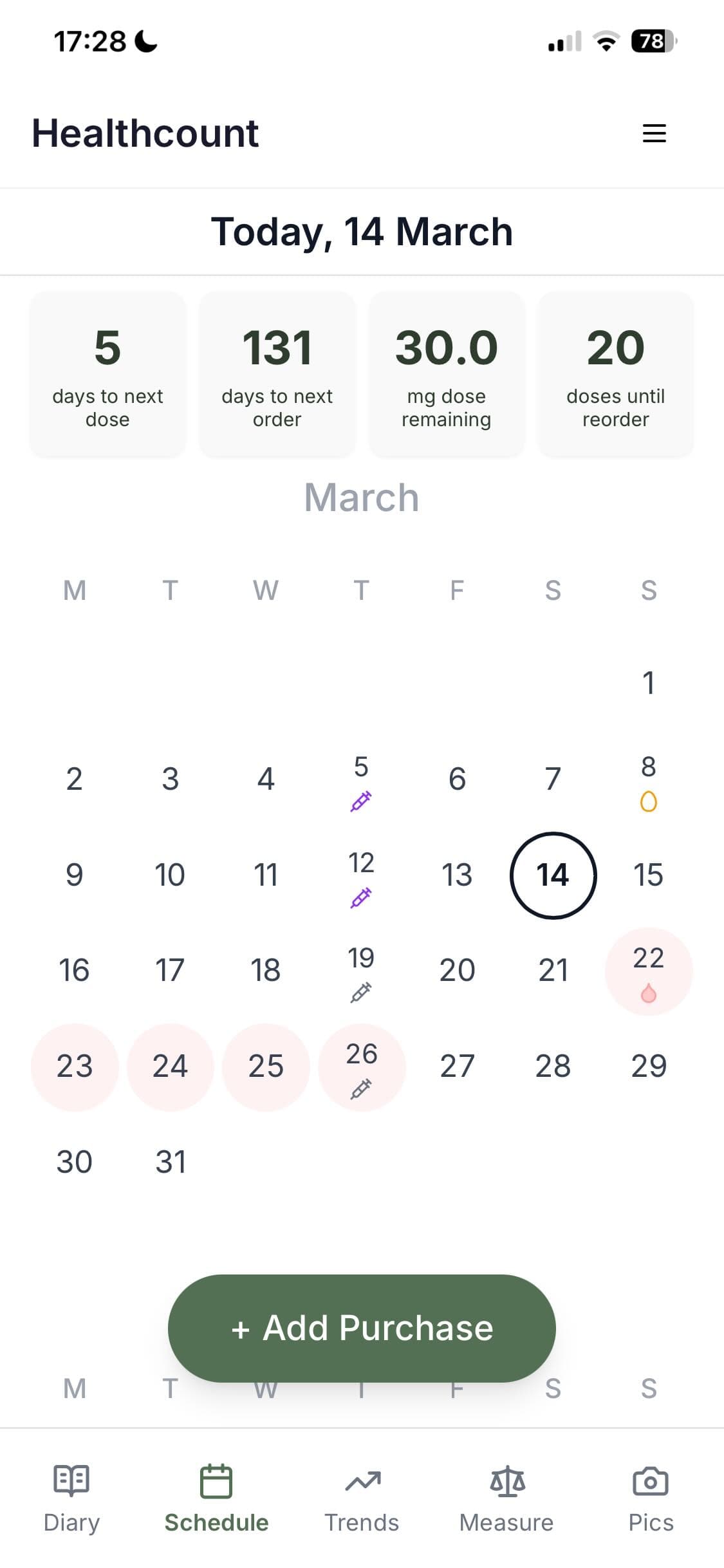
Log every Zepbound or Wegovy injection with the date and dose strength, or follow a daily schedule for the Wegovy pill and Foundayo. Healthcount knows when your next dose is due, estimates how long your supply will last, and reminds you to reorder in time. If you're on LillyDirect self-pay, that supply countdown is what keeps your refills inside the 45-day window.
Symptom and side effect logging
Track 11 common GLP-1 side effects, from nausea to injection site pain, each with a severity rating and time of day. Over weeks, the heatmap shows patterns you'd never spot from memory, like nausea clustering right after dose increases. That's a useful printout to bring to an appointment.
Progress photos and measurements
Dated photo collections with side-by-side comparison of your earliest and latest shots, plus body measurements at 7 points. Some months the scale refuses to move while your waist measurement quietly drops. You want a record of both.
Period tracking
Built-in cycle logging with phase predictions and ovulation estimates, no ring required. Period dates overlay your weight and symptom charts, which makes cycle-related patterns obvious instead of mysterious.
An AI guide for your diary
Healthcount's guide reads what you have logged and the notes you have written, and answers questions about your own records and about using the app. It can put an entry on a card for you to confirm, and it nudges you toward eating at regular times. It answers from your own diary, not with generic tips about drinking more water. It is not a coach or a therapist, and it does not give medical advice.
Who's switching
The GLP-1 user
On Zepbound, Wegovy, or one of the pills, and tired of running a tracker for food plus a notes app for doses plus a camera roll full of unlabeled progress photos. One dashboard replaces all three.
The ad-fatigued tracker
Just wants to log lunch without sitting through another ad, and doesn't think ad removal should be a $59.88-a-year purchase.
The subscription-fatigued budgeter
Already paying for the medication, maybe a telehealth membership, maybe a gym. The tracker is the one piece of the stack that can genuinely cost nothing.
FAQs
Is Healthcount really free?
Yes. Every feature is included, with no ads, no credit card, and no usage limits. There's no premium tier waiting behind a door.
Does Healthcount track micronutrients like Cronometer?
No. Healthcount tracks calories, protein, carbs, fats, fiber, and net carbs. If you need all 82 micronutrients, Cronometer is the better tool for that specific job. Most people tracking macros alongside a GLP-1 routine don't need that depth.
Does Healthcount have barcode scanning?
Not yet. AI photo analysis and natural language input cover most of the same ground, and many users find them faster than scanning packages one by one.
Can I import my Cronometer data?
Not automatically right now. You can export your Cronometer data for your records, then use Healthcount's fast logging to rebuild your common meals. Import tools are on the list.
Does Healthcount work with the GLP-1 pills?
Yes. Daily schedules for the Wegovy pill and Foundayo, weekly schedules for Zepbound and the Wegovy injection, all with reminders and supply countdowns.
Is Healthcount on the App Store?
Healthcount is a progressive web app, so it runs in the browser on iPhone, Android, tablet, or desktop. No download, no storage space, no update nags. Visit healthcount.app and sign in.
Is my data safe?
Yes. Healthcount is built to European GDPR privacy standards, which are stricter than most US state privacy laws. Your data is never sold, and you can export everything, photos included, as a ZIP file whenever you like.
One calm dashboard for your whole journey
Food, weight, doses, and side effects in one place. Free, and no app download needed.
Sign up freeView sources (10)
- Cronometer Gold subscription pricing, Cronometer
- What's included under the free account in Cronometer, Cronometer Blog
- Cycle tracking (Oura integration), Cronometer support
- Zepbound self-pay terms and conditions, LillyDirect
- Zepbound savings card, Lilly
- NovoCare Pharmacy self-pay pricing for Wegovy, Novo Nordisk
- FDA approves Novo Nordisk's Wegovy pill, the first oral GLP-1 for weight loss, Novo Nordisk press release, December 2025
- FDA approves Lilly's Foundayo (orforglipron), Eli Lilly press release, April 2026
- Medicare GLP-1 Bridge, CMS
- What to know about the BALANCE model for GLP-1s in Medicare and Medicaid, KFF