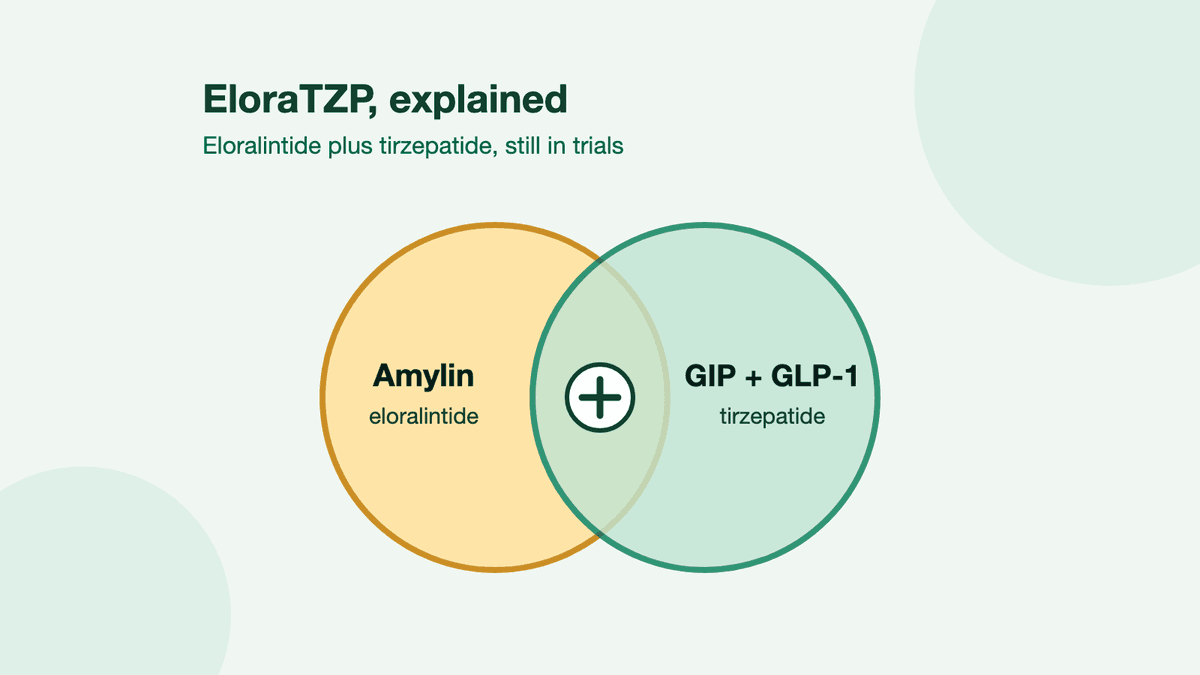
EloraTZP is Eli Lilly's experimental pairing of eloralintide, an amylin drug, with tirzepatide, the medicine in Mounjaro. In a 48-week phase 2 trial of 367 adults with obesity or overweight and type 2 diabetes, the highest-dose combination gave 23.3% weight loss on average, against 14.8% on tirzepatide 15 mg alone, if everyone had stayed on treatment. More people stopped because of side effects: 10.8% to 27.0% on the combinations, against 2.9% on tirzepatide. It isn't licensed anywhere, and Lilly plans to start phase 3 trials by the end of 2026.
Eloralintide and EloraTZP aren't licensed anywhere. Don't add anything bought online to your Mounjaro.
Both are still in clinical trials, so there's no legal supply in the UK. Anything sold online as eloralintide, often labelled "for research only", is not the medicine from Lilly's trials, and nobody has checked what's in it, how strong it is or whether it's sterile. The combination has only ever been given inside trials, with doctors watching. This page explains published research. It isn't advice.
At the end of September, Lilly put out a number that made a lot of people on Mounjaro look twice: 23.3% average weight loss, in people with type 2 diabetes, a group that usually loses less weight on these medicines than anyone. The drug behind it has an awkward name, EloraTZP, and an even more awkward ingredient list.
Here's what it actually is, what amylin does, what the trial found, and the part of the press release that deserves as much attention as the headline: how many people stopped.
What EloraTZP is
EloraTZP is two medicines given together. Eloralintide is an experimental once-weekly injection that copies amylin, a fullness hormone. Tirzepatide is the medicine already sold as Mounjaro, which acts on two other gut hormone receptors, GIP and GLP-1. "TZP" is shorthand for tirzepatide.
In the phase 2 trial, the two were given as separate weekly injections (HCPLive). For phase 3, Lilly plans a single combined injection, which it calls a co-formulation, with what it describes as an optimised way of stepping up the dose (Eli Lilly).
Amylin, in plain English
Amylin is a hormone your pancreas releases at the same time as insulin, when you eat. It's made by the same cells and comes out in the same little packets (Symlin label). Once it's in your blood, it does a few useful things at once.
From the pramlintide (Symlin) label
What amylin does after a meal
Tells your brain you've had enough
It works on appetite through the brain, by a different route from GLP-1.
Slows your stomach
Food leaves your stomach more slowly, so you stay full for longer.
Calms glucagon after meals
It dampens glucagon, a hormone that pushes blood sugar up, which helps with sugar control.
Here's one way to picture it. If GLP-1 is one voice telling your brain "that's enough", amylin is a second voice from a different room saying the same thing. Two voices are harder to ignore than one. That's the idea behind pairing them, and it's why amylin drugs are the busiest corner of obesity research right now: Novo Nordisk's CagriSema and amycretin are built on the same idea.
Amylin medicines aren't brand new. Pramlintide was approved in the US in 2005 as a mealtime injection for people with diabetes who use insulin. It was never a weight-loss medicine, and it has since been discontinued there (MedlinePlus).
What the trial found
The phase 2 trial ran for 48 weeks in 367 adults with obesity or overweight and type 2 diabetes, in the US and Argentina. People were split into ten groups: placebo, eloralintide alone, tirzepatide alone, or one of several EloraTZP combinations (Eli Lilly). On average they started at about 105 kg.
The highest-dose combination gave 23.3% weight loss, against 14.8% on tirzepatide 15 mg alone, the top dose of Mounjaro. The other combinations gave between 13.2% and 19.9%, so the lowest one did a little less than tirzepatide alone. Eloralintide on its own gave between 8.2% and 12.3%, and placebo 3.0%.
Company-reported trial data
Average weight lost after 48 weeks, people with type 2 diabetes
Lilly's phase 2 EloraTZP trial, if everyone had stayed on treatment
- Eloralintide, alone or combined
- Tirzepatide alone, or placebo
| Trial group | Average weight lost |
|---|---|
| EloraTZP, highest-dose combination | 23.3% |
| Tirzepatide 15 mg alone | 14.8% |
| Eloralintide alone, best group | 12.3% |
| Placebo | 3.0% |
Blood sugar improved too. HbA1c, the long-term blood sugar measure, fell by up to 2.9 points on EloraTZP against 2.4 points on tirzepatide 15 mg alone, from an average starting level of 8.1%.
Three honest caveats before anyone gets carried away:
- The trial's main test was EloraTZP against placebo. The comparison with tirzepatide was a secondary question, in small groups of about 37 people each.
- The figures assume everyone stayed on treatment, and quite a few people didn't (see the next section). Counting everyone who started usually gives a lower number.
- It's a press release and a conference talk, not a peer-reviewed paper, so the numbers may still change.
Side effects, and how many stopped
The most common side effects were in the stomach and gut, generally mild or moderate, and mainly while the dose was going up. They were more common with the combination than with either medicine alone (Eli Lilly).
The number that matters most is how many people stopped because of side effects. On the EloraTZP combinations it was 10.8% to 27.0%, against 2.9% on tirzepatide alone and 0% to 10.8% on eloralintide alone. The 27% was in the combination that lost the most weight (pharmaphorum). So the group with the biggest result also had more than one in four people stopping. That's exactly what phase 3, with what Lilly calls an optimised dose schedule, has to fix.
One oddity: 16.7% of the placebo group also stopped because of side effects, which is unusually high, and the release doesn't explain it. With about 37 people in each group, a handful of people can move these percentages a lot.
If you're in a trial, report side effects to the trial team. Suspected side effects, including from products sold online as eloralintide, can be reported on the MHRA's Yellow Card website.
Eloralintide on its own
Eloralintide is also being developed as a medicine by itself. In a 48-week phase 2 trial of 263 adults with obesity or overweight but without diabetes, it gave up to 20.1% weight loss on average, against 0.4% on placebo, if everyone had stayed on treatment (Eli Lilly) (The Lancet, 2025). The main side effects were stomach and gut symptoms and tiredness, more often at higher doses.
The two main phase 3 trials of eloralintide alone are under way: ENLIGHTEN-1, in about 1,980 people without diabetes, which started in February 2026 and is expected to finish its main phase around March 2028 (ClinicalTrials.gov), and ENLIGHTEN-2, in about 1,035 people with type 2 diabetes, which started in December 2025 (ClinicalTrials.gov).
EloraTZP vs retatrutide and CagriSema
"Eloralintide vs retatrutide" is a question a lot of people are asking, and the honest answer is that nobody knows yet. They've never been tested against each other, and they take different routes to the same goal.
| EloraTZP | Retatrutide | CagriSema | |
|---|---|---|---|
| Maker | Eli Lilly | Eli Lilly | Novo Nordisk |
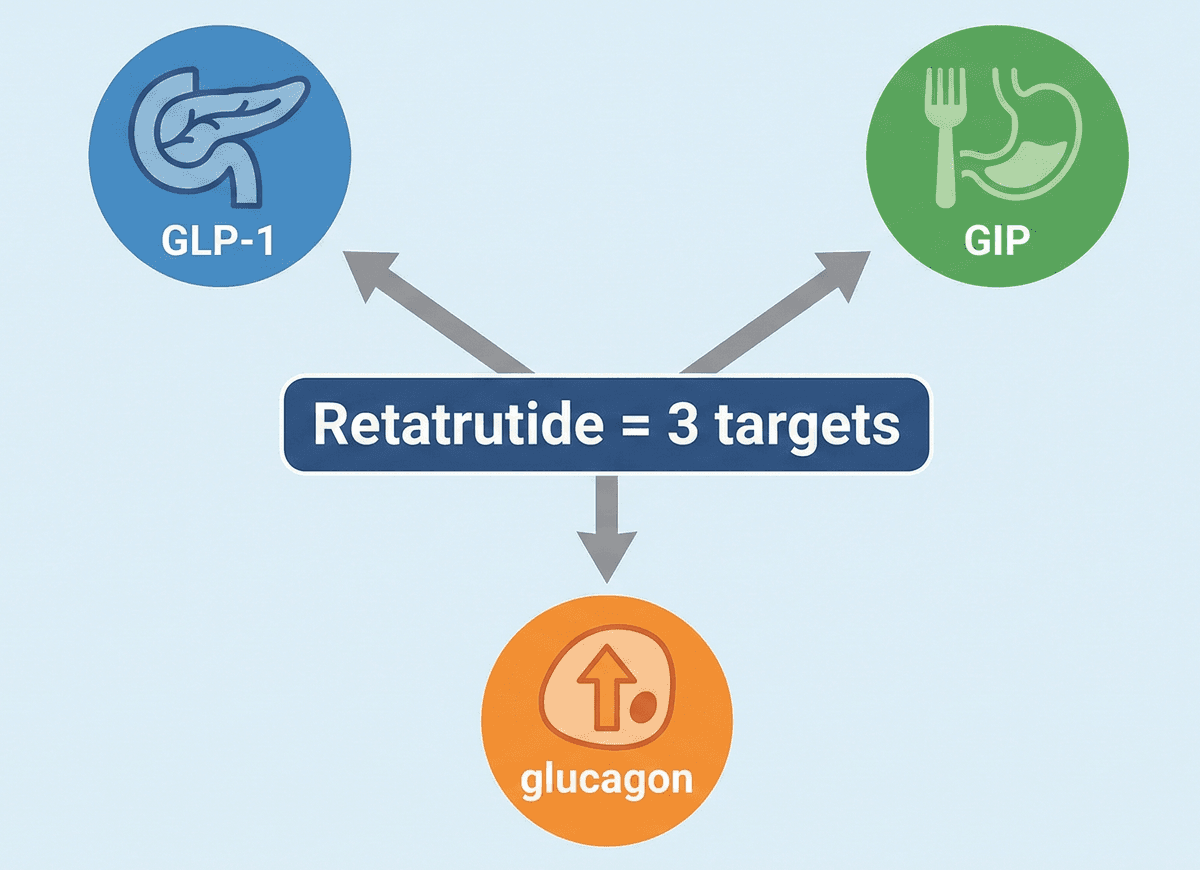
| What it is | Amylin drug plus tirzepatide | One molecule acting on GLP-1, GIP and glucagon | Amylin drug plus semaglutide |
| Stage | Phase 3 starting by end of 2026 | Phase 3 reported; US filing planned early 2027 | Filed with the US regulator, December 2025 |
| Result in type 2 diabetes | 23.3% at 48 weeks if everyone stayed on treatment (phase 2) | 20.8% at 80 weeks if everyone stayed on treatment, 18.8% counting everyone (TRIUMPH-2) | 13.7% at 68 weeks counting everyone (REDEFINE 2) |
Different trials, lengths, doses and ways of counting, so this is not a ranking. None of these is licensed in the UK.
Trials of different lengths can't be lined up fairly, and a phase 2 trial with about 37 people per group is a much smaller test than TRIUMPH-2, which had about 290 per group. One more data point worth knowing: when CagriSema was tested head to head against tirzepatide, it averaged 23.0% against tirzepatide's 25.5% at 84 weeks and missed the trial's main goal (Novo Nordisk). Head-to-head trials have a way of changing the story. For retatrutide's 2026 results in full, see retatrutide vs Mounjaro, and for Novo's amylin combination, CagriSema vs Mounjaro.
When could you get it?
Not for years. Lilly plans to start phase 3 trials of EloraTZP by the end of 2026 (Eli Lilly). Phase 3 obesity trials usually take two years or more, and a regulator's review adds more time after that. No application has been made anywhere, and a UK licence would need its own MHRA decision, with NHS use needing NICE on top.
If you're on Mounjaro now and doing well, nothing here is a reason to change course. If you want to be part of the research, clinical trials are the legitimate route, and your GP can help you look. If you've taken something sold as eloralintide and feel unwell, call NHS 111, or 999 (or go to A&E) for severe stomach pain that won't go away, yellow skin or eyes, chest pain, fainting, or if you can't keep fluids down. Tell them what you took, and report it on the MHRA's Yellow Card website.
FAQs
What is EloraTZP?
What is eloralintide?
How much weight did people lose on EloraTZP?
What are the side effects of EloraTZP?
Is eloralintide licensed in the UK?
Eloralintide vs retatrutide: which is better?
Can I take eloralintide with Mounjaro?
When will EloraTZP be available?
General information about published research, not medical advice. Eloralintide and EloraTZP are not licensed medicines.
View sources (14)
- Lilly's EloraTZP (combination of eloralintide and tirzepatide) delivered greater weight loss and A1C reduction vs. tirzepatide 15 mg in adults with obesity and type 2 diabetes, Eli Lilly, 30 September 2026
- EloraTZP bests tirzepatide on weight loss and A1C in type 2 diabetes, HCPLive, 30 September 2026
- EloraTZP phase 2 results and stopping rates by group, pharmaphorum, 1 October 2026
- The EloraTZP phase 2 trial (NCT06603571), ClinicalTrials.gov
- Billings LK, et al. Eloralintide in adults with obesity or overweight, a phase 2 trial. The Lancet, 2025
- Lilly's selective amylin agonist eloralintide demonstrated meaningful weight loss in a phase 2 study, Eli Lilly, 6 November 2025
- ENLIGHTEN-1: eloralintide in adults with obesity or overweight (NCT07321886), ClinicalTrials.gov
- ENLIGHTEN-2: eloralintide in adults with obesity or overweight and type 2 diabetes (NCT07282600), ClinicalTrials.gov
- Symlin (pramlintide) prescribing information, DailyMed: what amylin does
- Pramlintide injection, MedlinePlus (US National Library of Medicine), revised March 2026
- Retatrutide in adults with obesity and type 2 diabetes (TRIUMPH-2). The Lancet, 29 September 2026
- Cagrilintide-semaglutide in adults with overweight or obesity (REDEFINE 1). New England Journal of Medicine, 2025
- CagriSema head-to-head trial against tirzepatide (REDEFINE 4), Novo Nordisk, 23 February 2026
- Yellow Card: report a suspected side effect or a fake medicine, MHRA