You step on the scale, it's up two pounds, and your period's due in a few days. Before you decide everything's gone wrong, read this. Your weight, your appetite and your mood all shift in predictable ways across your cycle, and understanding the pattern takes a lot of the worry out of it. None of it means you've undone your progress.
Quick answer: the rise on the scale before and during your period is water, not fat, and it clears within a few days. You're genuinely hungrier in the second half of your cycle because of hormones, not weakness. And the mood dip is real and recognised. The single best habit is to weigh the trend over weeks, not panic at any single day.
The cycle in brief
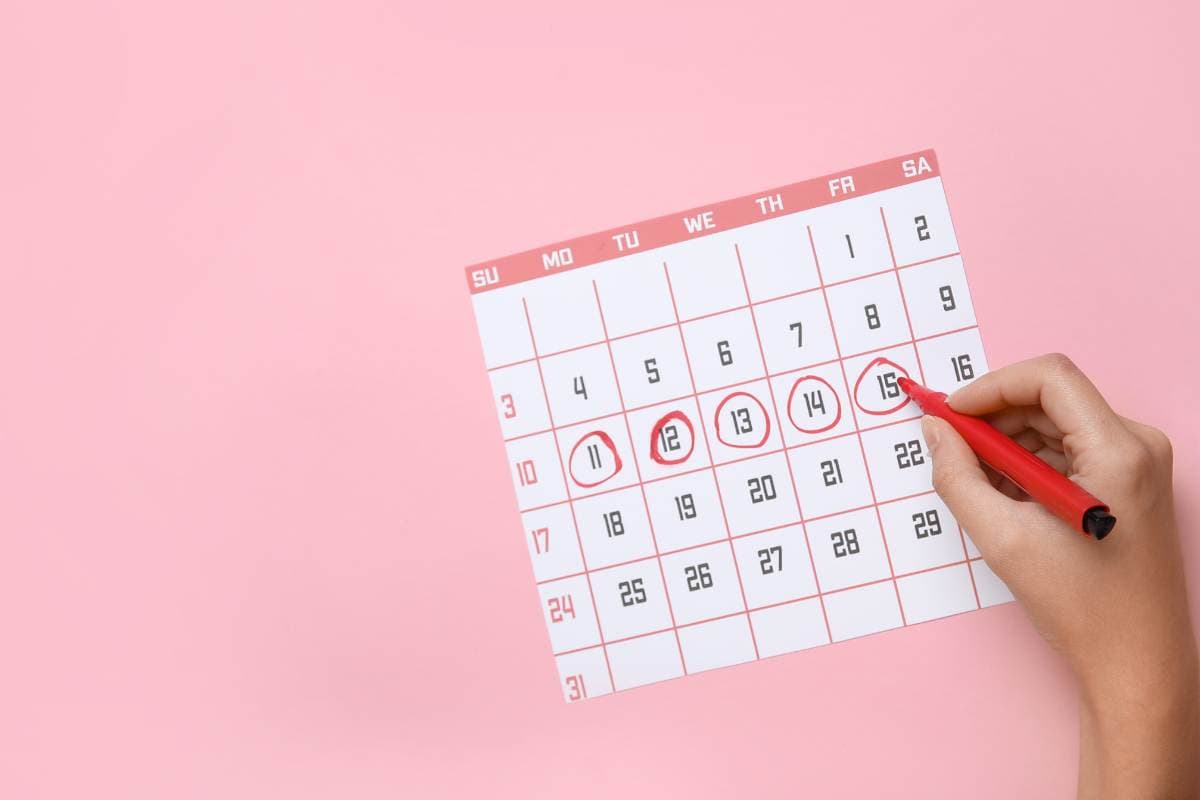
Your cycle is counted from the first day of your period to the day before the next one. The textbook average is 28 days, but anywhere from 21 to 35 days is normal (NHS). It splits into two halves around ovulation. In the first half (the follicular phase), oestrogen rises. In the second half (the luteal phase), progesterone takes over and becomes the dominant hormone. That second half is when most of the symptoms in this article cluster, and just before your period both hormones drop sharply and the bleed begins (Cleveland Clinic).
Why the scale goes up (and why it's fine)
This is the part to hold on to. When researchers weighed women across a full cycle, body weight was on average about 0.45 kg, roughly a pound, higher around menstruation, and that rise was explained almost entirely by extra water, with no change in fat mass (Kanellakis et al., 2023). In everyday terms, many women notice a 2 to 5 lb bump, and many notice nothing (Cleveland Clinic).
The timing surprises people: fluid retention tends to peak on the first day of your period, not the days before, and then eases off (White et al., 2011). So the scale usually drifts back down over the days after your period starts. The leading explanation is that rising progesterone makes your body hold on to sodium and water. Whatever the exact mechanism, the practical point is the same: it's temporary fluid, not fat, and it resolves on its own.
Why you're hungrier before your period
If you feel ravenous in the week before your period, you're not imagining it. On average, women eat around 168 more calories a day in the luteal phase than in the first half of the cycle (Tucker et al., 2025). There's a lot of variation between women, but the pattern is real. The reason is hormonal: after ovulation, progesterone rises and stimulates appetite while oestrogen falls, and a dip in serotonin drives cravings for sweet, high-carb foods, with chocolate the classic (Cleveland Clinic). The NHS lists food cravings as a recognised premenstrual symptom (NHS), so if you find this stretch harder, that's expected, not a failure of willpower.
Mood across the month
Mood swings, irritability, low mood, anxiety and tiredness are all recognised premenstrual symptoms, and they usually ease once your period starts (NHS). More than 90% of women get some premenstrual symptoms (Office on Women's Health), and for a smaller group the symptoms are strong enough to disrupt daily life. The severe form, premenstrual dysphoric disorder (PMDD), is dominated by mood symptoms and affects up to around 5% of women (Office on Women's Health).
If your symptoms are affecting your daily life, or simple changes haven't helped, it's worth seeing your GP, ideally after keeping a symptom diary for a couple of cycles (RCOG). And please take this seriously: if you ever have premenstrual symptoms alongside thoughts of suicide, call 999 or go to A&E (NHS).
Exercise and metabolism
You may burn very slightly more at rest in the second half of your cycle, but the effect is small and not guaranteed. The most careful studies put it within the range of measurement error (Benton et al., 2020). As for "cycle syncing" your workouts, it's popular but not well supported. The largest review of performance found at most a trivial dip and rated the evidence as low quality, recommending you go by how you actually feel rather than by a phase chart (McNulty et al., 2020). Move in the way that suits your energy that day, and don't worry about getting the "phase" right.
How to track it without the stress
- Weigh the trend, not the day. Since water shifts your weight by up to a kilo across the cycle, a single weigh-in can mislead. A weekly or rolling average shows the real direction.
- Expect the bump and let it pass. The premenstrual and early-period rise is fluid. It clears within a few days.
- Log your period alongside your weight. Seeing your period marked on the graph makes the monthly pattern obvious, so you don't mistake a water bump for fat gain.
- Plan for the cravings. Since the hunger is real, having satisfying, protein and fibre-rich options ready beats trying to white-knuckle through it.
A note if you're on a GLP-1
This matters even more on Wegovy or Mounjaro. The premenstrual water bump can briefly hide genuine fat loss, and it's easy to wrongly conclude your medication has stopped working. It hasn't. Mark your period on your weight graph and read the trend over the month. The medicines also act on an appetite that already rises in the luteal phase, so some weeks you may feel that natural hunger surge more than others. Logging both helps you make sense of week-to-week changes.
See your cycle and your weight together
Healthcount lets you log your period and plots it on your weight and trend graphs, so the monthly water bump never looks like a setback.
Try the free macro counterFAQs
Why do I gain weight on my period?
It's water, not fat. Hormones make your body hold extra fluid, so the scale rises temporarily by around half a kilo on average, then comes back down after your period starts.
Why am I so hungry before my period?
Rising progesterone boosts appetite and a serotonin dip drives cravings. Women eat about 168 more calories a day on average in the second half of the cycle. It's normal physiology.
Does my period affect my mood?
Yes. Low mood, irritability and anxiety are common premenstrual symptoms that ease once your period starts. If they disrupt your life, see your GP.